
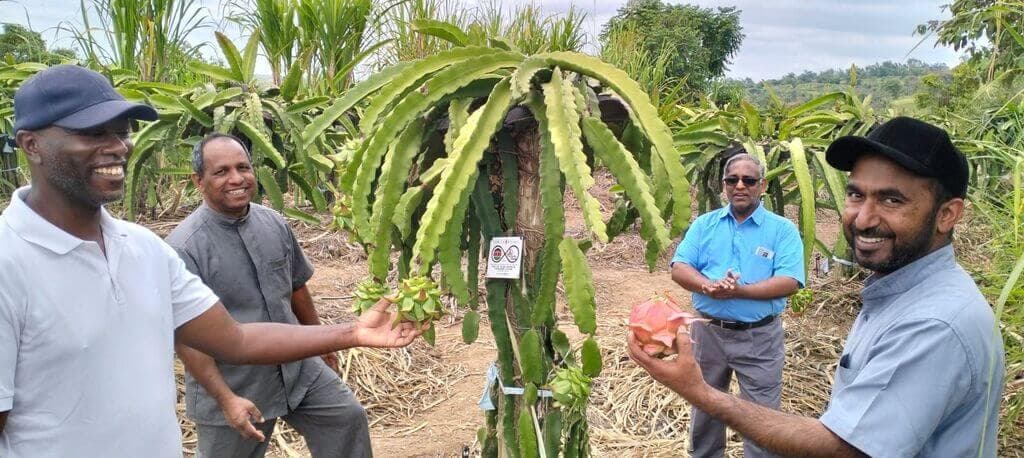
When Anthony Mugambi first read that one of Vietnam’s major exports grew in sandy semi-arid soils, he set about importing cuttings: today, the 22,000 farmer network he helped set up in Kenya cannot keep up with demand.
When we meet him on his now 20-acre dragon fruit plantation (when we were last here in 2019 he only had five acres) in Nkubu, Meru County, Anthony Mugambi is serving chilled sugarcane cubes to Indian missionaries who stopped by his farm in search of a taste of the sweet dragon fruits they’d heard so much about while on their Kenyan visit.
When he began growing dragon fruits in 2015, it was largely a pet project driven by his inability to grow many crops or fruits on his hilly sand soil-covered farm.
Today Mugambi juggles giant export orders and also supplies dragon fruits locally.
The beauty of the fruit is it can be easily added and cost efficiently added value to become a jam, juice, smoothie, yoghurt, or wine. He informed that he can barely manage to supply juice spots in Lavington with enough dragon fruits, proving a clear demand for the fruit locally as more Kenyans get to know of it.
The superfruit earning its pioneer farmer Sh2,000 a kilogram
The Kenyan farmers pioneering dragon fruit farming—the Sh1000/kg fruit
“I had read up on this superfruit that needed eight hours of sunshine, preferred to grow in semi-arid sandy soils, earning Vietnamese farmers millions,” he reminisced.
Dragon fruits earn Vietnam half as much in exports (Sh68 billion) as Kenya earns from its entire horticulture export industry.
He imported his first cuttings (these mature in 9 to 18 months compared to seeds that take four to seven years) from South Africa through Max van Heerden– the head of the Dragon Fruit South-Africa Community Program.
“With just 200 fruits on my first harvest, I could not access supermarkets which were the only dragon fruit buyers I knew then. But, almost anyone who had ever met me was eager to try this scaly, bright red yellow-skinned highly nutritious tropical fruit I could not shut up about,” Mugambi said.
Voted the super fruit of 2013, the pitaya or dragon fruit has multiple health benefits. It is rich in fiber, and calcium and 100 grams of the fruit has 50 per cent of the required daily vitamin C intake. It also helps lower cholesterol and its vitamin B-3 content enhances skin smoothness and appearance. It is also recommended for diabetics to help regulate blood sugar levels.
All his first harvest went to neighbours, friends, workmates, and acquaintances.
“Once they tasted the fruit, which has a mild sweet or sweet-sour flavor depending on the variety, they became converts. They came back for more fruits and looking for planting materials to grow their own,” he said.
This created a highly lucrative alternative income stream supplying dragon fruit cutting to new farmers which cost Sh500 to Sh300 depending on their level of maturity.
Kenyan growers cash in on ideal weather for world’s fastest-growing superfruit
New smartphone app guides E. Africa farmers on growing fruit trees
Together with other dragon fruit growers, Waweru Murimi and Jennifer George, they formed the Kenya Dragon Fruit Farmers Network which today has 22,000 members.
Thanks to being the pioneering dragon fruit farmers in Kenya, they have sold dragon fruits and cuttings to government cabinet secretaries, Kenya’s corporate bigwigs, and even King Phila Zulu, the great-grandson of Shaka Zulu.
Are you a farmer looking to grow the most profitable crop on your farm, with or without irrigation. Use FarmBizAfrica’s HarvestMAX on https://harvestmax.farmbizapps.com and it will tell you in less than a minute what the highest income-earning crops are for your weather, soil type and this season, based on your seasonal weather forecast. Don’t make weather losses ever again, and more than triple your income.

Comments
No comments yet. Be the first to share your thoughts.