
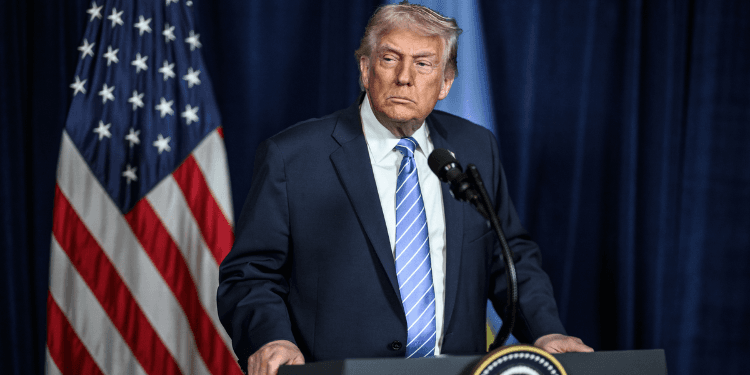
The White House has signaled that President Donald Trump is prepared to use “any means necessary” to pass the SAVE America Act.
Speaking during a press briefing on Wednesday, March 25, White House Press Secretary Karoline Leavitt indicated that the administration is open to pursuing a controversial fallback strategy via budget reconciliation, a process that allows legislation to pass with a simple majority in the Senate.
According to Leavitt, the president is willing to test the limits of Senate procedure to secure the legislation, even as some Republicans warn the approach may not succeed.
“I think he’s willing to try all strategies. I spoke with him about this yesterday, and he said if we can make it work through reconciliation, let’s absolutely do that. These again are common-sense policies that are backed by the vast majority of voters across this country,” Leavitt said, describing the proposal as a priority for the administration.
She added that President Trump remains committed to advancing the bill, characterizing its provisions as broadly supported by the public and central to the administration’s legislative agenda.
‘Plan B’ by Trump takes shape
The SAVE America Act, formally known as the Safeguard American Voter Eligibility Act, includes provisions requiring voter identification in federal elections and proof of citizenship during voter registration.
Leavitt emphasized that the president is prepared to pursue alternative legislative routes if necessary, stating that the administration is exploring all available pathways to ensure the bill reaches his desk.
“These are common-sense proposals that are wildly popular, and the president is willing to use any means necessary to get this legislation passed and onto his desk,” she added.
The White House stance comes as Senate Republicans remain divided over whether reconciliation is a viable path forward.
Senate Majority Leader John Thune this week floated the idea as a potential fallback option, suggesting lawmakers could “tee up” a reconciliation bill if required to secure passage with a simple majority.
However, the proposal has drawn pushback from within the party, with Senator Mike Lee dismissing the strategy on Tuesday. He argued that the SAVE America Act does not meet the strict requirements governing reconciliation, which is typically limited to budget-related measures.
Similarly, Representative Anna Paulina Luna has rejected the approach, warning that policy-heavy provisions such as voter ID mandates are unlikely to survive procedural scrutiny in the Senate.
SAVE America Act tied to DHS funding standoff
The debate over the SAVE America Act comes amid a prolonged funding standoff for the Department of Homeland Security (DHS), now in its sixth week.
Republicans have increasingly linked the legislation to negotiations to reopen DHS, framing both issues as part of a broader policy push tied to immigration enforcement and election integrity.
Secretary Markwayne Mullin, who was sworn in on Tuesday, has reinforced the administration’s support for the bill, describing it as a key component of ongoing legislative efforts.
At the same time, Senate Democrats, led by Chuck Schumer, have maintained that any agreement on DHS funding must include reforms to immigration enforcement practices, particularly within Immigration and Customs Enforcement (ICE).
The funding impasse has begun to show operational effects across DHS agencies, particularly at U.S. airports.
Addressing questions on the issue, Leavitt said the administration had taken interim steps to manage disruptions, including deploying ICE personnel to assist with airport operations.
“Well, to address this obviously short-term problem and the chaos that has been sown by these Democrats on Capitol Hill, to address the lines and to get Americans traveling and get them to where they need to be. So the president, I think this was a creative solution, again, that was criticized,” she added.
“But we have seen wait times decrease, not as much as we’d like. Hopefully they will continue to, but at major airports over the course of the last few days as ICE has been facilitating with travelers in these airports.”
The Transportation Security Administration (TSA) has faced staffing shortages linked to unpaid workers during the shutdown, contributing to longer security lines and delays at major airports.

Comments
No comments yet. Be the first to share your thoughts.