
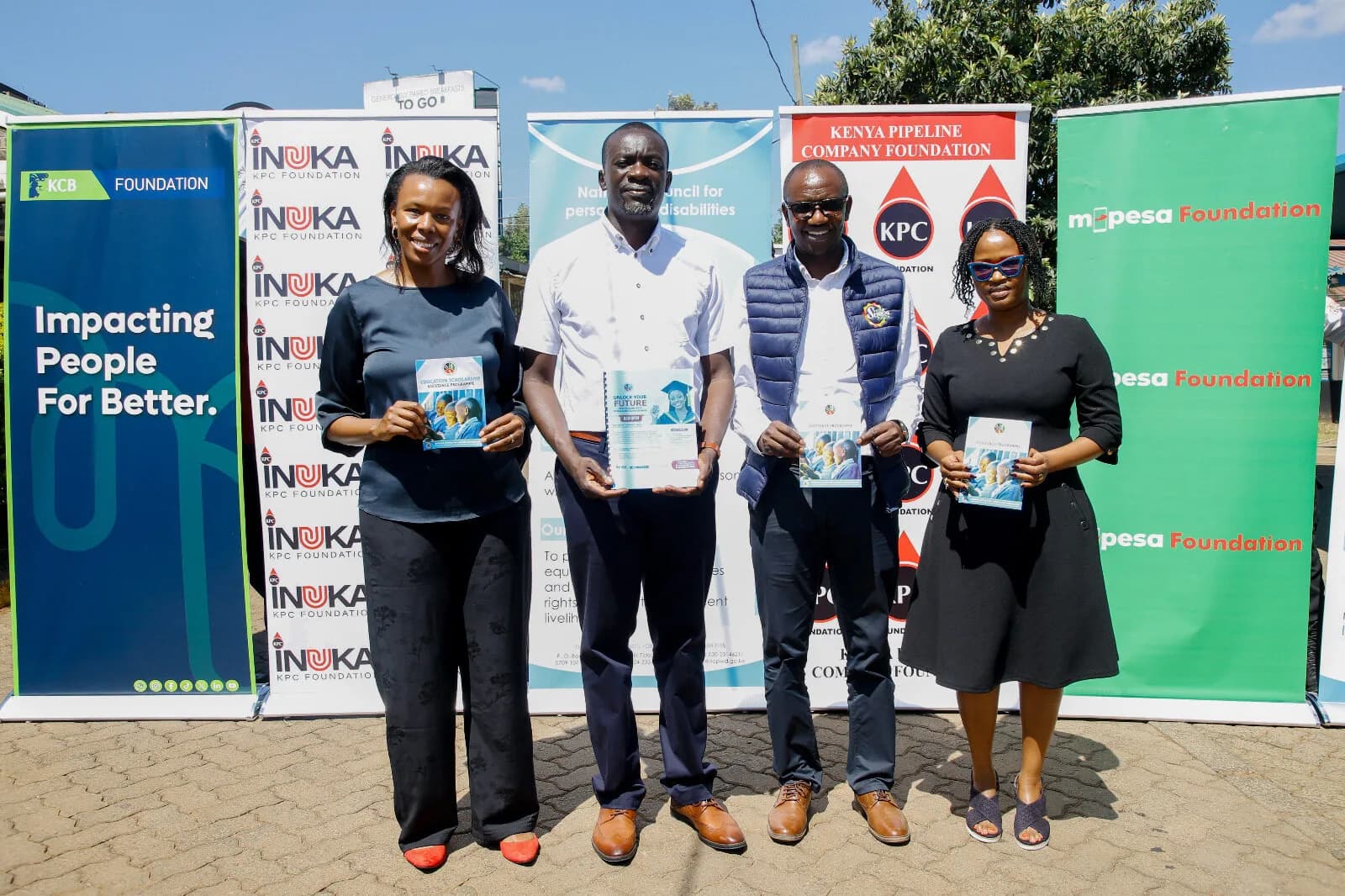
NAIROBI, Kenya Oct 29 – The KCB Foundation has partnered with the National Council for Persons with Disabilities (NCPWD) and other organisations to introduce a consolidated scholarship framework aimed at improving access to education for learners with disabilities transitioning to Grade 10 in 2027.
Launched in Nairobi, the initiative seeks to coordinate scholarship applications, reduce duplication and improve transparency in identifying learners who need financial support to proceed to senior secondary school.
NCPWD Chief Executive Officer Dr. Michael Munene said the framework would help participating organisations coordinate their efforts and strengthen support for learners with disabilities.
“The consolidated scholarship framework provides an important platform for aligning efforts among partners and strengthening support for learners with disabilities. By working together, we can improve access to education and ensure that these learners can transition successfully to senior secondary school and beyond,” Dr. Munene said.
The Grade 10 Senior Secondary School Consolidated Scholarship Framework will be implemented through coordinated awareness campaigns, shared county-level structures and a standardised assessment and verification process.
Participating organisations will work together to identify eligible learners, while each institution will retain responsibility for selecting and enrolling beneficiaries based on its programme requirements, available resources and scholarship allocations.
Speaking during the launch and dissemination of the framework in Nairobi, KCB Foundation’s Head of Programmes said the partnership was intended to make scholarship opportunities more accessible to learners and their families.
“Every learner deserves an opportunity to pursue their educational aspirations, regardless of disability or financial circumstances. By bringing scholarship providers together, we can make the recruitment process more coordinated, transparent and accessible to learners and their families. Our collective responsibility is to ensure that barriers in accessing scholarship opportunities do not prevent deserving learners from progressing to the next stage of their education,” the official said.
The initiative comes amid longstanding challenges in ensuring that learners with disabilities access and complete their education. Data from the Kenya National Bureau of Statistics’ 2019 Population and Housing Census Analytical Report on Disability showed that 190,916 persons with disabilities aged between five and 22 years were of school-going age.
Of these, 131,564, representing 68.9 per cent, were enrolled in learning institutions, while 59,352, or 31.1 per cent, were not enrolled.
Although the figures are based on the 2019 census and do not represent current estimates, they highlight the challenges affecting access to education for persons with disabilities, including financial constraints and difficulties in securing support.
The new framework follows earlier efforts to expand scholarship opportunities for learners with disabilities. In January 2026, the KPC Foundation launched a nationwide Grade 10 vetting exercise under its Inuka Scholarship Programme, targeting learners with disabilities across all 47 counties.
The exercise involved document verification, interviews and assessments of learners’ financial circumstances, with county officials, KPC Foundation representatives and NCPWD participating in the process.
The KCB Foundation has also supported approximately 486 learners with disabilities through its Scholars Programme since its inception. Of these, 312 are currently active in the programme, including 170 learners in high school and 49 enrolled in tertiary institutions.
The Foundation also supported 93 learners in the 2025 fourth-year cohort, comprising candidates undertaking the Kenya Certificate of Secondary Education and the International Baccalaureate Diploma Programme.
Under the consolidated framework, scholarship providers will coordinate recruitment and assessment to make the application process more accessible, while retaining responsibility for awarding scholarships according to their individual programme requirements and available funding.


Comments
No comments yet. Be the first to share your thoughts.