
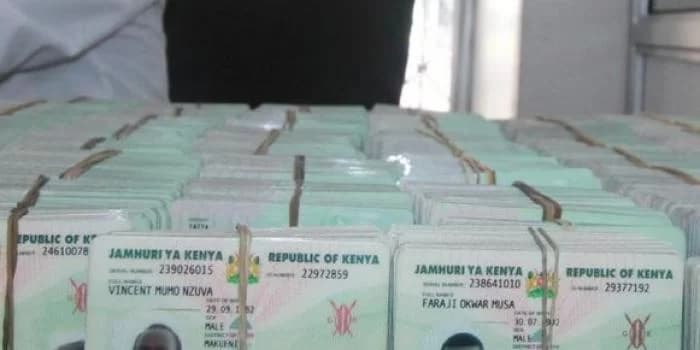
For many Kenyans, a national identity card is more than a document confirming citizenship. It is a gateway to employment, healthcare, education financing, banking, property transactions and government support programmes.
Without it, eligible citizens can face difficulties accessing services that are increasingly tied to identity verification, limiting their ability to participate fully in the country’s economic and social life.
The challenge has been particularly pronounced in historically underserved regions, including parts of Northern Kenya, where distance, financial constraints and administrative requirements have made obtaining identification difficult for some communities.
The government’s efforts to expand national ID registration, remove financial barriers and bring services closer to communities are aimed at addressing these obstacles under the principle of “Usawa ni Sawa” — the idea that every Kenyan deserves equal recognition, access to services and opportunities, regardless of where they come from.
The removal of national ID application and replacement fees in March 2025 marked a step towards reducing the cost of obtaining identification. Grassroots registration and collection initiatives, supported through local administration structures, are also intended to make the process more accessible to residents who would otherwise travel long distances to reach registration offices.
The State Department for Internal Security and National Administration, under Principal Secretary Raymond Omollo, has supported efforts involving chiefs, assistant chiefs and local administrators to bring registration services closer to communities.
The objective is to reduce the practical barriers that can prevent eligible Kenyans from obtaining IDs and accessing services for which identification is required.
From identification to economic opportunity
The importance of a national ID extends across several aspects of everyday life, particularly for young people entering the labour market, farmers seeking agricultural support and households applying for public services.
In healthcare, identification helps eligible Kenyans register for the Social Health Authority (SHA) and access covered services. In social security, it supports registration with the National Social Security Fund (NSSF), including for workers in the informal sector seeking to build retirement savings.
For farmers, identification can facilitate registration through the Kenya Integrated Agriculture Management Information System (KIAMIS), which is used to support participation in agricultural programmes, including subsidised fertiliser initiatives.
Access to identification can also help eligible households register on Boma Yangu, the affordable housing programme, while students may need IDs when applying for Higher Education Loans Board (HELB) financing and other eligible education support.
For young people seeking employment, the document is commonly required during identity verification and payroll registration. It also supports applications for programmes such as the National Youth Opportunities Towards Advancement (NYOTA), subject to the requirements of the relevant programme.
The same applies to entrepreneurs seeking to register businesses, open bank accounts, join savings and credit cooperative organisations (SACCOs), obtain permits or access financial services.
For adults seeking passports and potential overseas employment opportunities, a national ID is an important part of the documentation process.
These requirements mean that difficulties obtaining identification can have consequences beyond the registration process itself. They can delay applications, limit access to opportunities and complicate efforts by individuals to establish financial independence.
Bringing services closer to underserved communities
Distance remains a practical obstacle for people living in remote areas, particularly where registration offices are difficult or expensive to reach.
By involving local administrators in registration and collection, the government aims to reduce travel costs and make services more accessible to communities that have historically experienced lower access to identification.
The approach is particularly relevant to young adults who need IDs to pursue employment, education, training and enterprise opportunities, as well as residents of historically excluded and border communities.
Improved access can also benefit eligible members of communities whose recognition and access to documentation have been longstanding concerns. In Kilifi County, for example, Pemba families are among those who can benefit from improved identification access following citizenship recognition.
The broader objective is to ensure that access to government services does not depend on a person’s geographical location or ability to meet avoidable administrative costs.
The principle behind “Usawa ni Sawa” is that every eligible Kenyan should have a fair opportunity to obtain identification and use it to pursue personal and economic advancement.
How identification supports public planning
Beyond individual benefits, wider access to national IDs can help improve the information available to government institutions as they plan and deliver services.
When identification and programme registration records are combined with population and needs data, they can help national and county governments assess demand for healthcare, agricultural support, housing and social protection.
In agriculture, for instance, more complete farmer registration records can help authorities estimate fertiliser demand by region, acreage and crop requirements. Such information can support planning for the quantities of inputs required and where they should be distributed.
Similarly, SHA enrolment and healthcare utilisation data can help identify areas where demand for health services is high or where coverage gaps persist.
In affordable housing, information from eligible applicants registering through Boma Yangu can provide an indication of housing demand across different locations, helping inform development and supporting infrastructure plans.
Identification records can also support beneficiary verification in social assistance programmes, helping institutions identify eligible recipients and reduce duplication in registration systems.
At county level, such information can complement census data and local needs assessments when planning roads, water systems, markets and other public amenities.
However, identification data is one part of the planning process. Its usefulness depends on the accuracy of records and how effectively government institutions combine the information with other evidence on population needs and service delivery.
Turning equal recognition into meaningful access
The expansion of national ID registration is therefore linked to a wider question of inclusion: whether all eligible Kenyans can access the documentation required to participate in economic activity and benefit from public services.
Removing application and replacement charges addresses one financial barrier, while grassroots registration initiatives seek to reduce the cost and inconvenience of reaching registration services.
Under the “Usawa ni Sawa” principle, the goal is not simply to increase the number of national IDs issued. It is to ensure that every eligible Kenyan, regardless of location or financial circumstances, has a fair chance to access services, pursue opportunities and participate in national development.
>>> PS Raymond Omollo Rallies Kenyans to Shape Post-2030 Development Vision

Comments
No comments yet. Be the first to share your thoughts.