
The agency argues that existing fines are insufficient to deter offenders as the government intensifies its crackdown on illicit goods
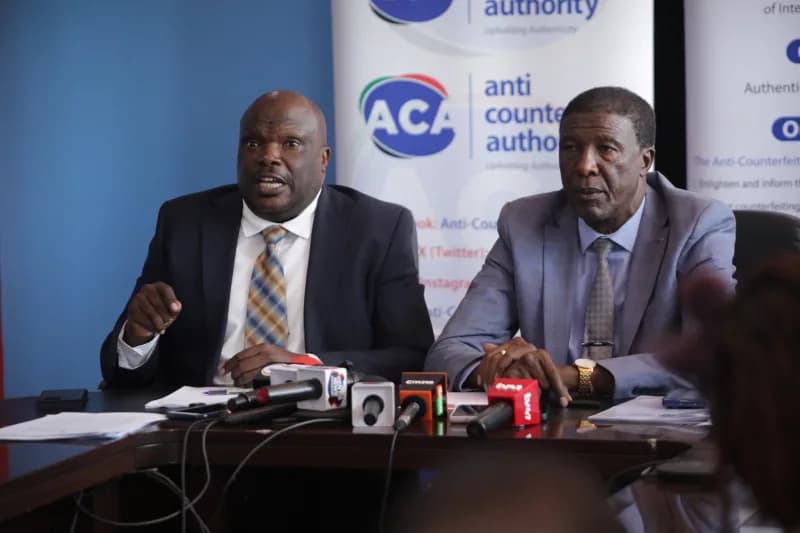
Anti-Counterfeit Authority director-general Robi Mbugua with board chairperson Nelson Gaichuhie during a press conference in Nairobi /HANDOUT

The Anti-Counterfeit Authority (ACA) is seeking the Attorney-General’s help to review the law and increase penalties for counterfeit traders.
ACA Director-General Robi Mbugua said the authority was working with the Office of the Attorney-General to amend the Anti-Counterfeit Act, with further consultations involving the Office of the Director of Public Prosecutions on appropriate imprisonment terms.
Under the current law, first-time offenders convicted of dealing in counterfeit goods face fines of three times the value of the products, rising to five times the value for repeat offences.
Mbugua said the authority wanted tougher penalties to discourage the trade, which undermines legitimate businesses, deprives the government of revenue and exposes consumers to potentially dangerous products.
“The law says that if you are found with a counterfeit product and convicted of dealing with it for the first time, you can be fined three times the cost of that product. If it is a repeat offence, it will be five times,” he said.
The proposed changes are expected to be subjected to public participation as the government seeks to strengthen enforcement against counterfeit products and other forms of illicit trade.
Mbugua cited a 2020–2021 study that estimated Kenya lost about Sh800 billion to illicit trade, with counterfeit products accounting for nine per cent of the losses.
He said the broader illicit trade problem also included contraband, substandard goods and products brought into the country without proper customs procedures.
The revenue lost through such activities could otherwise support public spending on services such as healthcare, education and infrastructure, he said.
ACA Board Chairperson Nelson Ributhi Gaichuhie said counterfeit trade had consequences beyond lost business and tax revenue, including risks to livelihoods, food security and consumer safety.
Farmers who use fake agricultural inputs risk losing their harvests, while consumers may be exposed to dangerous alcoholic drinks and substandard goods, he said.
The authority has stepped up operations targeting counterfeit and illicit alcohol, tobacco and nicotine products, foodstuffs, cosmetics, electrical equipment, agricultural inputs and school stationery.
Between August 20 and September 3, 2026, multi-agency operations in high-risk areas of Nairobi resulted in 36 arrests and apprehensions and the recovery of more than 5,555 suspected counterfeit bottles and about 39,580 litres of illicit alcohol, according to the authority.
In a separate operation on September 15, officers seized 8,459 suspected counterfeit alcoholic products in Makindu, valued at about Sh2.1 million. Further seizures in Nairobi, Nyeri and Eldoret brought the value of goods recovered during September to approximately Sh3.74 million.
The crackdown has also targeted agricultural inputs following the seizure of illegally repackaged fertiliser in Matungu, Kakamega County. The operation involved two loaded lorries and industrial packaging equipment.
Preliminary investigations indicated that the fertiliser had been diverted from a government subsidy programme and repackaged in counterfeit branded bags for commercial sale.
ACA is also seeking to strengthen controls on imported goods, with Mbugua estimating that about 70 per cent of counterfeit products entering Kenya originate from outside the country.
The authority is using a digital import-verification system to identify potentially counterfeit goods before consignments enter the domestic market.
Mbugua said Kenya was also pursuing a harmonised anti-counterfeit legal framework across the East African Community to address enforcement gaps that allow illegal traders to move products across borders.



Comments
No comments yet. Be the first to share your thoughts.