
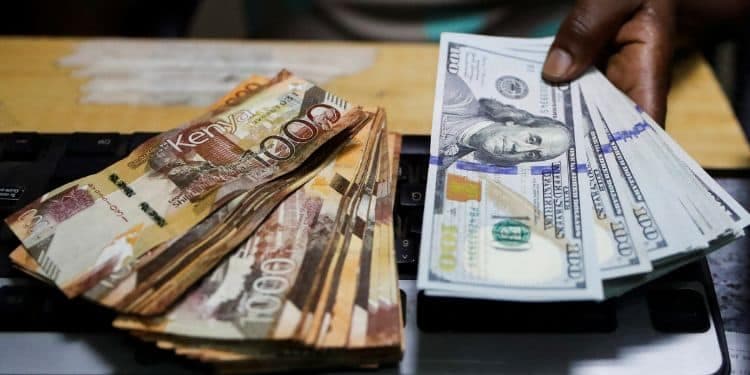
The Kenya shilling strengthened against the US dollar during the week ending July 30 as the dollar retreated in global markets and Kenya’s foreign exchange reserves rose sharply.
According to the Central Bank of Kenya (CBK), the shilling exchanged at Ksh129.40 per US dollar on July 30, compared to Ksh129.53 on July 23.
The local currency maintained a relatively stable performance against major international and regional currencies during the week.
CBK daily exchange rate data showed the shilling trading at Ksh129.44 against the dollar on August 3.
The currency also exchanged at Ksh174.41 against the Sterling Pound, Ksh149.31 against the Euro and Ksh82.75 per 100 Japanese Yen.
The Kenya shilling traded at 28.93 against the Uganda shilling, 20.38 against the Tanzania shilling and 11.32 against the Rwanda franc.
Kenya Shilling Gains as Dollar Weakens
The recovery of the shilling coincided with a significant increase in Kenya’s foreign exchange reserves.
CBK reported reserves of USD15.4 billion as of July 30, up from USD13.854 billion recorded a week earlier.
Import cover rose to 6.4 months from 5.9 months during the same period, remaining well above the statutory requirement of at least four months.
The regulator said the reserves were adequate to support the stability of the foreign exchange market and enable the country to meet its external payment obligations.
Meanwhile, inflation edged up in July. Overall inflation increased to 6.5 percent from 6.4 percent in June.
Core inflation rose to 3.2 percent from 3.1 percent, driven by higher transport costs and prices of processed foods, particularly wheat products and cooking oil.
Non-core inflation declined to 15.0 percent from 15.1 percent.
Data released by the Kenya National Bureau of Statistics showed some of the sharpest annual price increases were recorded in tomatoes, diesel and kale, while cooking oil, fresh milk and sugar also registered higher prices during the month.
The U.S. Dollar Index weakened by 1.6 percent during the review period.
At the same time, Murban crude oil prices fell to USD78.24 per barrel on July 30 from USD86.05 a week earlier following the recovery of oil exports through the Strait of Hormuz and increased OPEC+ production.
Spot gold prices rose to USD4,102.40 per ounce from USD4,047.15.
The U.S. economy expanded at an annualised rate of 1.5 percent in the second quarter of 2026, while growth in the euro area improved to 1.0 percent.
Money Market and Stocks Post Gains
The money market remained liquid during the week ending July 30, supported by CBK’s open market operations.
Commercial banks’ excess reserves averaged KSh13.5 billion above the required Cash Reserve Ratio, while the Kenya Shilling Overnight Interbank Average Rate remained unchanged at 8.75 percent.
Interbank market activity improved significantly, with the average number of transactions rising to 17 from six the previous week.
The average value traded increased to KSh12 billion from KSh3.7 billion.
The Treasury bill auction held on July 30 received bids totaling KSh27.4 billion against an advertised amount of KSh28 billion, representing a performance rate of 97.7 percent.
Interest rates on the 91-day Treasury bill increased marginally, while yields on the 364-day Treasury bill declined.
At the Nairobi Securities Exchange, the NASI, NSE 25 and NSE 20 share indices gained 1.70 percent, 1.44 percent and 1.97 percent, respectively. Market capitalization increased by 1.70 percent during the week.
Although total shares traded declined by 19.45 percent and equity turnover fell 17.66 percent, bond market activity strengthened.
Turnover in the domestic secondary bond market increased by 38.20 percent during the week ending July 30.
In the international market, yields on Kenya’s Eurobonds declined by an average of 2.74 basis points, while yields for Côte d’Ivoire and Angola increased.
Follow our and X Account for real-time news updates.



Comments
No comments yet. Be the first to share your thoughts.