

President William Ruto’s economic adviser, David Ndii, explained the role of firms in Kenya’s petroleum supply chain after Ugandan President Yoweri Museveni questioned how his country had been sourcing fuel through Kenya.
Ndii, in a post on Saturday, September 19, said firms described as middlemen in the petroleum trade do not buy and resell fuel on their own account, arguing that they mainly provide logistics and handling services for international suppliers.
“Gulf, Galana BE etc don’t trade on own account. They are logistics/handling agents nominated by the IOCs,” Ndii said.
Ndii was responding to a post by Gitobu M’Mwirebua, who compared the petroleum procurement arrangements used by Kenya and Uganda.
M’Mwirebua said Kenya’s transaction flow was from Abu Dhabi National Oil Company (ADNOC) and Saudi Aramco through Gulf, Galana and BE before reaching Oil Marketing Companies (OMCs) such as Vivo, Total, Rubis and Trinity.
He argued that a government-to-government (G-to-G) arrangement should instead have involved ADNOC and Saudi Aramco supplying the National Oil Corporation of Kenya (NOCK), which would then supply OMCs.
M’Mwirebua contrasted this with Uganda’s arrangement, which he described as Vitol supplying the Uganda National Oil Company (UNOC), which then supplies OMCs.
He suggested that Uganda could be securing a better deal under its arrangement.
David Ndii disputed the description of the Kenyan firms as independent fuel traders.
He added that OMCs and international oil companies (IOCs) have direct commercial contracts.
“Gulf, Galana BE etc don’t trade on own account. They are logistics/handling agents nominated by the IOCs,” he said.
“The OMCs/IOCs have direct commercial contracts i.e IOCs (ADNOC/ENOC/ARAMCO)<>OMCs (Vivo, Total, Rubis etc) with GtoG framework agreements serving as credit enhancement.”
Museveni Reveals How Uganda Ended Use of Fuel Middlemen in Kenya
His comments came after Museveni said Uganda had previously purchased petroleum products through intermediaries in Kenya.
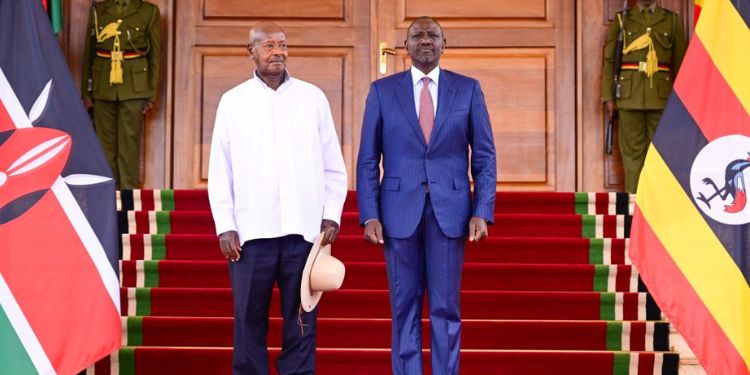
Speaking on Thursday, September 17, 2026, during the groundbreaking ceremony for a 320-million-liter petroleum storage terminal in Mpigi District, Museveni said he had not been aware of the arrangement until a Kenyan senator brought it to his attention.
“The Republic of Uganda was buying petroleum products through middlemen in Kenya. Can you imagine that? And the person who woke me up first was a senator from Kenya,” Museveni said.
The Ugandan president said the information prompted him to question officials responsible for petroleum procurement and examine how the country could obtain fuel directly from bulk suppliers.
Museveni said the review found significant differences in the premiums paid for petroleum products under the previous arrangement compared with the current arrangement involving Vitol and UNOC.
According to figures presented at the ceremony, the diesel premium had fallen from $118 per metric tonne to $83.
The petrol premium had dropped from $97.50 to $61.50 per metric tonne, while the aviation fuel premium had declined from $114.25 to $79.25.
“So that’s when I had to come in and say, this must end. And it ended,” Museveni said.
Uganda subsequently moved to give UNOC a bigger role in importing petroleum products directly.
The shift also led to discussions between Kenya and Uganda over access to Kenya’s petroleum infrastructure, including the Port of Mombasa and the Kenya Pipeline network.
In 2024, Uganda sought to reduce its reliance on Kenyan oil marketing companies by allowing UNOC to directly import petroleum products through Kenya.
The two countries later reached an agreement allowing UNOC to use Kenya’s infrastructure to bring petroleum products into Uganda.
How Kenya’s Government-to-Government Fuel Deal Works
Kenya introduced its government-to-government petroleum supply framework in 2023 to secure supplies through agreements with government-linked suppliers in the Gulf.
The framework includes suppliers such as ADNOC, Emirates National Oil Company (ENOC) and Saudi Aramco, with Kenyan OMCs participating in the purchase and distribution of petroleum products.
Ndii’s explanation places the role of firms such as Gulf, Galana and BE within the logistics and handling side of the supply chain, while maintaining that the actual commercial contracts remain between the international suppliers and OMCs.
Follow our WhatsApp Channel and X Account for real-time news updates.


Comments
No comments yet. Be the first to share your thoughts.