

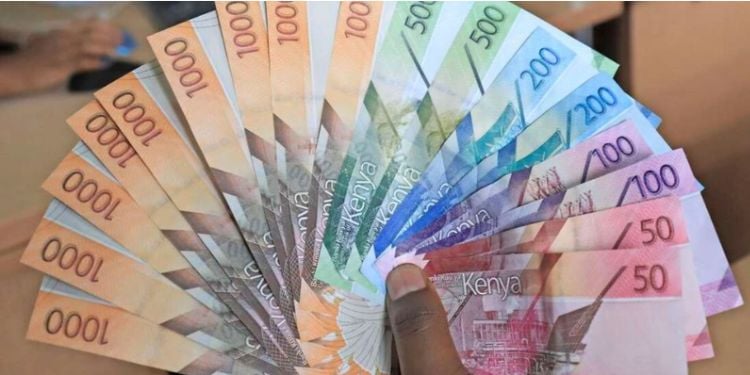
The Kenya shilling remained steady against the US dollar on Monday, exchanging at Ksh129.34 according to the latest Central Bank of Kenya (CBK) daily exchange rates.
The local currency’s performance means the dollar has continued to trade below the Ksh130 mark despite ongoing global economic uncertainties and rising geopolitical tensions.
CBK data showed the shilling traded at KSh175.11 against the British pound and KSh149.60 against the euro.
The Japanese yen exchanged at KSh81.34 per 100 units. Regional currencies also remained largely stable against the Kenyan currency.
Kenya Shilling Maintains Stable Run
The recent exchange rates follow CBK’s report that the shilling stayed stable during the week ending August 13, trading at Ksh129.40 per US dollar, virtually unchanged from Ksh129.41 a week prior.
Two key factors have helped the shilling remain below KSh130 per dollar, strong foreign exchange reserves and improved foreign currency inflows.
CBK reported that Kenya’s foreign exchange reserves stood at $15.245 billion as of August 13, equivalent to 6.3 months of import cover.
The reserves remain comfortably above the statutory requirement of at least four months of import cover, giving the country a significant buffer against external shocks and supporting the stability of the local currency.
Kenyans living abroad have also played a key role in supporting the local currency through increased remittance inflows.
According to the CBK, remittances rose to $436.6 million in July, up from $375.6 million in June, a 16.2 percent increase.
The regulator attributed the growth to higher inflows from key source markets.
Remittances remain one of Kenya’s largest sources of foreign exchange alongside exports, tourism and foreign investment.
The inflows increase the supply of dollars in the economy, helping cushion the shilling against depreciation pressures.
CBK Maintains Key Interest Rate
The stability of the shilling has also been supported by the Central Bank’s monetary policy stance.
At its August 11 meeting, the Monetary Policy Committee retained the Central Bank Rate at 8.75 percent, saying the current policy stance remains appropriate to keep inflation expectations anchored and preserve exchange rate stability.
The committee noted that global energy prices remain elevated because of disruptions to oil supplies and uncertainties linked to the conflict in the Middle East.
However, it expressed confidence that Kenya’s inflation will remain within the target range in the near term, supported by appropriate monetary policy actions, government interventions and a stable exchange rate.
CBK further observed that average bank lending rates had declined further, helping improve private sector credit growth.
The regulator also noted that liquidity conditions in the money market remained adequate, with commercial banks maintaining excess reserves above the required levels.
Developments in the global economy have also supported emerging market currencies, including the Kenya shilling.
According to CBK, headline inflation in the United States eased to 3.4 percent in July from 3.5 percent in June.
During the same period, the US Dollar Index weakened by 0.4 percent, reducing some of the pressure that stronger dollar conditions often place on emerging market currencies.
Nevertheless, risks persist. On August 13, Murban crude oil prices rose to $79.29 per barrel from $72.54 the previous week, mainly driven by supply worries caused by tensions in the Middle East.
Gold prices also rose significantly during this period.
Kenya’s currency has remained resilient despite these challenges.
However, CBK noted that cumulative remittances for the 12 months to July declined by 1.8 percent to $4.99 billion, compared to $5.08 billion recorded during a similar period in 2025.
Despite the annual decline, the inflows continue to provide critical support to the country’s balance of payments and foreign exchange market.
Follow our and X Account for real-time news updates.


Comments
No comments yet. Be the first to share your thoughts.