
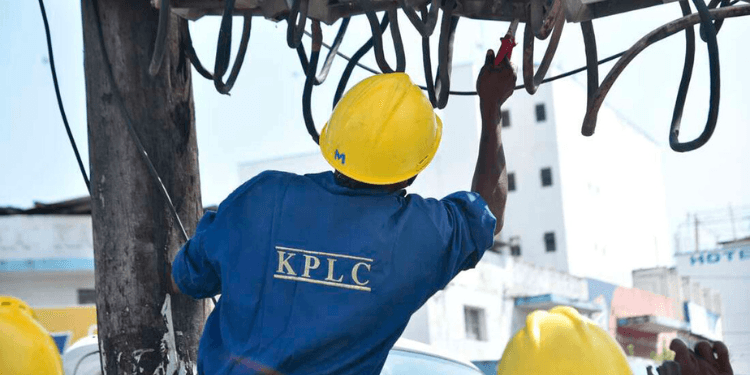
The Kenya Power and Lighting Company PLC (KPLC) is the national utility responsible for transmitting, distributing, and retailing electricity.
Established in 1922, the company is publicly listed on the Nairobi Securities Exchange (NSE).
According to the company’s latest annual report for the financial year ended June 30, 2025, the National Treasury remains Kenya Power’s largest shareholder, holding a controlling 50.09 percent stake.
The Treasury owns a total of 978,492,034 shares, including 977,641,695 ordinary shares, cementing the Government’s position as the utility’s majority shareholder.
Standard Chartered Kenya Nominees Ltd A/C 131550500013 is the second-largest shareholder with 2.97 percent, followed by Standard Chartered Nominees Resd A/C KE11450 with 1.66 percent and Kiharu Member of Parliament Samson Ndindi Nyoro with 1.38 percent.
Other major shareholders include Standard Chartered Nominees Non-Resd A/C KE11794 and Naran Khimji Hirani and Virji Khimji Hirani, each holding 1.23 percent, Kenya Commercial Bank Nominees Limited A/C 915B with 1.17 percent, Hydery (P) Limited with 0.77 percent, James Ochieng Ooko with 0.70 percent, and Wilson Kimeli Maiyo with 0.62 percent.
The annual report further shows that local East African individual investors collectively own 28.84 percent of the company’s shares, while local East African institutional investors hold 14.60 percent. Foreign investors account for the remaining 6.47 percent of the shareholding.
Kenya Power Top 20 Shareholders (As at June 30, 2025)
Profile of Each Board Member
Kenya Power’s Board of Directors is made up of 13 members with backgrounds in law, engineering, finance, economics, energy and corporate governance.
2025 Financial Results
Kenya Power posted a profit before tax of KSh35.37 billion for the financial year ended June 30, 2025, down from KSh43.67 billion recorded the previous year. The company’s profit after tax stood at KSh24.47 billion.
Electricity revenue declined by 5 percent to KSh219.28 billion, largely due to lower foreign exchange recoveries following the stability of the Kenya shilling and a lower base tariff.
Despite the drop in revenue, electricity sales grew by 8.4 percent to 11,403 gigawatt-hours (GWh), driven by 401,848 new customer connections and improved system efficiency.
During the period, Kenya Power reduced its power purchase costs by KSh5.94 billion, supported by the stable local currency, even as the volume of electricity purchased increased.
The company also cut operating expenses by KSh3.86 billion, mainly due to a review of its IFRS 9 expected credit loss model. However, finance costs rose by KSh5.4 billion, largely because of the reversal of unrealized foreign exchange gains recognized in the previous financial year.
Kenya Power further improved operational efficiency by reducing system losses from 23.16 percent to 21.21 percent, contributing to the growth in electricity sales.
Follow our and X Account for real-time news updates.


Comments
No comments yet. Be the first to share your thoughts.