
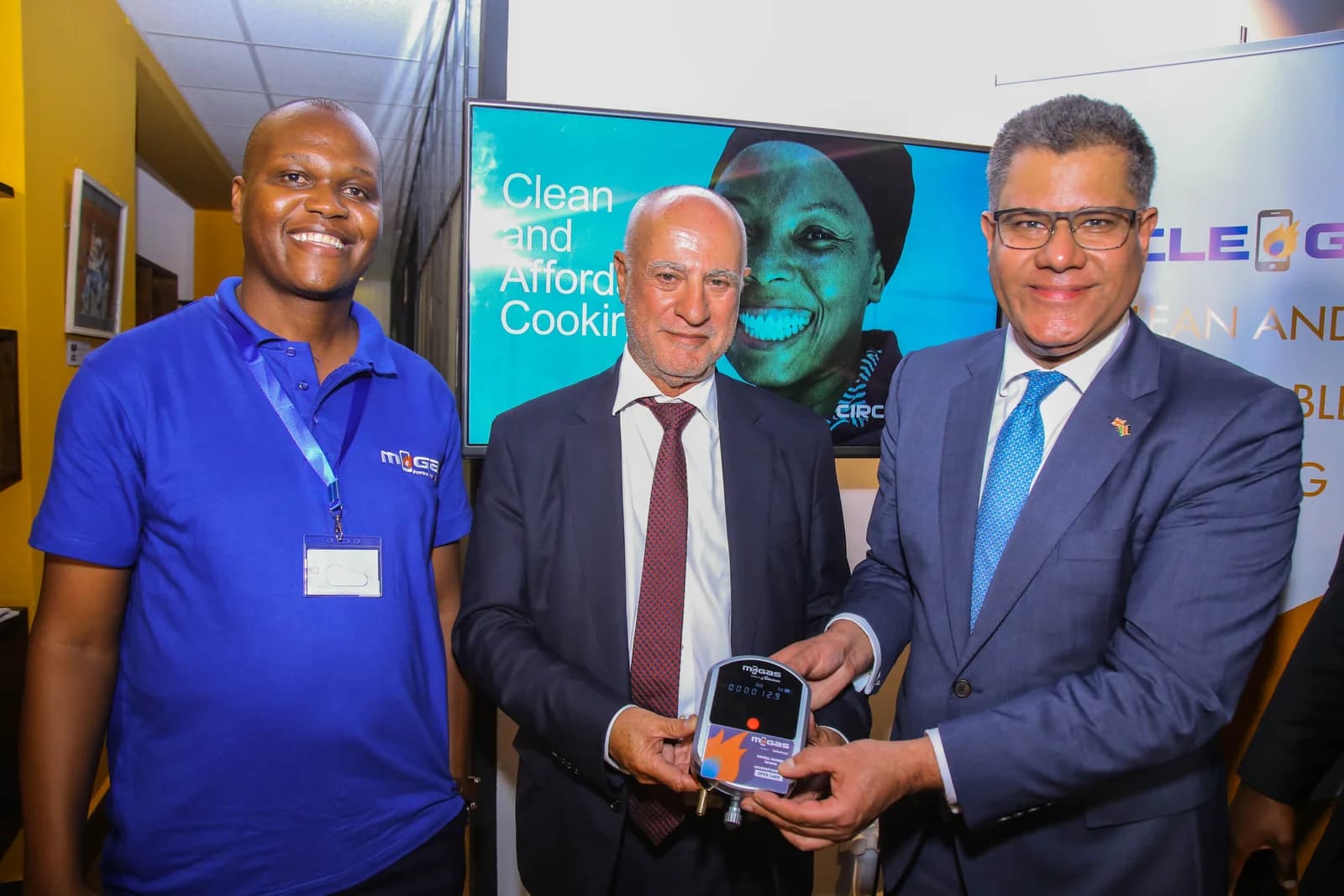
Circle Gas, the UK parent company of the M-Gas cooking gas service in Kenya, says Kenya has cleared its carbon project to apply for a Letter of Authorisation. That letter would let it sell carbon credits to buyers abroad, at what the company calls a significantly higher value than it gets today. The company says so in its accounts for 2025, filed on 30th September 2026.
Being cleared to apply doesn’t mean the letter is granted, and the accounts don’t say whether Circle Gas has applied yet. The company also leaves the extra money out of its cash forecast. It still needs about USD 28 million from outside investors to keep growing, and the accounts say there is no certainty it will get it.
M-Gas sells cooking gas, known as LPG, on a pay-as-you-cook basis. Customers pay in small amounts through M-Pesa, and the smart meter on the cylinder cuts the supply when the paid amount runs out. In January 2020 we explained how that works when M-Gas launched with Safaricom, which has since invested in Circle Gas. Circle Gas, which also operates in Tanzania, ended 2025 with 391,139 customers. That is 6% fewer than the 417,629 a year earlier, because it removed customers who used little gas.
Each carbon credit stands for one tonne of carbon dioxide, or its equivalent, kept out of the atmosphere. Circle Gas earns them when households switch from charcoal and other polluting fuels to gas. Today it sells them on the voluntary market, to businesses and others who choose to offset their emissions.
An authorised credit can be used for more. Under Kenya’s carbon market regulations, the request form for authorisation lists use towards a buyer country’s Paris Agreement climate target, or under CORSIA, the carbon offsetting scheme for international flights. Both need the credit to count, and a tonne of emissions saved can only count once. So when Kenya authorises a credit for sale abroad, it has to take that tonne off its own national count. That step is called a corresponding adjustment, and it is why Kenya charges the shilling equivalent of USD 4, or about KES 520, for each authorised unit.
That is probably why buyers pay more for these credits, since they get a credit that counts towards a target. The accounts give no figure for the premium, and it has to cover the USD 4 fee.
The regulations set three steps: a letter of no objection, a letter of approval and then authorisation. The authority has a deadline for the first two. For authorisation it has none, and the text says it “may” authorise a transfer, with the Cabinet Secretary’s approval.
“Letter of Acceptance” is not a name the regulations use. A request for authorisation has to include the letter of approval, and M-Gas announced one in January 2026, so the two probably describe the same document.
Kenya has also limited how much it will authorise. In August it published a guide to Article 6 of the Paris Agreement, the part of the agreement that covers countries trading credits. The guide caps authorised international transfers at 10 million tonnes of carbon dioxide equivalent through 2030 and limits annual allocations to 1.67 million tonnes. Every request is judged against that ceiling.
Another clean cooking company has already been refused. Koko Networks, a bioethanol cooking fuel company, shut down at the end of January 2026 after it did not get a Letter of Authorisation, despite an investment framework agreement it signed with the government in June 2024. Trade Cabinet Secretary Lee Kinyanjui said in February that approving Koko’s full request would have used up everything Kenya could otherwise authorise.
Circle Gas loses money. Its operating loss in 2025 was USD 25.5 million, or about KES 3.3 billion. Cash kept coming in because carbon buyers paid in advance. Circle Gas received USD 29.1 million, or about KES 3.8 billion, in 2025 from presales of credits it will deliver later, and the future credits it has presold add up to about USD 57.0 million, or about KES 7.4 billion. It says it will deliver them from credits it generates and, where necessary, credits bought from other projects.
The plan for January 2026 to March 2027 is a net cash outflow of USD 53.0 million, or about KES 6.9 billion. To keep growing, Circle Gas needs the USD 28 million from outside investors. If that money doesn’t come, it stops expanding. It would use only the smart meters it has already made, scale back in Tanzania and cut meter spending in Kenya, and the funding it needs falls to about USD 25.0 million, or about KES 3.2 billion.
The directors rest their case that the company can keep operating, known as the going concern assumption, on that smaller plan. The accounts say the group has enough funding sources to cover it, and the auditor’s report found no material uncertainty. The directors also cite their record with investors and advanced talks with “a sovereign clean cooking initiative”, which the accounts don’t name.
The authorisation sits outside all of this. The forecast does not count its benefit, which the accounts say is “expected to be significant”, and they give no figure. The 2024 accounts did: they said an authorisation could raise at least USD 9 million, or about KES 1.2 billion.
For now the authorisation is a prospect, and Circle Gas’s own forecast treats it as one. The decision is discretionary, it has no deadline, it is made inside a national ceiling, and Koko shut down without one. What Circle Gas can plan around is the outside funding. Until it arrives, the accounts say the group will manage on a no-growth basis within existing resources, so whether it comes probably decides how many new customers M-Gas can connect.
Comments
No comments yet. Be the first to share your thoughts.