
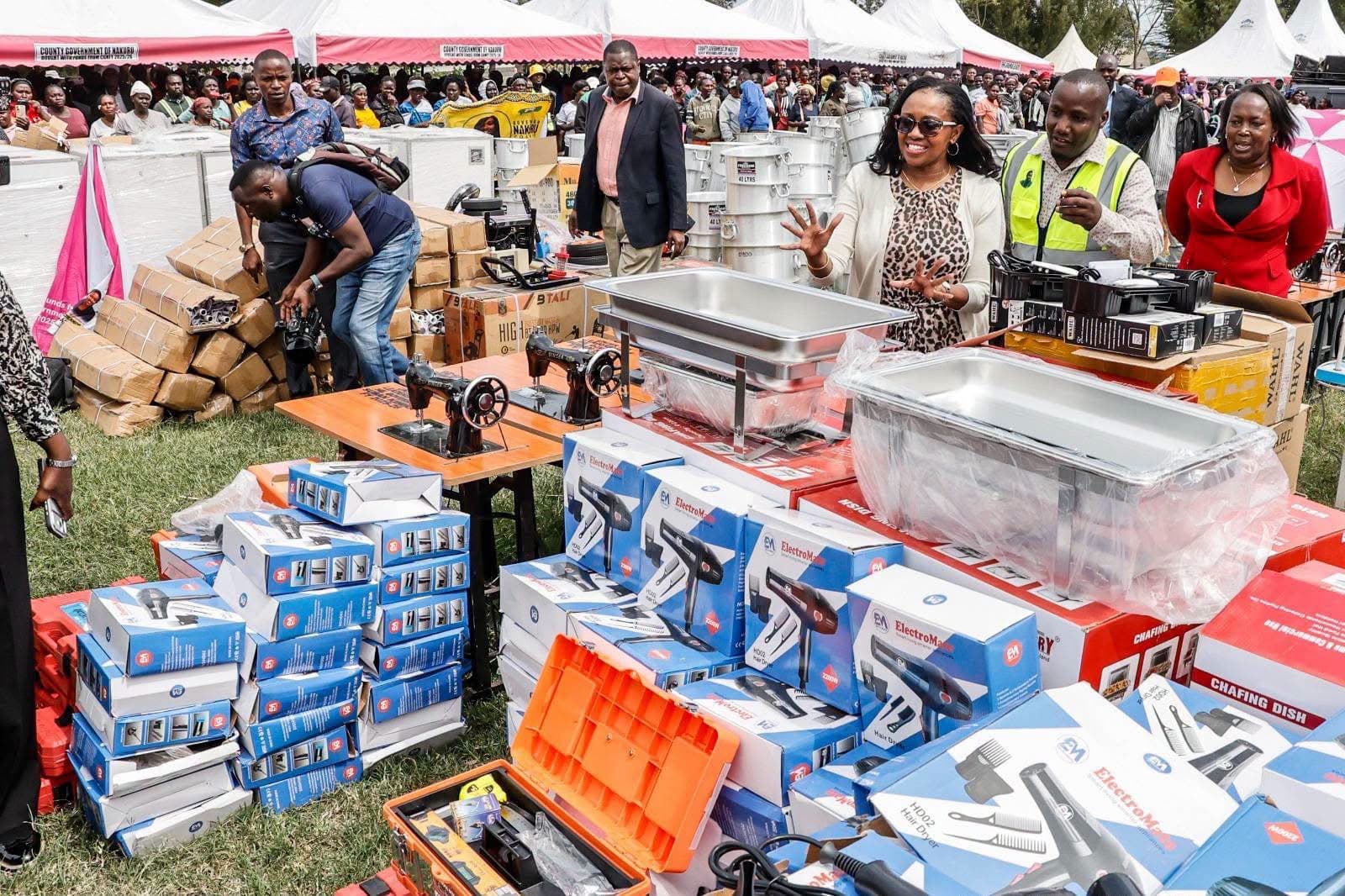
A total of 1,257 youth groups across all 11 sub-counties of Nakuru County have benefited from empowerment equipment worth Sh127 million, aimed at promoting entrepreneurship and creating employment.
The initiative seeks to boost business growth, enhance self-reliance and improve overall livelihoods, among young people across the region.
Distributed by Governor Susan Kihika at the Agricultural Training Centre (ATC) Soilo, the equipment is intended to help youth groups establish and expand income-generating enterprises across various sectors, reducing barriers to self-employment and strengthening grassroots economic development.
The items include egg incubators, sewing machines, welding equipment, concrete mixers and smokie trolleys, alongside tools for enterprises in catering, event management, poultry farming, tailoring, hairdressing, barbering, car washing, plumbing and electrical work.
Speaking during the distribution exercise, Governor Kihika said the initiative was part of the county government’s commitment to equipping young people with practical resources to turn their skills and business ideas into sustainable sources of income.
“The distribution of this equipment is about giving our young people an opportunity to participate meaningfully in the county’s economic development,” said Governor Kihika.
She said that her administration recognises that most youths have the skills, ideas and determination to start businesses but lack the tools and resources needed to translate their ambitions into reality.
Governor Kihika noted that by providing equipment that directly supports different trades and enterprises, the government is helping youth groups move from planning to actual production and service delivery.
“Our intention is to ensure that young people are not left behind but are empowered to create their own opportunities, generate income and build sustainable livelihoods,” she said.
The County Boss said her administration is committed to ensuring that any young person interested in poultry farming should have the equipment needed to improve production, a tailor to access the tools required to serve more customers, while a welder or artisan can establish an enterprise that can grow and eventually employ others.
She added that the same applies to those venturing into catering, event management, hairdressing, barbering, car washing, plumbing and electrical services.
The governor highlighted that equipment should not simply be received and stored away but must be put to productive use, shared responsibly among group members and managed in a way that benefits the greatest number of people.
She urged the groups to develop clear business plans, maintain their equipment properly, keep proper records and reinvest part of their earnings to expand their enterprises.
Ms Kihika reiterated that her administration’s goal is to move beyond distributing resources to building businesses that can stand on their own, create employment and contribute to the economic well-being across all communities.
When young people establish successful enterprises, she stated, they improve their own lives, support their families and create opportunities for others through employment and the demand for goods and services.
The Governor also explained that in the current financial year, the County government of Nakuru had allocated Sh383 million towards empowering 3,000 youth groups across Nakuru County.
She emphasized that this allocation demonstrates her commitment to reaching more young people and ensuring that economic opportunities are spread across all our 11 sub-counties.
“We are also investing in skills development and affordable financing because we understand that equipment alone may not address every challenge facing young entrepreneurs. Through our Youth Empowerment Centres and the Wezesha Fund, we are creating an environment where young people can develop their talents, access business support and seek financing to grow their enterprises,” said Kihika.
The equipment distribution is expected to help beneficiaries reduce the initial cost of starting businesses, increase their capacity to deliver goods and services and improve their ability to compete in local markets.
For groups receiving egg incubators, the equipment can support poultry production by enabling members to hatch chicks for sale or for their own farming activities.
Sewing machines can help tailoring groups produce garments and school uniforms, while welding equipment and concrete mixers can support fabrication and construction-related businesses.
Similarly, smokie trolleys and catering equipment can help young entrepreneurs enter the food vending and hospitality sectors, while tools for hairdressing, barbering, plumbing, electrical work and car washing can enable beneficiaries to provide services within their neighbourhoods.
The county government expects the enterprises to generate income for group members while creating opportunities for additional workers, suppliers and other small businesses within the local economy.
Increased business activity could also stimulate demand for locally produced goods and services, strengthening trade across the county.
The group-based approach is expected to encourage members to pool their skills, share responsibilities and jointly manage business assets.
With proper management, the equipment can help groups build a common source of income, expand their customer base and gradually reinvest profits into additional tools, stock and business operations.
However, the long-term impact of the initiative will depend on the beneficiaries’ ability to maintain the equipment, identify viable markets, manage operating costs and sustain demand for their products and services.
Beyond equipment distribution, Governor Kihika said the county had established Youth Empowerment Centres in Bondeni and Naivasha to provide spaces for talent development and skills training in areas including music, fashion, tailoring and technology.
The centres are intended to complement the equipment programme by helping young people develop practical abilities that can be converted into employment and entrepreneurial opportunities.
Nakuru County is also implementing the Sh100 million Wezesha Fund, to improve access to affordable financing for enterprises and cooperatives.
The Fund is expected to complement the equipment initiative by supporting eligible businesses that require additional capital to purchase stock, meet operating expenses or expand their activities.
By combining productive equipment, skills development and access to financing, the county government aims to address some of the barriers that prevent young people from starting and sustaining businesses.
The wider objective is to strengthen self-employment, support the growth of small enterprises and broaden participation in the county’s economic activities.
The governor also highlighted the county’s investment in education support, announcing that Nakuru Town West had received Sh18,566,373 in bursaries for 2,140 students, while Nakuru Town East received Sh14,114,500 for 2,613 students.
She further announced plans to introduce free uniforms for all learners in public Early Childhood Development Education (ECDE) centres from January 2027, alongside the county’s existing school feeding project dubbed Lishe na Mama Uji programme.
The education initiatives are intended to ease the financial burden on vulnerable households, support school attendance and improve access to early learning, complementing the county’s economic empowerment efforts.
Through the youth equipment programme, the Wezesha Fund, skills development centres and education support initiatives, the Nakuru County Government seeks to expand economic opportunities, strengthen household livelihoods and improve the welfare of residents.
Beneficiaries welcomed the empowerment initiative, saying the equipment would help them establish and expand businesses, improve their income and create employment opportunities for other young people.
They expressed optimism that the support would ease the financial burden of acquiring business tools and enable their groups to turn their skills into sustainable enterprises while contributing to improved livelihoods across Nakuru County.
by Caroline Nyakio and Jane Ngugi



Comments
No comments yet. Be the first to share your thoughts.