
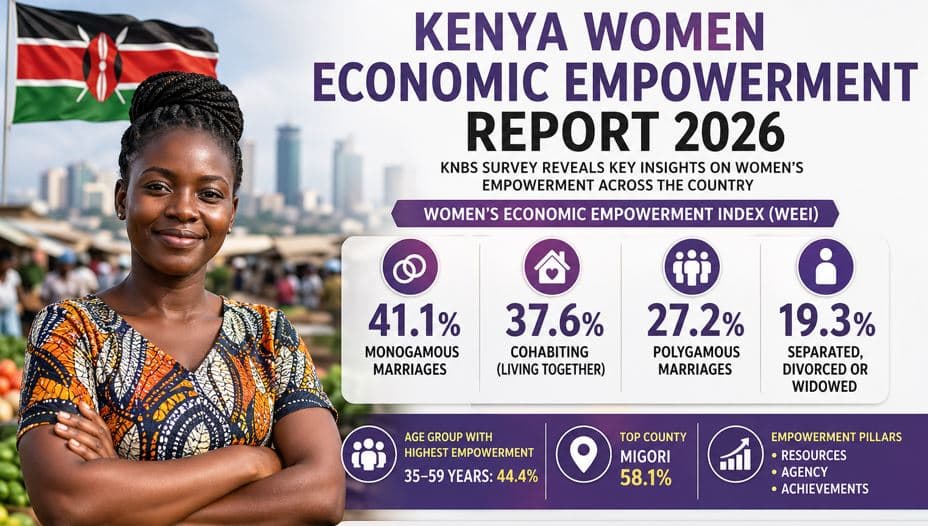
The latest Economic Survey 2026 from the Kenya National Bureau of Statistics (KNBS) reveals that Kenyan women in monogamous marriages experience higher levels of economic empowerment than those in cohabiting or polygamous unions.
Drawing from the Women’s Economic Empowerment Index (WEEI), the report shows that 41.1 percent of women in monogamous marriages reach the empowerment threshold, while those living together as a couple follow at 37.6 percent.
In contrast, women in polygamous marriages recorded a lower empowerment level of 27.2 percent. The survey found the lowest levels among women who are separated, divorced, or widowed, at just 19.3 percent. KNBS attributes this specific decline to the financial and social hardships that often follow the end of a marriage.
To measure these figures, KNBS built the WEEI around three fundamental pillars. These include resources, which cover access to assets and financial services; agency, focusing on a woman’s ability to make independent life decisions; and achievements, which track actual outcomes like economic independence and overall well-being.
The survey achieved a strong response rate, successfully interviewing 14,589 households out of the 15,189 eligible for the WEEI module. At the individual level, researchers gathered data from 15,920 women out of an eligible 19,497, providing a robust statistical foundation for the report’s conclusions.
While the bureau highlighted that women’s economic empowerment remains a cornerstone of inclusive growth and sustainable development, it also issued a clear warning about the uneven progress across the country. The data reveals that deep-seated inequalities still divide different regions and demographic groups.
“The findings underscore that while progress has been made in advancing women’s economic empowerment in Kenya, significant inequalities persist across regions and population groups,” the report stated.
In light of these disparities, the KNBS is calling for targeted policy interventions. The bureau urges the government and stakeholders to focus on improving access to financial resources, strengthening women’s ability to make independent choices, and aggressively expanding economic opportunities to ensure no one is left behind.


Comments
No comments yet. Be the first to share your thoughts.