
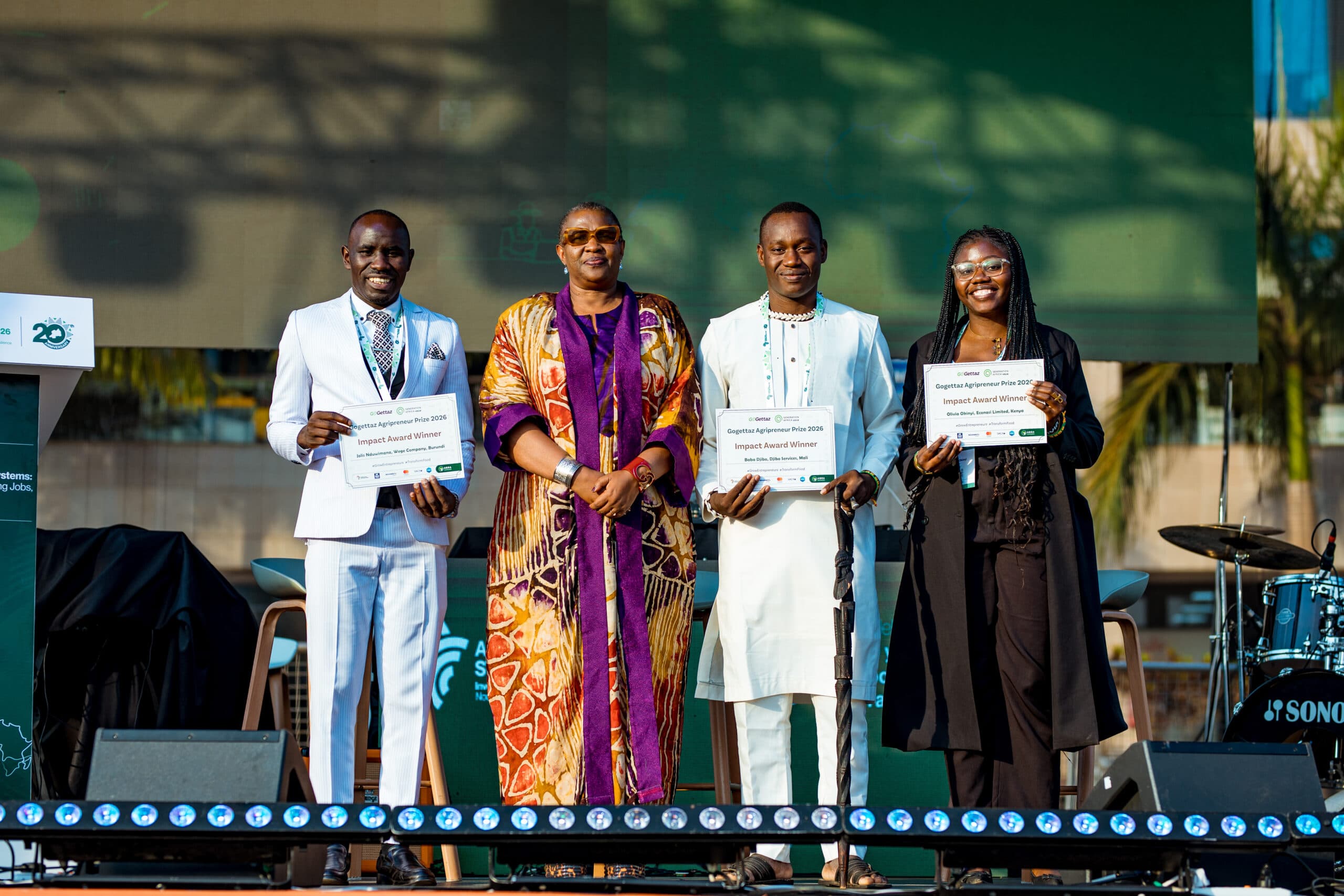
At the Africa Food Systems Forum (AFSF) closing ceremony in Kigali, Rwanda, Africa’s young agrifood entrepreneurs stole the spotlight as the 2026 GoGettaz Agripreneur Prize Competition announced its latest cohort of game-changing winners.
The awards celebrated youth-led ventures driving high-impact, scalable solutions across the continent’s agricultural landscape.
Taking home the top honors and US$50,000 grant awards to scale their enterprises were Israel Smart Obidah (Nigeria) and Nabakka Sandra (Uganda), selected after a rigorous judging process focused on innovation, market potential, social impact, business model, and leadership.
- Smartel Agri-tech (Nigeria): Founded by Israel Smart Obidah, the startup leverages its signature “Farm-in-a-Box”, a system combining hydroponics, IoT monitoring, and AI-powered crop diagnostics. Operating year-round, it uses 90% less water, slashes input costs by 70%, and has seen over 7,000 deployments since launching commercially in 2024.
- Sandi AI Technologies (Uganda): Co-founded by Nabakka Sandra, this platform utilizes AI combined with rural savings groups to help farmers access solar-powered irrigation without traditional loans or collateral. Reaching over 301,000 people across 10,000 groups, Sandi AI has unlocked more than US$4 million in agricultural tech acquisitions.
Four innovators received Impact Awards for addressing critical ecological and operational challenges in local food systems:
| Entrepreneur | Venture & Country | Solution & Achievements |
| Jolis Nduwimana | Wege Company (Burundi) | Converts banana and rice straw into eco-friendly packaging; serves 10,000+ monthly customers and engages 15,200+ farmers in its supply chain. |
| Josiane Mujawayezu | Amazing Insect Ltd (Rwanda) | Transforms organic waste into organic fertilizers and insect feed; works with 96 Rwandan cooperatives to support 5,000+ customers. |
| Baba Djibo | Djibo Services (Mali) | Developed a bio-compost activator reducing waste transformation time from months to just 10 days; trains youth and women in green business. |
| Olivia Okinyi | Econasi Limited (Kenya) | Processes pineapple waste into plant-based leather and packaging; boosts 500 smallholder incomes by nearly 40% while reducing landfill waste. |

Recognizing high-potential ventures expanding access to markets, green energy, and precision tools, six additional finalists secured Catalytic Awards:
-
Nancy Githumbi (Sincy Group Holdings, Kenya): Provided over US$720,000 in input credit, serving 549,000 farmers with traceable inputs and market access.
-
Chaimae Sqalli Adoui (Foodeals, Morocco): Tracks expiry dates and predicts demand via a digital app to curb food waste; successfully redistributed nearly 2,200 surplus meals in pilot phases.
-
Tariku Denekew (ZTN PLC, Ethiopia): Operates solar-powered edge AI networks for offline precision irrigation, boosting yields by 30% while reducing water usage by 48%.
-
Godfrey Noel (Kilimora, Kenya): Uses offline AI and soil monitoring to connect 1,500 cooperative operators, over 60% of whom are women—to carbon markets and resilient buyers.
-
Daouda Faye (B2C Agribusiness, Senegal): Connects 35,000+ farmers in Senegal, Ghana, and Togo to digital financial profiles through the MBAY’MI CONNECT platform.
-
Uche Kenneth (Smokeless Briqs, Nigeria): Turns ag-waste into clean briquettes and smart stoves, powering 25,000+ rural users and enabling 15,000 households to generate off-grid electricity.
Hosted by Generation Africa, AGRA’s youth initiative, the prize provides winner acceleration through mentorship, investor networks, and policy exposure alongside cash support.
Representing nine nations across West, East, and North Africa, the 2026 cohort demonstrates that localized tech, circular economics, and digital finance are already turning agricultural challenges into thriving commercial opportunities.
“Africa’s food systems transformation will ultimately be driven by businesses that can solve real problems at scale,” noted AGRA President Alice Ruhweza. “The opportunity now is to help businesses like these move from promising enterprises to companies that can operate on a scale. That requires capital, strong markets, the right partnerships, and an enabling environment.”


Comments
No comments yet. Be the first to share your thoughts.