
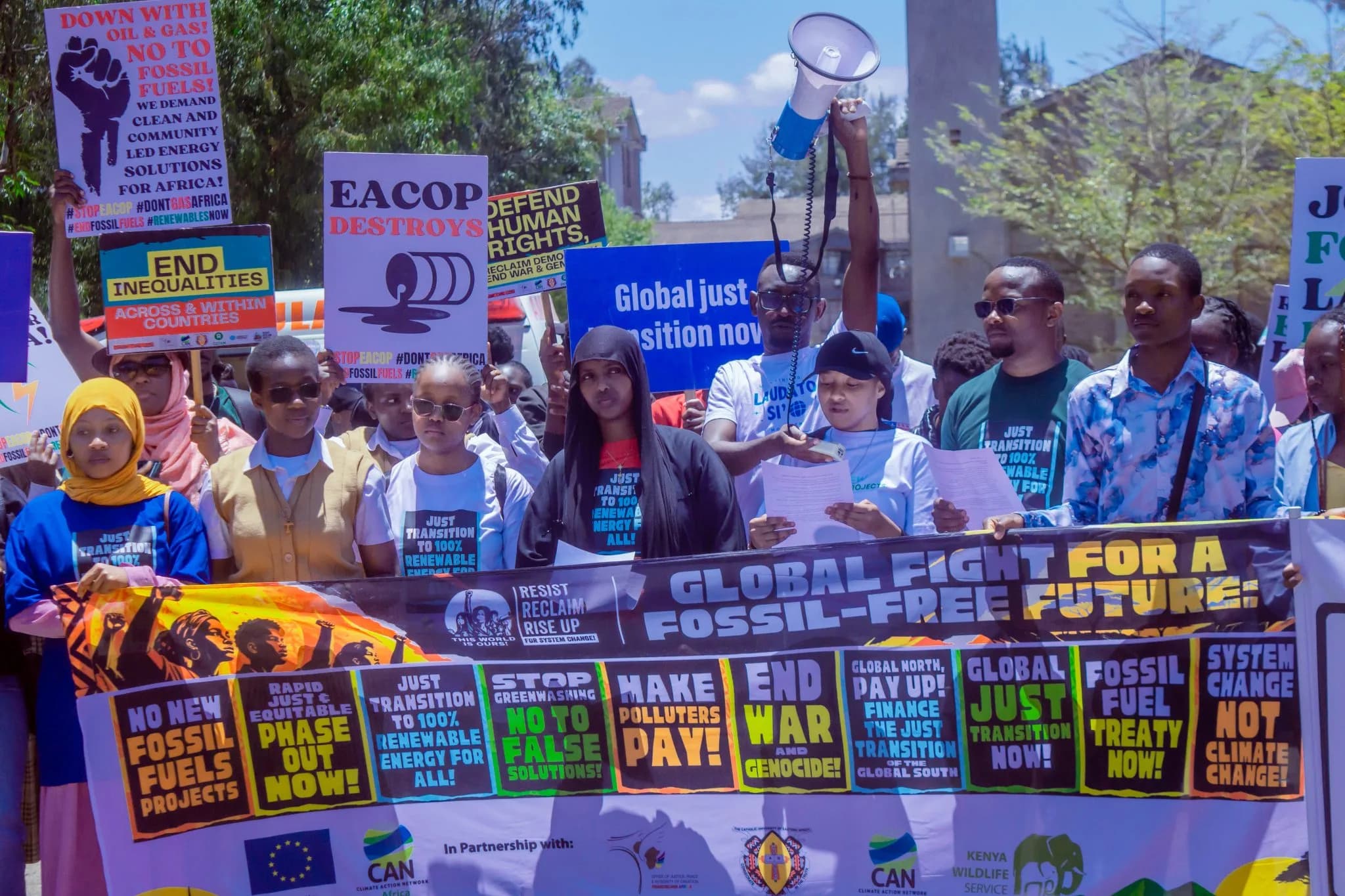
NAIROBI, Kenya,Sep 19 – Climate campaigners have urged Kenya to prioritize renewable energy investment over new fossil-fuel infrastructure, arguing that the country’s growing clean-energy capacity provides an opportunity to reduce long-term exposure to oil and gas projects.
The call was made in Nairobi on Saturday during a Climate Walk organised by Climate Action Network Africa (CAN Africa), the Office for Justice, Peace and Integrity of Creation (JPIC) – Franciscans Africa and other climate and faith-based organisations.
The mobilisation comes as East Africa advances major oil infrastructure projects, including the 1,443-kilometre East African Crude Oil Pipeline (EACOP), which is being developed to transport crude from Uganda to Tanzania’s coast.
According to the EACOP project company, the pipeline had reached 92.7 percent overall completion by early September 2026.
Uganda expects its oil developments to eventually produce about 230,000 barrels per day.
In Kenya, Nigerian businessman Aliko Dangote has proposed a $15–16 billion refinery in Lamu with a planned capacity of 700,000 barrels per day.
President William Ruto has backed the proposal, saying it could help reduce Kenya’s reliance on imported refined petroleum products.
However, the proposed refinery also faces questions around financing, crude supply, supporting infrastructure and environmental considerations.
“We recognise that African countries are starting from very different energy realities, and some remain far more dependent on fossil fuels than others. But Kenya already receives nearly four-fifths of the electricity supplied to its grid from renewable sources, giving it a strong foundation from which to move faster towards 100% clean renewable electricity.”
“New long-term fossil-fuel investments risk pulling in the opposite direction. We want African governments to build on the continent’s renewable-energy potential rather than lock future generations into another cycle of dirty energy dependence,” said Ms Ajra Mohamed, Campaign Lead at CAN Africa.
Kenya’s energy mix already has a significant renewable component.
Data from the Energy and Petroleum Regulatory Authority shows renewable sources accounted for 78.79 percent of electricity supplied to the national grid between July and December 2025, while renewables made up 80.60 percent of installed generation capacity.
Geothermal power accounted for more than 40 percent of electricity generation during the period, highlighting Kenya’s comparatively strong position in renewable electricity.
The campaigners say the challenge is now to expand renewable generation, transmission and access while ensuring that the transition remains affordable and reliable.
The Nairobi event concluded with an artivism exercise at the Catholic University of Eastern Africa, where participants depicted competing energy futures and called for what they described as a fair and equitable transition to renewable energy.
The mobilisation formed part of the Global Week of Action to End Fossil Fuels, running from September 14 to September 21, with campaigners also calling for increased climate finance for developing countries.
Comments
No comments yet. Be the first to share your thoughts.