
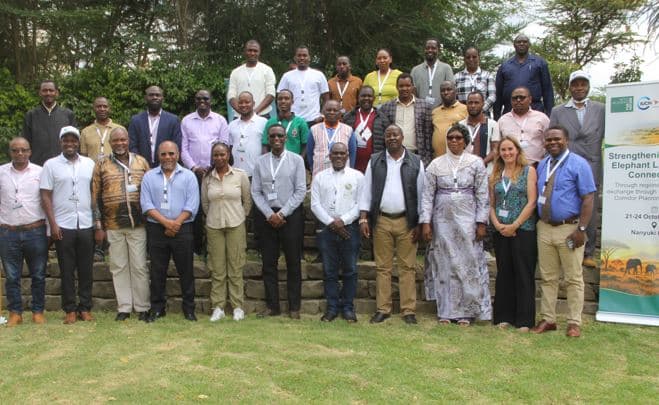
African countries are stepping up efforts to protect elephant migration corridors through regional collaboration, policy reforms and community-led conservation initiatives amid growing threats of the elephant survival due to human activities.
Delegates from Kenya, Gabon, South Africa, Zimbabwe, the Democratic Republic of Congo (DRC), Burkina Faso, Côte d’Ivoire, Botswana and Namibia made the call during a three-day workshop on Strengthening African Elephant Landscape Connectivity through Regional Knowledge Exchange and Corridor Planning held in Nanyuki, Laikipia County.
The delegates said the destruction and blockage of wildlife corridors by human settlements, agriculture and industrial development had disrupted elephant movements across national and international borders, threatening wildlife populations and increasing human-wildlife conflict.
They called for stronger cooperation among African governments and conservation stakeholders to develop policies and legal frameworks that protect existing corridors, restore threatened migration routes and secure wildlife habitats.
Speaking during the workshop which was convened by the Wyss Academy for Nature and its partners, Principal Secretary for Wildlife Silvia Museiya said human-wildlife conflict remained a major challenge in Kenya, resulting in loss of lives and destruction of property.
Museiya estimated that the government spends at least Sh1 billion annually for compensating victims of human-wildlife conflict, noting that elephants account for approximately 80 percent of reported cases.
She attributed the growing conflict to blocked wildlife corridors, which force elephants and other animals to stray into human settlements in search of food and movement routes.
The PS singled out Nairobi National Park as a critical example of the challenges facing wildlife connectivity, saying expanding industries, agricultural activities and human settlements had increasingly restricted traditional wildlife migration routes.
“We presented our concerns to President William Ruto and told him we are worried about the threats that are happening. He himself was concerned about the Nairobi National Park–Athi-Kapiti Wildlife Corridor,” said Museiya.
She warned that restricting wildlife movements had contributed to animal deaths and declining genetic diversity, particularly among species such as lions. She also cited the disruption of wildebeest migration as an example of the ecological consequences of human interference.
“From a marketing point of view, Kenya says it is the only country that has a national park in the city, and our oldest park was established in 1946. By virtue of being within the metropolis, it is surrounded by industries, settlements and agriculture, and so we have seen all possible corridors crossed down over time,” she said.
Museiya added that human-wildlife conflict had intensified around Nairobi, with cases of lions attacking children in settlements on the city’s outskirts raising further concerns about the safety of communities living near wildlife habitats.
She emphasized the need for both national and cross-border cooperation, particularly between Kenya and Tanzania in the Amboseli-Mkomazi landscape, where wildlife movements depend on connectivity across international boundaries.
The PS noted that elephants and other wildlife underpin more than 70 per cent of Kenya’s tourism sector, supporting employment and generating significant national revenue.
She called for the mapping and protection of existing wildlife corridors, restoration of threatened routes and the establishment of stronger institutional mechanisms to ensure their long-term conservation.
Museiya also cited a 3.8-million-dollar World Bank-supported initiative implemented through the National Environment Trust Fund (NETFUND), which she said was already underway to address human-wildlife conflict and improve ecological connectivity.
Wyss Academy for Nature Director Dr. Ben Okita said the organisation was working with local communities and other stakeholders to safeguard elephant corridors and ensure their protection was anchored in law.
In Isiolo, Samburu and Laikipia counties, Okita said more than ten elephant corridors had been identified, with three having been secured through legal protection efforts.

“We have identified more than ten corridors in this area, and the ones we have identified are the ones we are trying to secure. We have processes of securing them in practice and securing them into law,” he said.
A spot check by the Kenya News Agency during a visit to Oldonyiro, along the Laikipia-Samburu border, found local women known as ‘’Mama Corridors’’ playing a key role in monitoring elephant movements and recording wildlife data.
The women collect information on elephant movements and activities, including grazing and migration patterns, before transmitting the data to the Wyss Academy for Nature to support conservation planning.
Agnes Pani, one of the women involved in the initiative, said the programme had provided employment opportunities while raising awareness of the importance of protecting wildlife corridors.
“We are about six women, and our major role is to monitor elephant movements and collect data. Besides that, we also record information about other wildlife and people. Some of the issues we note are whether animals are grazing, moving or engaging in other activities,” said Pani.
She said the initiative had enabled the women to participate directly in conservation while contributing to efforts to reduce conflicts between communities and wildlife.
Delegates said the Kenyan experience demonstrated the importance of involving local communities, government institutions and the private sector in protecting elephant migration routes.
Emmanuel Hema, a delegate from Burkina Faso, said the workshop provided an opportunity for participating countries to exchange experiences and learn from one another’s approaches to wildlife conservation.
“The workshop has provided us with so much good information and experiences that we can share from different countries. In Kenya, one can see that many things are being done in terms of elephant landscape connectivity, involving communities, government institutions and the private sector, which is a good experience,” said Hema.
Steeve Gama, a delegate from Gabon, said he hoped to apply lessons from the workshop in his country to strengthen elephant conservation and improve wildlife corridor management.
The delegates expressed optimism that regional knowledge-sharing, community participation and stronger legal protections would help restore disrupted elephant migration routes, safeguard biodiversity and reduce human-wildlife conflict across Africa.
By Muturi Mwangi


Comments
No comments yet. Be the first to share your thoughts.