
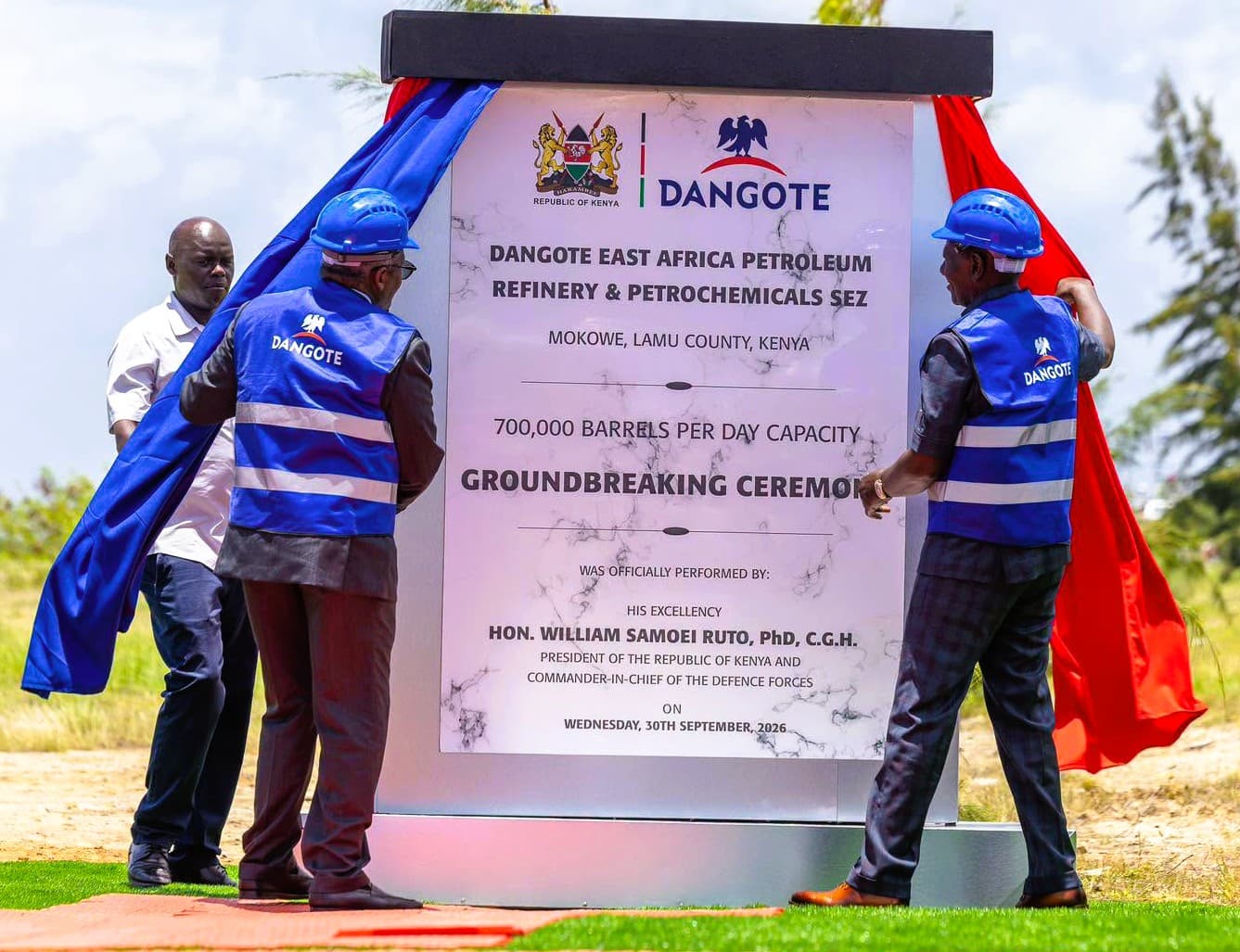
Coast leaders have hailed the Sh2.6 trillion Dangote East Africa oil refinery in Lamu County as a ‘transformative path for economic development and property’.
They contend the Lamu oil project being undertaken by Nigerian billionaire Aliko Dangote will transform the Lamu archipelago into a major regional energy and logistics hub.
The Dangote East Africa Refinery, launched by President William Ruto on September 30, 2026, is scheduled to be completed and commissioned in early 2030.
During the groundbreaking ceremony President Ruto was joined by African leaders such as Paul Kagame (Rwanda), Yoweri Museveni (Uganda), Abiy Ahmed (Ethiopia), Évariste Ndayishimiye (Burundi), Romuald Wadagni (Benin) and Jean-Lucien Savi de Tové (Togo).
Observers say that the construction of an oil refinery which would be processing crude into products like diesel and aviation fuel will in the long run lower East Africa’s fuel costs and save the region hard currency used to import refined products.
Stakeholders maintain the oil refinery will leverage Lamu ports strategic location to distribute refined fuel across East and Central Africa.
Lamu Port serves as Kenya’s critical second deepwater maritime gateway after Mombasa Port and the foundational anchor project for the LAPSSET corridor.
The coastal leaders, including Cabinet Secretary (CS) for Youth Affairs, Creative Economy and Sports Salim Mvurya, dismissed those opposed to the crude oil refinery project with the capacity to help bring down pump prices as ‘anti-development and agents of poverty’.
Beyond refining crude into petrol, diesel, and aviation fuel, the integrated site is planned to include a 1,000 MW power plant, a fertilizer and chemical manufacturing plant, and a plastics facility.
Mvurya said once the project is completed within 40 months from the groundbreaking ceremony, Lamu will never be the same.
He said more than 60,000 people from Lamu, the Coast Region and across East Africa will access opportunities during the construction of the Dangote East Africa Petroleum Refinery and Petrochemicals Special Economic Zone (SEZ) in Mokowe, Lamu County.
The CS said around the project an entirely new industrial ecosystem and industrial zone will take shape, opening opportunities for local enterprise, logistics, transport, housing, hospitality, trade and countless businesses along the value chain.
He described the 700,000 barrel-per-day refinery, when at full operation, making it the largest oil refinery in East and Central Africa, as a ‘game changer’ that would cut fuel imports and achieve energy self-sufficiency.
The Lamu refinery is Dangote’s largest investment outside Nigeria, which also has a processing capacity of 700,000 barrels a day.
“Within the same period, more than 1,000 local young people will be professionally trained across different technical and engineering fields, building a pool of homegrown expertise that will not only participate in this project but also sustain the industrial economy it creates,” he said.
Mining, Blue Economy and Maritime Affairs CS Hassan Joho described the Lamu investment as a landmark heralding a new chapter of economic transformation.
“The oil refinery project holds immense promise for the coastal region and the country at large,” he said, adding that the value chain in the economy would be huge.
He went further, ‘it will unlock new opportunities for investment, create jobs, stimulate local enterprises, strengthen value chains and contribute to the growth of a more diversified and resilient economy’.
Joho said for generations, the coastal region has stood at the crossroads of trade, culture and commerce and the Lamu oil project stands out as one of Kenya’s most significant energy undertakings
He said the Lamu crude oil refinery comes as the Lokichar crude oil Project in Turkana County has officially transitioned into its highly anticipated commercial development phase, targeting First Oil production by December 2026.
“Today we are witnessing the writing of a new chapter, one in which our strategic location, natural resources and human capital are transformed into engines of prosperity and opportunity,” he said.
The Lamu oil project is expected to boost energy security, reduce reliance on imported refined petroleum products, and support industries such as petrochemicals, fertilizer and manufacturing.
It will also create jobs, support local businesses, expand maritime activities and attract further investment along the LAPSSET (Lamu Port-South Sudan-Ethiopia-Transport) corridor.
LAPSSET corridor is East Africa’s largest integrated infrastructure project, designed to link Kenya with landlocked countries of Ethiopia, South Sudan, and Uganda, enabling movement of people and cargo along the LAPSSET corridor.
The planned oil refinery in Lamu and the Turkana crude oil reserves are core anchors of the wider LAPSSET (Lamu Port-South Sudan-Ethiopia-Transport) corridor project.
The LAPSSET Corridor Program is a regional flagship project intended to provide transport and logistics infrastructure aimed at creating seamless connectivity between Kenya, Ethiopia and South Sudan.
The project connects a population of 160 million people in the three countries, and additionally, the LAPSSET Corridor is part of the larger land bridge that will connect the East African coast from Lamu Port to the West coast of Africa at Douala Port in Cameroon.
Speaker of the Senate Amason Kingi said with the launch of the Dangote Lamu oil project the message that goes out loud and clear is that ‘Lamu, coast region, and Kenya will never be the same again, thanks to this landmark project’.
Kingi says the oil refinery project comes at a time the government has been working to improve its refining capacity and efficiency to meet the rising energy demand.
Joho, Mvurya and Kingi are past two-term governors of Mombasa, Kwale and Kilifi counties, respectively, who served as pioneer county chiefs between 2013 and 2022.
On his part, Lamu Governor Issa Timamy says the new oil investment presents a great opportunity to transform the region, create thousands of jobs, empower the youth, stimulate local businesses and accelerate infrastructure development.
Timamy says his administration is committed to ensuring that local people are at the ‘heart of this transformation’ and that the benefits of the project reach local communities.
Timamy says the devolved government will fully cooperate with investors and provide a conducive working environment that will spur socio-economic growth in the Lamu archipelago and beyond through return on investments.
“With this investment, Lamu, a UNESCO World Heritage Site, is poised to become a major industrial hub, opening new doors for economic growth and prosperity for generations to come,” he said, noting that the project marks a major step towards scaling up sustainable fuel production.
By Hussein Abdullahi
Comments
No comments yet. Be the first to share your thoughts.