
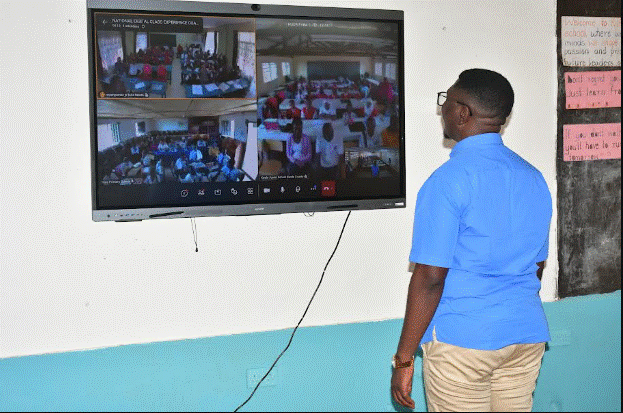
Parents have been urged to embrace digital learning to nurture talent and creativity among children and equip them with skills relevant to the changing technological environment.
Principal Secretary in the State Department for Youth Affairs and the Creative Economy Fikirini Jacobs said digital platforms could help learners access creative learning materials and interact with peers from different locations.
Speaking to journalists at Kilifi Comprehensive School during the launch of digital learning equipment under the Kenya Digital Economy Acceleration Project (KDEAP), Jacobs said interactive smartboards in junior secondary schools would enhance teaching and learning.
“For instance, learners studying traditional music can access demonstrations online instead of travelling to places where particular songs are performed,” he said.
Jacobs said digital technology complemented teachers’ work by improving access to learning resources and enabling learners to participate in shared lessons regardless of their locations.
“Technology complements the role of a teacher and enhances their ability to deliver better. Every parent should embrace it because it enables teachers to do better work in the classroom,” he said.
He added that the system would support modern teaching methods, nurture learners’ creativity and allow them to revisit lessons at their convenience.
ICT Authority Deputy Director Kevin Atibu said the initiative was intended to complement teachers rather than replace them, noting that digital skills would help teachers improve lesson delivery and enhance learners’ development.
“This particular initiative is supposed to complement the teachers’ education practices within the class. It is not meant to replace a teacher but basically to equip the teacher with skills that they are able to transform and also use the same to impact the students,” he said.
Atibu said the exercise marked the main installation phase of the project following an earlier pilot, with the Government targeting at least 20,000 schools by the end of the year.
“We did piloting some months ago, and this is the main installation project running across the country, with 10,323 schools having received installations. We hope that by the end of the year, we will have reached about 20,000 schools,” he said.
He added that interactive smartboards enabled learners from different schools and counties to participate in shared lessons, promoting collaboration and knowledge exchange.
During the launch, learners from Kilifi joined others from across the Coast region in a lesson delivered by one teacher through an interactive smartboard.
Kilifi Comprehensive School ICT teacher Gladys Kahonzi said the technology would simplify learning and strengthen connections between schools.
“We are happy because learning will become easier. It will be easier to connect schools within the region and help bridge the gap caused by the shortage of teachers,” she said.
More than 64,000 teachers across the country have been trained to use the digital boards, while more than 10,000 schools have received smartboards as part of efforts to strengthen digital learning.
The Government is also digitising learning content for junior secondary school learners, including Grades Seven and Eight, with work on Grade Nine content nearing completion.
The initiative is expected to expand access to learning resources, support the development of learners’ talents and strengthen the integration of technology into classroom teaching.
by Queen Wanzia and Stephen Mrira


Comments
No comments yet. Be the first to share your thoughts.