
The government has declared an all-out war on alcohol, drugs and substance abuse, with a multi-agency review underway to strengthen the Narcotic Drugs and Psychotropic Substances (Control) Act and the NACADA Act.
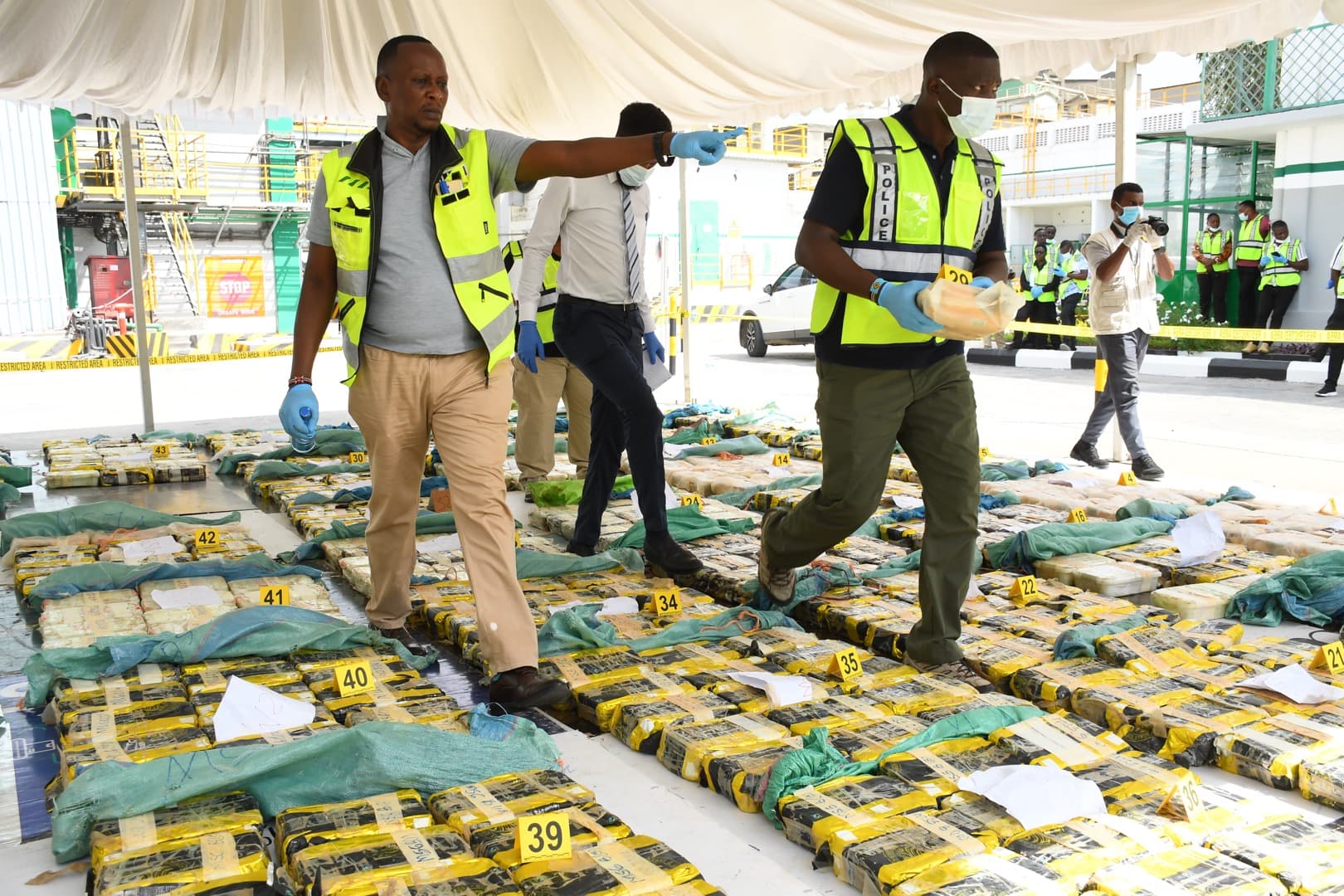
Cabinet Secretary (CS) for Interior and National Administration Kipchumba Murkomen said this during the destruction of 1,036 kilogrammes of methamphetamine worth Sh8.2 billion at Bamburi Cement Factory in Mombasa, noting that the government was tightening the law to address the drug scourge, which he described as an existential security, health and socio-economic threat.
A breakthrough in the fight against transnational organised crime and drug trafficking was recorded on October 23, 2025, when a multi-agency operation intercepted 1,036 kilogrammes of methamphetamine worth Sh8.2 billion aboard a stateless vessel in the Indian Ocean.
Methamphetamine, a powerful synthetic stimulant typically manufactured in illegal laboratories, appears as a powder, tablet or crystal. It induces intense euphoria and heightened physical and mental stimulation.
The stateless vessel, christened Igor, which had long been on the radar of international authorities over suspected narcotics trafficking in the Western Indian Ocean, was found carrying six Iranian crew members. It was intercepted about 630 kilometres east of Mombasa in an operation codenamed Bahari Safi, led by the Kenya Navy.
The multi-agency team comprised officers from the Kenya Navy, Kenya Coast Guard Service, the National Authority for the Campaign Against Alcohol and Drug Abuse (NACADA), and the Directorate of Criminal Investigations (DCI).
CS Murkomen explained that the proposed amendments would strengthen the legal, institutional, investigative, prosecutorial and enforcement framework for combating narcotic drugs, psychotropic substances, transnational drug trafficking, organised criminal syndicates and substance abuse.
“Our aim is enhanced penalties, stronger tools against organised crime, and operationalising the Rehabilitation Fund. We must match enforcement with prevention, treatment and rehabilitation,” said the CS.
In July 2025, the Ministry launched the first National Policy for the Prevention, Management and Control of Alcohol, Drugs and Substance Abuse. A workplace policy on substance abuse is also being finalised.
A countrywide assessment of 266 rehabilitation facilities has been completed, with 164 facilities accredited. The CS noted that 11 counties have confirmed their willingness to establish rehabilitation centres.
The rehabilitation centres will play a pivotal role in reforming drug users, as the CS disclosed that the numbers are sobering: one in six Kenyans aged between 15 and 65, equivalent to more than 4.7 million people, are using at least one drug or substance of abuse.
The Coast region is among the hardest hit, with Mombasa County recording the highest rate in the country at 34.4 per cent.
NACADA was lauded for rolling out the Community-Based Rehabilitation Framework for Substance Use Disorders. The strategy hinges on four pillars: drug education and awareness campaigns; affordable, culturally sensitive rehabilitation services; justice reforms that divert non-violent offenders into treatment instead of prison; and grassroots structures such as Nyumba Kumi.
“The Government’s message is clear: we will hunt down traffickers, but we will not abandon the victims of drugs. As we dismantle criminal networks, we are also building a recovery network, a whole-of-government, whole-of-society approach that leaves no one behind,” affirmed CS Murkomen.
He added, “All assets used in or acquired through drug trafficking and the illicit alcohol trade will be treated as proceeds of crime, promptly frozen, and forfeited to the State. Critically, the president directed that these assets be redirected towards rehabilitation, prevention and treatment.”
The CS said any government official found colluding with drug traffickers or illicit alcohol networks would be dismissed from service and prosecuted to the full extent of the law.
“There will be no sacred cows. The Government of Kenya’s position is clear: There will be no safe space for the manufacture, trafficking, distribution or sale of illicit drugs and illicit alcohol in this country,” he stated.
Inspector General of Police Douglas Kanja said the achievement in intercepting the largest haul of drugs underscored the commitment of the National Police Service to combating illegal drugs.
“We have deliberately and strategically strengthened our capacity to confront this threat. The capacity of the National Anti-Narcotics Investigation Bureau has been enhanced through specialised training and deployment of our regional personnel.
He added, “We have invested in intelligence gathering and surveillance capability and forensic experts to ensure those who deal with illegal drugs are met with the full force of the law.”
DCI Director Mohamed Amin explained that methamphetamine is a highly addictive, dangerous and destructive drug that fuels crime in communities and affects the health of users.
He warned drug traffickers that Kenya is neither a market nor a transit route for their poison. “Our Police Officers and other law enforcement officers will forever remain alert; we will profile, we will find and arrest you, and we will destroy your drugs,” said Amin.
Kenya Navy Commander Major Paul Otieno said the operation was meticulously carried out through intelligence and information sharing between nations.
NACADA Chairman Bishop Stephen Mairori said it would not be business as usual for drug barons. “You will not enjoy the proceeds at the expense of our children.”
Director of Public Prosecutions Renson Ingonga called for intensified efforts to dismantle criminal networks behind narcotics trafficking, saying drug seizures alone cannot defeat the growing threat.
The DPP said narcotics trafficking was increasingly transnational, organised, technologically facilitated and financially sophisticated, with criminal networks exploiting Kenya’s geographical position, extensive coastline and international transport connections.
“We must move beyond arresting the courier at the end of the chain,” Mr Ingonga said, stressing the need to establish who financed an operation, coordinated it, moved the money and benefited from the proceeds.
by Sadik Hassan.

Comments
No comments yet. Be the first to share your thoughts.