
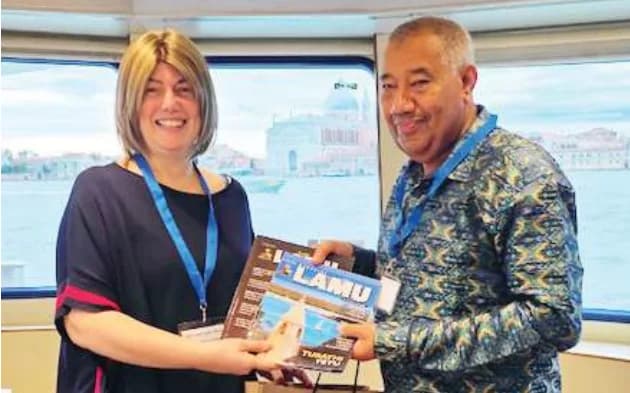
UNDP local government advisor Diana Lopez and Lamu Governor Issa Timamy aboard the Il Doge di Venezia in Venice, Italy on October 22 / BRIAN OTIENO

Lamu governor Issa Timamy makes a presentation aboard the Il Doge di Venezia in Venice, Italy on October 22 / BRIAN OTIENO

Lamu governor Issa Timamy and director of disaster risk management and peace-building Shee Kupi / BRIAN OTIENO

When Amina Mohamed, a refugee in Lamu county, first got fresh water next to her makeshift home in Kiunga in 2019, she never imagined what the future held.
In her wildest dreams, she could not have thought her name would one day be mentioned in Venice, Italy, thousands of miles away.
She had previously trekked for kilometres, sometimes encountering suspected militants from the terror group al Shabaab and having to either beg for her life or brazenly escape from them just to fetch water.
The resource was scarce and so was security.
Then came an idea from one of the brilliant minds in Lamu county, Shee Kupi.
Drawing on knowledge acquired during his stay in a Rotary Peace Fellowship programme, as well as additional knowledge from Bahçeşehir University in Türkiye, he came up with the idea of using a water project to promote peace.
His idea was to establish a desalination plant, turn seawater into fresh water and deliver it to the doorsteps of community members. The project would also create water-sharing points, encouraging members of the community to interact.
This became the starting point of a peace journey that would later foster harmony among community members and local authorities, including peace actors.
This was the model, dubbed the ‘Water for Peace Initiative’, that was showcased aboard a water vessel in Venice, Italy, on 22 October.
Governor Issa Timamy showcased the project at the United Nations Development Programme (UNDP) SDG Local Action Venice Winter School.
The international forum brought together participants from more than 65 countries to exchange ideas and practical solutions for advancing the Sustainable Development Goals (SDGs) through local action.
Lamu stood out as the only participating county from East Africa, providing a platform for Kenya to share its experience in integrating water security, peace-building and inclusive development.
In a distinctive setting, the forum took place aboard Il Doge di Venezia, a vessel navigating the Venetian waterways, creating a unique environment for international dialogue, learning and collaboration.
During his presentation under the Blue Trail – Clean and Affordable Water theme, Timamy highlighted how Lamu is using solar-powered desalination and water distribution infrastructure to address longstanding water challenges in Kiunga, a coastal town on the Kenya–Somalia border.
The initiative represents an investment of about Sh48.9 million and includes a 15.09-kilometre water distribution network, a desalination system with a production capacity of 5,000 litres per hour and 573 household connections.
More than 3,500 people benefit from the initiative, alongside three schools and two health facilities.
The presentation demonstrated how investment in an essential public service can extend beyond infrastructure to support broader development priorities.
“Improved access to water creates opportunities to ease pressures associated with scarcity, strengthen everyday interaction among community members and support more constructive relationships between communities and public institutions,” Timamy said.
“These opportunities are particularly relevant in areas where community trust, early warning, information-sharing and peaceful coexistence are important to wider security efforts.”
He said that, by combining renewable energy, improved access to safe water and inclusive service delivery, the initiative offers an example of how local governments can address interconnected challenges through integrated solutions.
Beyond the project’s measurable outputs, the presentation explored the relationship between access to essential services and peace-building in a sensitive border region.
The initiative also reflects the importance of inclusive local development, including efforts to strengthen relations between refugee and host communities in Kiunga, where refugees live alongside the host population rather than in a conventional refugee camp.
Kupi, the director of disaster risk management and peace-building in Lamu county, who accompanied Timamy, said the county’s approach recognises that lasting peace requires more than responding to insecurity.
“It also requires institutions that address people’s everyday needs, promote fairness in service delivery and build confidence through practical action,” he said.
Kupi was the technical lead for the Water for Peace case study.
Their joint participation demonstrated the value of political leadership supported by technical expertise in communicating local innovations and strengthening opportunities for international knowledge exchange.
Kupi said the Venice presentation also provided an opportunity to share the wider Lamu Peace Model, which received the 2026 United Cities and Local Governments (UCLG) Peace Prize in June 2026.
The award recognised Lamu county’s approach to institutionalising peace-building within county governance and coordinating the work of public institutions.
The Kiunga Water for Peace Initiative illustrates how this broader approach can translate into practical local action by connecting essential service delivery with community well-being, inclusion and peaceful coexistence.
“Lamu’s participation at the Venice Winter School provided an opportunity to share local experience with an international audience and learn from approaches developed in other parts of the world,” Kupi said.
Comments
No comments yet. Be the first to share your thoughts.