
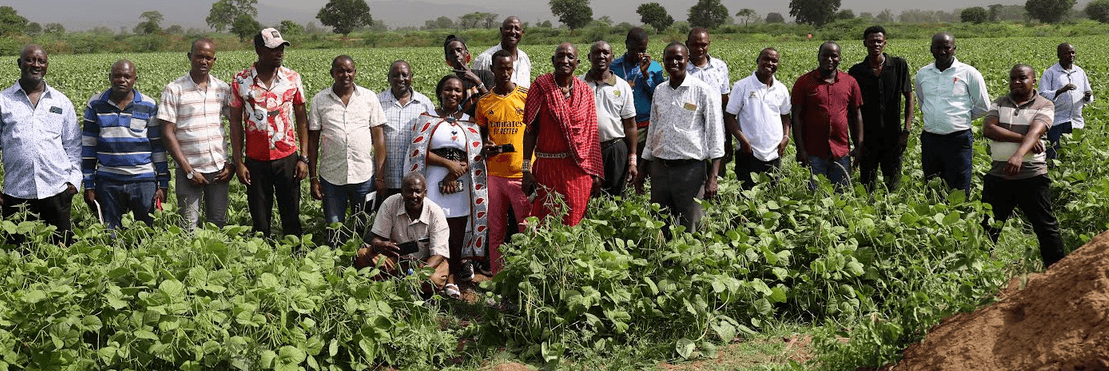
The State Department for Irrigation is rolling out a transformative exchange programme to mobilize farmers to shift from traditional rain-fed agriculture to modern irrigation farming to boost agricultural productivity, improve livelihoods and increase household incomes.
According to the Director, Management of Irrigation Schemes, State Department for Irrigation, Moris Opondo, the department is using farmers’ field exchange visits to woo farmers to change their mindsets towards irrigation by embracing agriculture as a way of improving livelihoods, promoting good governance in irrigation schemes and equipping farmers with practical skills to enhance production.
Opondo said the Department is mobilizing farmers to form Irrigation Water Users Associations (IWUAs) to manage water resources and sustain operations after the completion of irrigation infrastructure projects.
“Adults learn more when they see,” said the Director, explaining that the exchange visits would enable farmers to interact with their counterparts in operational irrigation schemes to observe successful practices and learn how to improve production and management.
He revealed that recently the Department organised an exchange field visit for farmers from Nguruman Irrigation Scheme in Kajiado County to Pekera Irrigation Scheme in Baringo County, where they learnt about effective scheme management, commercial farming, water-use efficiency and financial sustainability.
The irrigation expert said Pekera was selected because of its improved performance following a scheme an assessment conducted in 2024, which helped strengthen governance, improve compliance with bylaws and promote timely elections.
He said the scheme had also recorded an operational and maintenance fee collection rate of more than 85 per cent, demonstrating the importance of farmers contributing towards the maintenance of irrigation infrastructure.
Opondo noted that Pekera farmers had embraced commercial agriculture through contractual arrangements with the Kenya Seed Company, particularly in seed maize production, providing a model for farmers in Nguruman to explore market-oriented farming.
He said the exchange programme would help farmers understand the importance of good governance, timely payment of water-use fees, dispute resolution mechanisms and commercial production.
The Director said the initiative forms part of the Programme for Enhancement of Water Productivity, Production and Sustainability of Irrigation Schemes (PEWAPSYS), which seeks to improve water-use efficiency, increase agricultural production and ensure the long-term sustainability of irrigation schemes.
He explained that the programme promotes water metering to enhance accountability and discourage wastage, with farmers paying for water according to their consumption.
Opondo observed that some completed irrigation schemes were not being utilised to their full potential, with only part of the available acreage under cultivation.
He said the department was working to ensure that all available irrigated land was put into production, while increasing yields per acre through improved farming practices, technology adoption and efficient water management.
The programme also seeks to strengthen environmental conservation, climate resilience and financial sustainability by encouraging farmers to establish capital replacement funds to cater for repairs and maintenance without relying entirely on government support.
The Director added that the department was also promoting social inclusion by encouraging the participation of women, youth, persons with disabilities and other disadvantaged groups in irrigation scheme management.
The Parkerra Irrigation Scheme Manager, Daniel Waweru, who took the visiting farmers from Nguruman Irrigation Scheme in Kajiado County, urged them to strengthen governance, promote transparency in financial management and ensure equitable water distribution to enhance productivity and sustain irrigation activities.
He added that said effective coordination among farmers’ institutions and government agencies was essential for the successful management of irrigation schemes.
Waweru said Irrigation Water Users Associations, Dispute Resolution Committees, cooperative societies and Scheme Management Committees should work together to improve governance, resolve disputes and promote sustainable agricultural production.
He encouraged the visiting farmers to strengthen collaboration among the institutions responsible for water management, marketing and the overall operation of their scheme.
He further urged farmers to prioritise the payment of operation and maintenance fees to ensure that irrigation infrastructure remained functional without over-reliance on government funding.
He said sustainable financing would enable schemes to meet routine maintenance costs, address infrastructure breakdowns and maintain uninterrupted agricultural production.
Samuel Chebii, the Chairperson of Perkerra Cooperative Society, urged farmers to form and join cooperative societies to benefit from bulk purchasing, collective marketing and better bargaining power.
Chebii said collective farming had helped farmers reduce production costs, access agricultural inputs and negotiate better prices for their produce.
The chairperson said the cooperative brings farmers together to coordinate production and marketing, enabling them to benefit from economies of scale and partnerships with seed companies and other agricultural stakeholders.
He explained that selling produce collectively enables farmers to negotiate better prices than they would receive when operating individually.
“When we negotiate, we get a better deal than going as an individual,” said Chebii.
Marona Lerpaine, the Treasurer of Nguruman Farmers Association, said the exchange visit had exposed them to practical approaches to improving agricultural production, accessing markets and strengthening the management of their irrigation scheme.
Rimpaine said one of the key lessons was the importance of farmers working together through a cooperative society to negotiate better prices, access agricultural inputs and secure reliable markets for their produce.
She noted that collective marketing would help farmers improve their bargaining power and create opportunities for sustainable income generation.
Nicholas Bowen, the Chairperson of Perkerra IWUA, underscored the importance of formal registration of IWUAs, adherence to bylaws and ensuring equitable distribution of water resources as a foundation for harmony and efficient water use.
The farmers toured the source of water for the Perkerra Irrigation Scheme, where they learnt how water is controlled, flown to the farms and sustainably managed to serve all the scheme members.
They later toured the irrigation blocks within the scheme, where they interacted with host farmers, observed different types of crops planted and learned more on crop diversification, field management and productivity.
The benchmarking visit is expected to equip Nguruman farmers with practical lessons and technologies that can be adapted back home to improve water management, boost production, strengthen commercialization through strong farmer institutions, and resolve emerging disputes, while at the same time banking on the strength of the farmer-cooperative movement to get larger and better markets for their produce, thereby enhancing farmer incomes.
The benchmarking tour was organised by the Program for Enhancement of Water Productivity, Production and Sustainability of Irrigation Schemes (PEWAPSIS), under the stewardship of Maurice Opondo, Director, Irrigation Water Management.
By Benedict Wasiche and Peninah Kihika

Comments
No comments yet. Be the first to share your thoughts.