
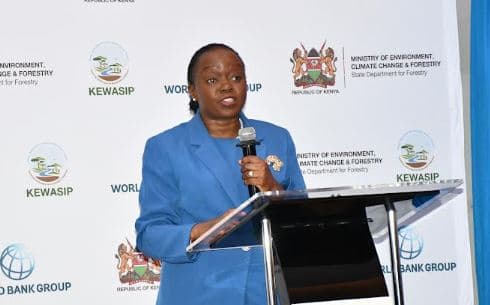
The Government has launched a Sh200 billion (US$200 million) project aimed at restoring degraded landscapes, improving water security and strengthening the livelihoods of communities in 12 counties over the next five years.
The Kenya Watershed Services Improvement Project (KEWASIP), financed by the World Bank and implemented by the State Department for Forestry, will rehabilitate 200,000 hectares of degraded ecosystems and directly and indirectly benefit about 750,000 people, according to the project brief.
Speaking during the launch in Nairobi, the Cabinet Secretary (CS) for Environment, Climate Change and Forestry, Dr Deborah Barasa, said the initiative, would help protect critical water catchments, while addressing the effects of land degradation, unsustainable land use and climate change.
Barasa emphasized that environmental restoration must go beyond planting trees, to include better land management, biodiversity protection, stronger watershed functions and sustainable economic opportunities for communities.
“Restoration must address the underlying causes of degradation, improve land management, protect biodiversity and create sustainable economic opportunities for communities,” the Cabinet Secretary said.
The project will be implemented in five priority landscapes: Marsabit, Marmanet, Nyambene Hills, Chyulu Hills and Shimba Hills.
The landscapes span Marsabit, Isiolo, Meru, Tharaka Nithi, Laikipia, Samburu, Baringo, Makueni, Kitui, Garissa, Tana River and Kwale counties.
The programme will link upstream forests and water towers with river systems, agricultural areas and downstream communities.
It is expected to improve water security, conserve biodiversity, strengthen climate resilience and support sustainable farming and income-generating activities.
The Cabinet Secretary called on County governments to take ownership of the programme, incorporate its activities into County development plans and protect environmentally sensitive areas, including hilltops, riparian zones and community forests.
“Environmental challenges, do not respect administrative boundaries, and neither should our solutions,” Barasa said, urging National and County agencies, to coordinate their work and respond to the needs of local communities.
Barasa called on the different institutions involved in the implementation of the programme, to ensure transparency, accountability and prudent use of project resources, saying success should be measured not only by the number of trees planted or hectares covered, but also by seedling survival, improved watershed functions and lasting benefits to communities.
Principal Secretary (PS), State Department for Forestry, Gitonga Mugambi, underscored the importance of transparency and accountability in project implementation, particularly in the utilisation of allocated resources.
The PS called on all implementing partners to work collaboratively, to ensure the successful delivery of the five-year initiative.
KEWASIP aligns with the National Landscape and Ecosystem Restoration Strategy, the 15 Billion Tree Growing Initiative, the Bottom-Up Economic Transformation Agenda (BETA) and the National Climate Change Action Plan. It will contribute to the target of restoring 10.6 million hectares by 2032.
The Project brief says natural resources support more than 80 per cent of livelihoods in Kenya, while about 88.6 per cent of the country’s land is at risk of degradation, increasing pressure on food security, incomes and climate resilience.
Priority beneficiaries include community interest groups involved in natural resource management, nature-based enterprises, vulnerable and marginalised groups and communities.
The Government says community participation, particularly by women and young people, will be central to identifying priorities, implementing activities and sustaining restoration efforts.
The Cabinet Secretary said the Government, would work with County Administrations, development partners and national agencies, to ensure the investment delivers healthier ecosystems, stronger local economies and a more climate-resilient country.
By John Brighton and Stephen Musau

Comments
No comments yet. Be the first to share your thoughts.