
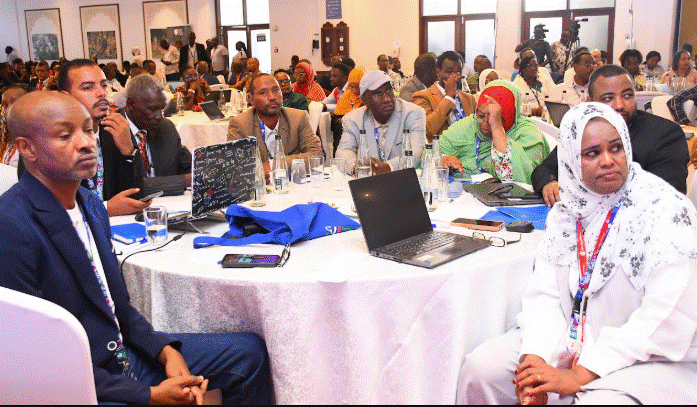
The Government has pledged to make Anticipatory Action, a core function of National and County disaster risk governance, as climate change increases the frequency and severity of extreme weather events across the region.
Speaking in Mombasa during the official opening of the Second Eastern Africa Dialogue Platform on Anticipatory Action, themed “Transforming Risk into Resilience,” Cabinet Secretary (CS) for Interior and National Administration, Kipchumba Murkomen, said the government would fully operationalise the Disaster Risk Management Act, 2026.
He said the law would establish clear mandates, coordination mechanisms and pre-agreed standard operating procedures, supported by transparent progress tracking.
Kenya will also complement domestic resources with risk financing, insurance and support from development partners.
CS Murkomen urged development partners, international financial institutions and the private sector to provide predictable and flexible financing that strengthens national systems rather than creating parallel structures.
“National efforts must also be matched by stronger regional cooperation through IGAD,” he said.
For the region to achieve sustainable results, the CS called for the sharing of risk information, interoperable early warning systems, harmonised triggers, peer learning among member states and predictable, multi-year and flexible support from partners. He said such support should reinforce government-led systems and minimise administrative duplication.
Delegates, from government ministries, UN agencies, development partners and civil society were urged to focus on actionable outcomes that mainstream early action into national legislation, development budgets and regional frameworks.
The CS commended the Intergovernmental Authority on Development (IGAD) for convening the three-day forum, noting that disasters transcend national borders, with droughts, floods and climate-related displacement affecting several countries simultaneously.
“We meet with a clear responsibility: to move from shared ambition to practical government action,” he said, adding that disasters across Eastern Africa and the world were occurring with increasing frequency and intensity.
CS Murkomen observed that climate change was rapidly reshaping the environment, making extreme weather events more frequent, severe and unpredictable.
“As of December 2025, an estimated 48.5 million people across our region required humanitarian assistance. These figures represent immense pressure on public institutions, community security, and the stability of our societies,” he said.
He urged governments to integrate disaster risk reduction into short- and long-term national planning, including the development of resilient public infrastructure and the establishment of sound fiscal frameworks.
“Infrastructure that is built to last protect our economic investments, prevents catastrophic supply chain failures, and safeguards communities before disasters even strike,” Murkomen said.
He added that Kenya was aligning its domestic milestones with international standards as a signatory to the Sendai Framework for Disaster Risk Reduction.
The CS further noted that disasters and conflicts often coexist in a destructive cycle, with climate shocks destroying livelihoods and triggering resource-based conflicts, while instability deepens vulnerability and exacerbates disasters.
“Anticipatory action is therefore not simply a technical intervention, but a vital instrument of public safety, national security, and responsible governance,” he said.
He emphasised that anticipatory action must be integrated into government operations through clear mandates, agreed procedures and accountability mechanisms rather than being left to temporary projects or external partners.
IGAD Executive Secretary, Dr Workneh Gebeyehu, said warnings often arrive before disasters strike, but resources tend to come only after the damage has been done.
“That is the gap we have come here to close. IGAD was born of drought and the conviction that our region must face shared risks together. That conviction remains as relevant today as it was at our founding,” Dr Gebeyehu said.
He noted that the region faced multiple, interconnected and cascading risks, including climate shocks, conflict, economic pressures and public health emergencies, which were placing immense strain on communities and institutions.
Dr Gebeyehu said anticipatory action could be transformative only if it was adequately supported, financed, institutionalised and implemented, noting that forecasts alone could not protect families, communities or countries.
“The difference is made when information leads to a decision, the decision releases resources, and those resources reach communities before the impact. That is when early warning becomes early action. That is when preparedness becomes protection. And that is when anticipatory action begins to deliver its full value,” he said.
He also advocated for the integration of anticipatory action into national policies, disaster risk management frameworks, sectoral plans, local government systems and development planning.
“It must be connected to the institutions responsible for early warning, agriculture, water, livestock, health, social protection and humanitarian response, and it must reach the local level. Communities are the first to face the consequences of climate extremes, paid for in lives, livelihoods, and assets,” he said.
Dr Gebeyehu further stressed that communities should not only benefit from anticipatory action but also play a central role in shaping and leading it.
“Let us finance anticipatory action predictably. This is where our ambition must meet our responsibility. We cannot institutionalise anticipatory action through short-term projects alone. We cannot expect governments and local institutions to act before disasters if the resources are uncertain, fragmented or arrive too late,” he said.
He urged IGAD member states to progressively integrate anticipatory action into national budgets, contingency arrangements and disaster risk financing systems.
by Sadik Hassan



Comments
No comments yet. Be the first to share your thoughts.