
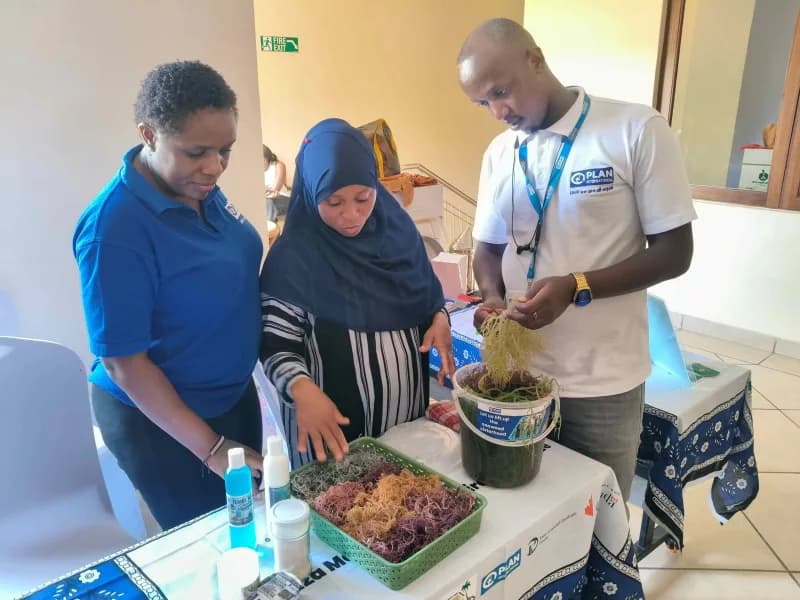
Plan International Kenya country director George Otim and Masoud Kong in Mombasa on Thursday / BRIAN OTIENO

Fatuma Masudi explains how seaweeds are processed to Plan International officers in Mombasa on Thursday / BRIAN OTIENO

Plan International Kenya country director George Otim in Mombasa on Thursday / BRIAN OTIENO

They are making a killing from seaweed farming and beekeeping, which helps them become more independent as they navigate life with the help of organisations that empower them.
Rose Maua, the Ushiri Self Help Group chairperson in Takaungu, Kilifi county, said they have been in the mangrove restoration space for about four years now, thanks to a project by Plan International.
Through the Conservation and Sustainable Management of Coastal Marine Ecosystems (Cosme) project, Maua and her fellow women have been planting mangrove trees in a bid to restore the forests in Takaungu.
“When we put up a nursery, Cosme buys the seedlings and also pays us to plant the mangroves for them. This helps us get some food on the table for our families and help us educate our children,”
Maua said at the Cosme closeout event in Mombasa on Thursday.
A section of the women have also ventured into beekeeping, taking advantage of the mangrove forests.
They acquired 79 beehives from Bee Farmers Hub, a youth-led agribusiness company that initiates sustainable beekeeping projects, free of charge. “We have now started a beekeeping venture and we are grateful it is doing well because the market is already there. As we plant mangroves, we also monitor the beehives. Honey is liquid gold,” Maua said.
She said Cosme has also empowered women in Takaungu and beyond, through gender justice journey (GJJ), which has elevated the women and are now key components of decision-making at the household level.
Gender Justice Journey is a continuous process of dismantling systemic, cultural, and legal barriers to achieve true equity, safety, and self-determination for women, girls, and marginalised genders.
Maua said Takaungu now has relatively more rain because of the trees they planted. “Before that, it was so dry. In Takaungu town today, the air feels so fresh,” she said.
Maua said because of the mangroves, fish stocks have increased and their husbands now catch more fish which means more food and more money for their families.
Fatuma Masudi, a seaweed farmer in Kwale, said they moved from mangroves to seaweed farming in 2019.
She said she saw her neighbours making a kill from the seaweeds and decided to join the bandwagon.
“We did not know that seaweeds can make medicine and can be turned into other products that can be sold,” she noted.
She said from the seaweed, they are now making beauty products like lotions, shower gels, and body wash.
“That same seaweed can be crushed into powder which can be used to make maandazi and chapatis,” she said.
Seaweeds also have beneficial nutrients to the human body.
“If you have diseases or conditions like high blood pressure, diabetes, and low sexual power, seaweed is a good antidote,” Masudi said.
She said Cosme has helped them gain more knowledge about seaweeds and they have also benefited from boats granted to them to venture into the sea for the seaweeds.
“The biggest challenge we have today is access to markets for the seaweeds. We had a good client but it seems the client has had challenges and is not buying the seaweed anymore,” Masudi said.
Plan International Kenya country director George Otim said Cosme was a four-year project that tried to address the challenges women faced in three main ways.
These included restoration of mangroves using gender responsive way of managing the resources, terrestrial forest restoration, and sustainable seaweed farming with value addition and marketing.
Through gender justice journey, Cosme saw women being empowered not only by giving them economic resources but also opportunities to take leadership in the governance of the natural resources and the ecosystem.
“There has been significant improvement in the position and condition of women. The time they spend in terms of unproductive workforce has reduced. There is a bit of collaboration in terms of making decisions, control of resources and governance,” Otim said.
The project saw 165561 acres of land restored, with over 400,000 mangrove seedlings planted, restoring the mangrove forests across the Coast region.
Otim said the innovation in the seaweed farming in terms of value addition, partnership for marketing and the creation of the seed bank, saw some women start business ventures nobody could have thought of.
The restoration of the forest also gave birth to beekeeping ventures for some of the women.
“In general, the project reached about 47,000 people, of whom 70 per cent were women, because that was our target group. There were over 65 groups of women and over 65 schools involved too,” Otim said.
He said the quality of the seaweed being exported from Kenya’s Coast is quite high compared to other countries. He however said there is need to invest in value addition so that the women stop exporting raw seaweed to exporting value added goods.
Global Affairs Canada, which partnered with Plan International on the Cosme project, said the project has demonstrated how climate action, biodiversity conservation, and gender equality can reinforce one another to create lasting change.
“When Global Affairs Canada invested in Cosme, the vision was ambitious: to improve climate-resilient and equitable economies in Kenya’s coastal communities through nature-based solutions, while ensuring women and girls were at the centre of climate adaptation efforts. The results show that this vision is being realised,” Global Affairs Canada said in a statement.


Comments
No comments yet. Be the first to share your thoughts.