
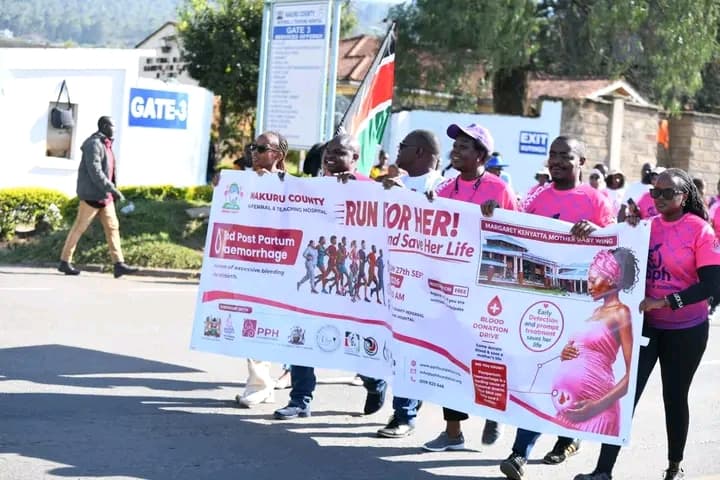
The County Government of Nakuru has initiated a campaign to help in addressing Post-Partum Haemorrhage (PPH), a leading cause of maternal mortality, through emphasis on early detection, treatment and management of the complication.
The drive that also involves nurses, midwives, doctors, clinical officers, survivors of postpartum haemorrhage and members of the public is part of a broader effort to reduce maternal deaths from postpartum haemorrhage (PPH) through healthcare-based and community and interventions.
County Director for Medical Services Dr Kevin Awere noted that maternal mortality rates remain a major challenge in the public health sector, with the Ministry of Health indicating that Kenya records 355 maternal deaths per 100,000 live births.
Dr Awere observed that the campaign is part of the third edition of the end postpartum haemorrhage (End-PPH) Foundation’s Run for Her, held across Kenya, an initiative bringing together communities, health professionals and partners to raise awareness on PPH and mobilize blood donors.
According to the End-PPH Foundation, the 2026 Run for Her is being used to mobilize communities and health professionals on prevention of PPH, while separate activities are being undertaken to strengthen blood collection and security, blood-supply systems and healthcare-facility participation.
The initiative is organised by the University of Nairobi in collaboration with the Kenya Obstetrical and Gynaecological Society and the Midwives Association of Kenya.
The Nakuru edition was inaugurated by Dr Awere, County Chief Nursing Officer Wendy Tirop and Nakuru County Referral and Teaching Hospital (NCRTH) Director Dr Santosh Devaraj.
Dr Awere stated that Postpartum Haemorrhage (PPH) has been cited as the main cause of maternal deaths, accounting for 25 to 45 per cent.
He highlighted the need for a collaborative approach to tackle the issue, saying, they could not allow women to continue dying from preventable conditions like PPH.
“Early detection and timely intervention can save lives, and that is why continuous efresher training programs towards its prevention and management is so critical, “ he elaborated.
According to medical experts PPH usually occurs within 24 hours of childbirth, but it can happen up to 12 weeks after childbirth. When the bleeding is caught early and treated quickly, it leads to more successful outcomes.
They indicate that PPH happens when the total blood loss is greater than 32 fluid ounces after delivery, regardless of whether it’s a vaginal delivery or a Cesarean section, or a C-section; or when bleeding is severe enough to cause symptoms of too much blood loss or a significant change in heart rate or blood pressure.
Dr Awere stated that there are two types of PPH. Primary postpartum haemorrhage occurs within the first 24 hours after delivery. However, secondary or late postpartum haemorrhage occurs 24 hours to 12 weeks postpartum.
The campaign also focuses on enhancing knowledge and skills of midwives particularly those operating in low resource settings in PPH prevention and management. It is also raising awareness about PPH within communities and advocating for policy changes to improve maternal health outcomes.
The Chief Nursing Officer Ms Tirop indicated that health workers need to be well versed with drape – a direct blood measurement technique which uses a BRASS-V clear curtain-looking pouch placed on the bed where mothers give birth for blood collection.
If blood loss passes the 250ml mark it signifies a need for control while between 500ml-1000ml is classified as a danger zone hence postpartum hemorrhage.
Ms Tirop affirmed Nakuru’s dedication to evidence informed health policies adding that they will continue to use research data to inform decisions that lead to improved patient care and outcomes.
In 2023 the Ministry of Health and the World Health Organization recommended using the calibrated drapes to accurately measure blood loss after childbirth.
Ms Tirop disclosed that they were encouraging purchase and distribution of drapes to health facilities that offer childbirth services to ensure that excessive bleeding is detected early and managed to prevent complications that arise from losing blood.
She said that PPH kills women because it is detected late and or even misdiagnosed altogether. He cited information gaps on potential complications that mothers experience as a key challenge in addressing maternal deaths, with a majority of the mothers reporting late.
“Early diagnosis is critical to determine what can be managed at what facility and make necessary referrals in good time to save the mothers,” said the Chief Nursing Officer.
A 2023 World Health Organization (WHO)-backed study that involved over 200,000 women in 80 public hospitals in Kenya, Nigeria, South Africa, and Tanzania showed that after the diagnosis, the healthcare provider offers all the treatments available within 15 minutes, and not one after another, as has been the practice.
Medical experts have underscored the need to wholly change tact in Kenya to manage the deadly PPH complication by first using calibrated drapes and then giving all the treatments as a bundle of massaging the uterus, giving uterotonics (medicines to contract the womb and stop the bleeding), giving the mother intravenous fluid and healthcare providers examining the mother to see whether there is need for referral.
The awareness run culminated in a blood donation drive at NCRTH, highlighting the importance of maintaining adequate blood supplies for women who develop severe bleeding during childbirth.
Dr Santosh noted that the national maternal and perinatal mortality surveillance report has also identified postpartum haemorrhage as the major maternal complication and cause of maternal deaths recorded between 2018 and 2024.
The NCRTH director said prevention and rapid management of obstetric haemorrhage is at the centre of Kenya’s efforts to reduce preventable maternal deaths.
The current campaign Dr Santosh explained, was combining public awareness with a practical intervention through blood donation. It builds on ongoing efforts to strengthen maternal and newborn services.
The official added that the County Government had previously worked with the World Health Organization, University of Nairobi and other partners on interventions targeting PPH, including training health workers and evaluating the use of heat-stable Carbetocin as a first-line medicine for prevention of excessive bleeding after childbirth.
“The interventions are important because PPH can occur even where a woman has no obvious risk factors, making preparedness by health workers and facilities critical,” he added.
The University of Nairobi Department of Obstetrics and Gynaecology describes PPH as excessive blood loss following childbirth and identifies it as a leading cause of maternal mortality globally, particularly affecting women in low- and middle-income countries.
Kenya is simultaneously expanding national investments in maternal and newborn health.
In May 2026, the Ministry of Health launched Every Woman Every Newborn Everywhere (EWENE) Acceleration Plan 2026–2028 to accelerate reductions in preventable maternal and newborn deaths.
The plan includes an additional KSh4 billion allocation through the Social Health Authority to expand maternal healthcare coverage and KSh1 billion for essential maternal and newborn health commodities through the Kenya Medical Supplies Authority.
The government also announced plans to recruit and deploy 5,000 nurses and midwives nationally as part of efforts to strengthen frontline maternal and newborn services.
In August, the Ministry further announced plans to establish 10 specialised 250-bed maternal and newborn health facilities in high-burden counties, including Nakuru.
The facilities are intended to bring specialised services closer to communities and support the Universal Health Coverage agenda.
Health Cabinet Secretary Aden Duale has also identified maternal haemorrhage, healthcare-worker skills and access to appropriate technologies as priority areas in ongoing collaboration between the national government and development partners.
Dr Santosh said the initiative places the county’s maternal health efforts within the wider national drive to reduce preventable deaths.
He underscored the important role of frontline healthcare workers in detecting and managing obstetric emergencies.
Dr Santosh pointed out that the blood donation drive provided another critical link in the response, since severe maternal haemorrhage may require urgent transfusion alongside medicines, clinical intervention and, where necessary, surgery.
The EndPPH Foundation has made blood availability a specific focus of its 2026 activities, including initiatives aimed at strengthening blood collection, security and supply. Dr Santosh explained that as Kenya implements its 2026–2028 maternal and newborn health acceleration plan, sustained investment in skilled personnel, essential medicines, blood availability and functional referral systems will remain central to reducing deaths that can be prevented with timely intervention.
by Jefther Simeon Afuyo and Esther Mwangi



Comments
No comments yet. Be the first to share your thoughts.