
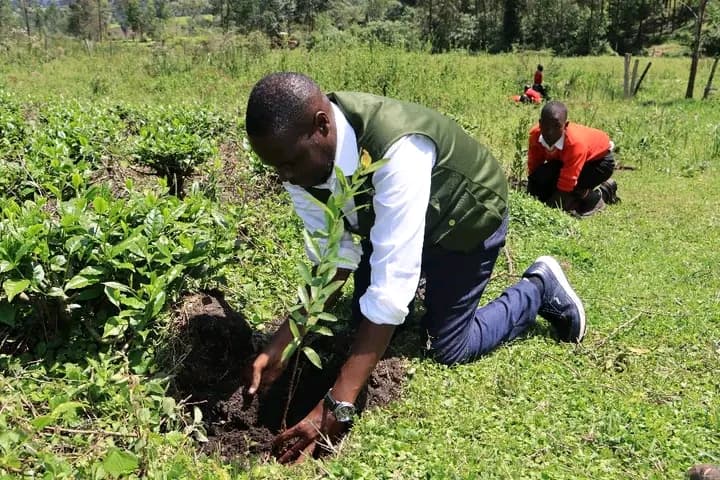
Nandi County has stepped up efforts to conserve and restore its wetlands through strengthened collaboration with national government agencies, community groups and other partners.
This has been prompted by growing concerns over encroachment, farming, tree cutting, sand harvesting and other activities threatening the vital ecosystems.
The County Executive Committee Member for lands, environment and natural resources Hillary Serem said the initiative has brought together the county government, National Environment Management Authority (NEMA), Kenya Forest Service (KFS), Kenya Wildlife Service (KWS) and Women in Water, alongside local communities and other stakeholders, in a coordinated campaign to protect wetlands and promote sustainable use of natural resources.
Among the wetlands receiving attention are King’wal, Kibirong, Matambach, Tinderet, Kapkongony and Mutwot. King’wal and Kibirong have previously been mapped as part of efforts to establish their extent, biodiversity and areas affected by human activities.
Serem said the county was committed to working with national agencies and communities to safeguard wetlands as important sources of water, biodiversity and livelihoods. He said stakeholder engagement would remain central to addressing threats facing the ecosystems while ensuring residents understand the long-term benefits of conservation.
He said King’wal Wetland is particularly significant because it provides habitat for the rare and endangered sitatunga antelope as well as various bird species.
The wetland is linked to the Kimondi-Yala basin and is fed by water systems including the Kesses River and its tributaries. Kibirong Wetland, meanwhile, extends across Kaptumo and Koyo wards and has historically supported water supply, irrigation, papyrus production, research and other community activities.
He warned that uncontrolled human activities have placed considerable pressure on the wetlands.
The County Executive stated that farming, settlement, eucalyptus planting, deforestation, brick making, soil harvesting, sand harvesting and livestock grazing have contributed to degradation in some areas.
“In King’wal, for instance, human encroachment has threatened the habitat of the sitatunga and other wildlife, while poor fencing has exposed parts of the ecosystem to livestock and other disturbances,” he said.
He pointed out that the conservation campaign seeks to move beyond enforcement and embrace community participation, environmental education and alternative livelihoods. Women in Water and other community groups are expected to play a key role in sensitizing residents on the importance of protecting water sources, planting appropriate trees and avoiding activities that destroy wetland vegetation.
The National Environmental Management Authority (NEMA) is expected to support environmental awareness, compliance and enforcement, while Kenya Wildlife Service (KWS)will contribute expertise on wildlife and biodiversity conservation.
The Kenya Forest Service (KFS) will support restoration through tree growing and appropriate forest-management practices, with the county government providing coordination and linking conservation activities to local development priorities.
Serem said previous interventions have demonstrated the potential of partnerships in restoring degraded ecosystems. In Kibirong, the county government and its partners have supported bamboo planting as one of the approaches aimed at restoring the wetland while creating opportunities for communities to benefit from sustainable natural-resource use. More than 1,000 bamboo seedlings were planted during an earlier restoration exercise.
The county has also developed a policy framework for wetland management and conservation, while management plans have been prepared for King’wal and Kibirong.
Recent restoration efforts have seen more than 500 acres of wetlands mapped and restored, with other areas including Matambach, Tinderet, Kapkongony and Mutwot also identified for restoration.
Serem said continued cooperation between government agencies and communities would be critical in reversing wetland degradation and securing water resources for future generations. He emphasised the need for residents living around wetlands to view conservation not as a restriction on their livelihoods but as an investment in water security, agriculture, biodiversity and climate resilience.
The stakeholders are also expected to intensify public awareness through community meetings, environmental education and restoration activities, while encouraging residents to adopt practices that minimize pressure on wetlands.
Such interventions are particularly important as climate variability continues to affect water availability and agricultural production.
For Nandi, conservation of wetlands is increasingly being viewed as part of a broader strategy to protect the county’s environment and strengthen resilience to climate change.
By bringing together government agencies, the county administration, community organisations and residents, the initiative seeks to ensure that the wetlands continue serving as sources of water, habitats for wildlife and important ecological assets for generations to come.
By Sammy Mwibanda


Comments
No comments yet. Be the first to share your thoughts.