
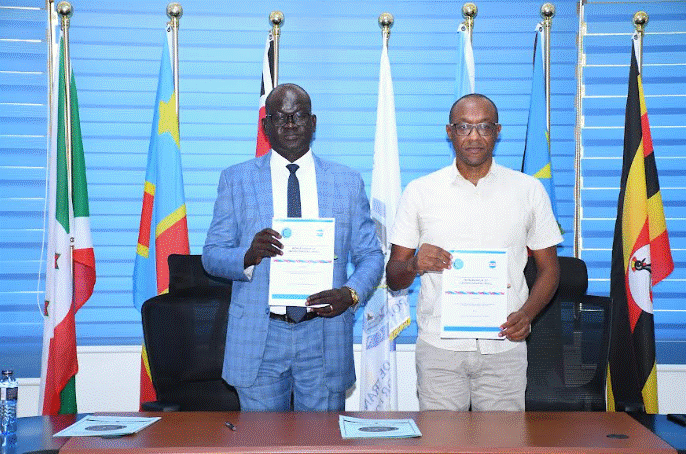
The Northern Corridor Transit and Transport Coordination Authority (NCTTCA) and the Kenya Transporters Association (KTA) have signed a Memorandum of Understanding (MoU) to promote eco-driving and sustainable freight transport in Kenya and along the Northern Corridor.
The partnership will support the implementation of the Northern Corridor Green Freight Strategy 2030, focusing on improving fuel efficiency, reducing greenhouse gas emissions, enhancing road safety and promoting sustainable fleet management.
Under the strategy, NCTTCA is targeting a 10 per cent improvement in freight fuel efficiency, a 10 per cent reduction in carbon dioxide emissions intensity, a 12 per cent reduction in particulate matter, black carbon and nitrogen oxide emissions, and the training of at least 1,000 heavy commercial vehicle drivers in eco-driving by 2030.
Key areas of collaboration include building the capacity of truck drivers and fleet managers in eco-driving practices, promoting fuel-efficient driving to reduce fuel consumption and operational costs, and improving road safety through defensive driving.
The partnership will also encourage transport companies to integrate eco-driving into their daily operations, strengthen data collection and performance monitoring, and promote knowledge sharing.
The initiative is expected to contribute to reduced transport costs, lower emissions, improved road safety and increased adoption of sustainable freight practices.
The MoU underscores the shared commitment of NCTTCA and KTA to developing a greener, safer and more efficient freight transport system along the Northern Corridor.
NCTTCA Executive Secretary (ES) Dr. Eng. John Deng said freight transport is indispensable to regional trade, making it necessary to improve how freight is moved by using less fuel, reducing emissions, enhancing road safety and lowering operating costs.
Dr. Deng noted that these objectives cannot be achieved by government institutions or regional organisations working alone, but require the involvement of transport operators and drivers, who are at the centre of the solution.
“KTA provides an important bridge to the industry. Through this partnership, we can work directly with transport companies to translate regional green freight objectives into practical changes in fleet and driver operations,” stated Dr. Deng.
He added, “The MoU recognizes KTA’s role in mobilizing operators, facilitating industry participation and supporting wider adoption of sustainable freight practices.”
The ES further emphasised that eco-driving is not simply about training a driver for a few days, but about changing the way freight operations are managed.
“We want eco-driving to become part of driver induction and refresher training, fleet management, vehicle maintenance, fuel monitoring, driver performance management and the everyday operating culture of transport companies,” he affirmed.
Dr. Deng explained that the partnership provides for the engagement of transport and fleet managers, the use of telematics and fuel-monitoring systems, the practical application of eco-driving techniques, data collection and monitoring, as well as peer learning among transport operators.
“We want participating companies to be able to demonstrate measurable improvements in fuel efficiency, environmental performance and road safety.”
He further stated that eco-driving encourages smoother acceleration and braking, appropriate speeds, better vehicle inspection and maintenance, fatigue management, defensive driving and responsible use of vehicle technologies, all of which complement road-safety objectives.
“We therefore see fuel efficiency, emissions reduction, road safety and operational efficiency as mutually reinforcing objectives rather than separate agendas,” he said.
KTA Chairman Newton Wang’oo said green freight is not simply an environmental conversation but also a business and operational issue, noting that fuel is one of the highest operating costs for road transporters.
“If we can reduce unnecessary fuel consumption through better driving behaviour, better fleet management, proper vehicle maintenance, improved route planning, and effective use of technology, we achieve several objectives at the same time,” said Wang’oo.
He added, “We reduce operating costs and emissions. We improve road safety. We reduce wear and tear on our equipment. And ultimately, we improve the competitiveness of the transport industry. These are significant targets, but they are achievable if government agencies, corridor institutions and the private sector work together.”
by Sadik Hassan

Comments
No comments yet. Be the first to share your thoughts.