
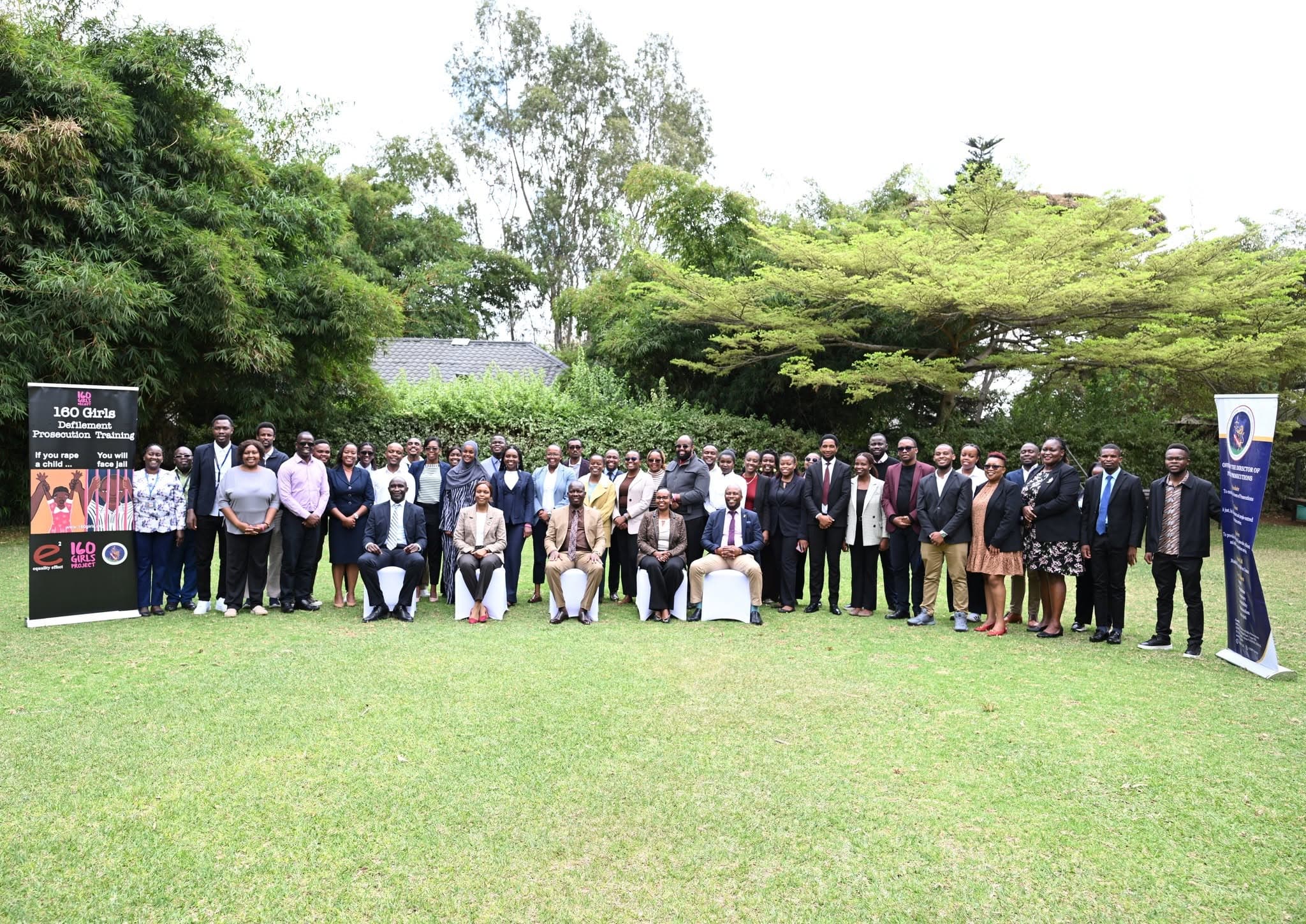
The Office of the Director of Public Prosecutions (ODPP), in partnership with Equality Effect, has completed a nationwide training programme aimed at transforming the prosecution of defilement cases involving children in Kenya.
The 160 Girls Defilement Prosecution Training Programme, which began in April 2026, equipped 569 prosecutors from all 47 counties with specialised skills to handle sexual offences while taking into account the trauma experienced by child survivors.
The programme concluded with the 18th and final cohort, marking a milestone in efforts to strengthen trauma-informed prosecution and improve the quality of justice delivered to children who have suffered sexual violence.
Speaking during the closing ceremony, Director of Public Prosecutions Renson Ingonga said the programme represented more than routine capacity building, describing it as a shift in how prosecutors understand and handle defilement cases.
Ingonga said the 160 Girls Project was established to transform the National Police Service, ODPP and Judiciary into institutions capable of responding to sexual violence in a manner that is trauma-informed and responsive to the rights of survivors.
He said prosecutors needed to understand the effects of trauma on children, particularly why survivors may delay disclosure or provide accounts that appear inconsistent, fragmented or out of sequence.
“The role of a prosecutor in the criminal justice system is not passive,” said Ingonga, noting that decisions made at every stage of a case can shape a child’s experience of the justice process.
The programme draws inspiration from the landmark 160 Girls case, which exposed shortcomings in institutional responses to defilement and affirmed the constitutional rights of child victims. The case subsequently became a catalyst for reforms aimed at making Kenya’s justice institutions more responsive to survivors of sexual violence.
The training sought to help prosecutors understand that children who enter the justice system following sexual abuse may experience fear, confusion, delayed disclosure and difficulties recalling traumatic events.
Such experiences can affect how children interact with police officers, children’s officers, prosecutors and courts, making a trauma-informed approach important when gathering and assessing evidence.
Equality Effect Global Legal Adviser Anne Ireri said the Toronto-based legal charity had worked in Kenya for 14 years and was actively involved in the landmark 160 Girls case.
Ireri said Equality Effect uses legal advocacy to identify gaps in law and policy and develop interventions aimed at turning legal rights into practical realities.
She welcomed the continued partnership with ODPP and other justice sector institutions in expanding access to justice for survivors of sexual violence.
Secretary, Prosecution Services, Alloys Kemo, said the training had received strong feedback from participating prosecutors.
Kemo said 99.7 per cent of prosecutors who completed the programme indicated that they would recommend the training to a colleague.
He said participants also rated the various components of the programme highly and expressed strong confidence that they would apply the strategies and concepts acquired in their daily work.
The programme challenged prosecutors to examine their assumptions, processes and procedures when handling defilement cases, Kemo said, urging them to remain conscious of the children awaiting justice.
He called on prosecutors to remember the courage of the 160 girls whose case became the foundation for the training initiative.
Deputy Director of Public Prosecutions Ebby Maswai said every child who enters the justice system after defilement carries a unique trauma experience.
She said understanding trauma was essential to ensuring that the pursuit of justice remained both effective and compassionate.
The training covered trauma-informed evidence in defilement cases, effective police investigations, stakeholder collaboration, prosecution checklists, action planning and best practices in handling sexual offences.
Unlike conventional classroom-based programmes, the 18 cohorts adopted an interactive and practical approach combining group discussions, plenary sessions, question-and-answer sessions, case studies and experiential learning.
The 12-module programme used realistic defilement scenarios to link legal and technical concepts to situations prosecutors encounter in their daily work.
Participants examined police investigations, evidence analysis, the relationship between trauma and memory in children and the importance of collaboration among justice sector actors in the investigation and prosecution of defilement cases.
The programme also emphasised the importance of examining evidence carefully and applying the law fairly and professionally while recognising the circumstances and needs of child survivors.
The completion of the final cohort signals the end of the current training cycle, but ODPP and Equality Effect said the broader objective was to ensure that lessons from the 160 Girls case continue to influence everyday prosecution practice.
The initiative places the experiences and dignity of child survivors at the centre of efforts to strengthen Kenya’s criminal justice response to sexual violence, while maintaining the obligation of prosecutors and other justice sector actors to apply the law fairly, professionally and consistently.
by Joseph Ng’ang’a

Comments
No comments yet. Be the first to share your thoughts.