
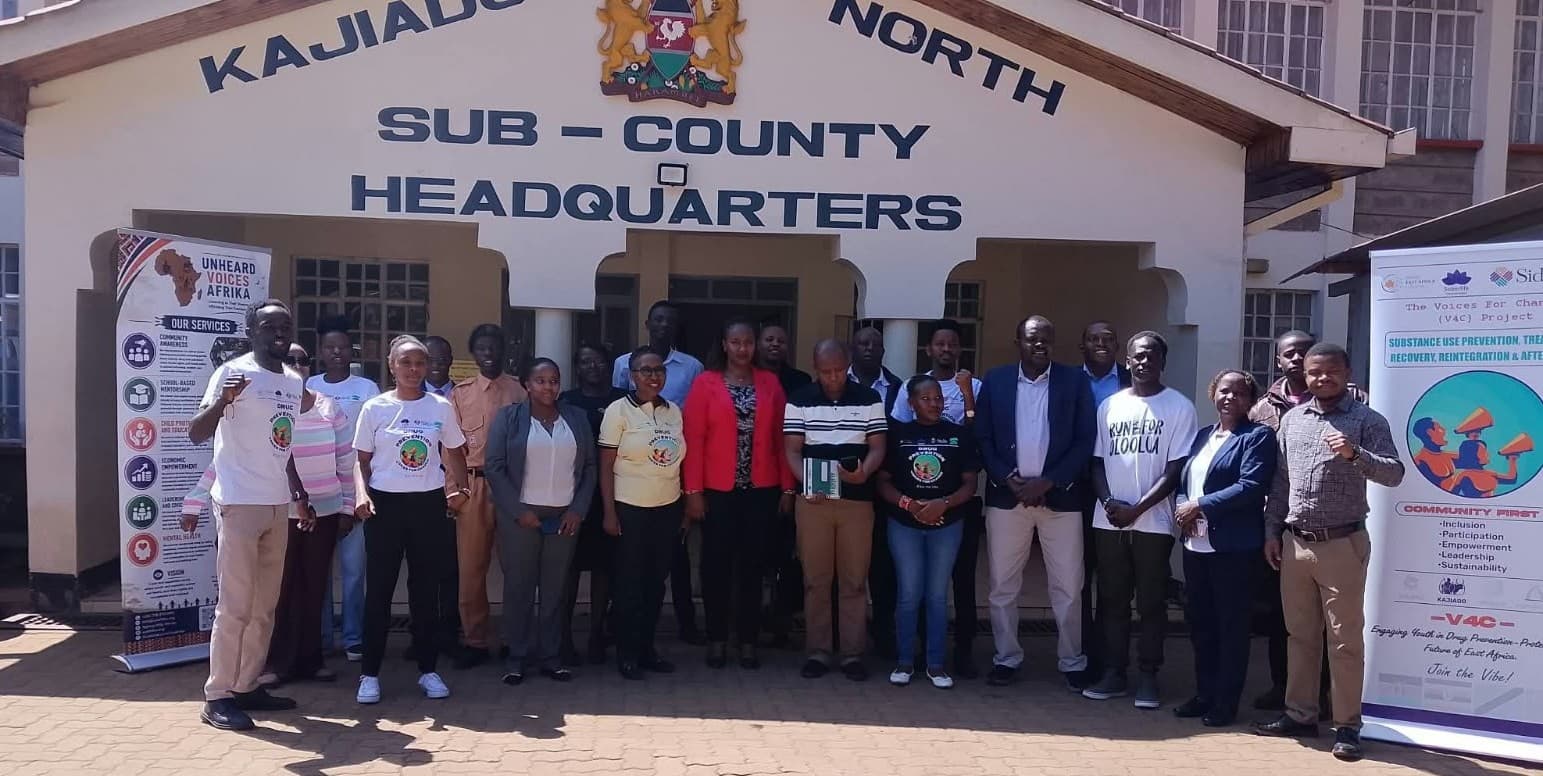
Kajiado North leaders have called for a coordinated, multi-agency approach to tackle drug and substance abuse among young people, citing gaps in enforcement, limited public awareness and socioeconomic challenges driving addiction.
The stakeholders said efforts to combat the problem must go beyond arrests and enforcement to include prevention, treatment, rehabilitation, youth empowerment and the disruption of supply networks.
Speaking during a stakeholders’ forum organised by the ‘Voices for Change project and Unheard Voices Afrika’, Kajiado North Deputy County Commissioner Yusuf Mohamed said repeated interventions had failed to deliver lasting results, calling for a change in strategy.

“We have been doing it over and over again, but the results are still the same. We challenged each other: can we start doing things differently?” he said.
Mohamed said the fight against drug abuse should not be left to the National Authority for the Campaign Against Alcohol and Drug Abuse (NACADA), police, or non-governmental organisations alone, urging communities, religious institutions and government agencies to work together.
He called for greater attention to reducing demand for drugs by strengthening public awareness and empowering young people, noting that traffickers often adapt their products, routes and distribution networks in response to enforcement operations.
Mohamed attributed Kajiado North’s vulnerability partly to its proximity to Nairobi, the informal settlements of Rongai and Ngong, and its large student population.
“We have quite many university students. These are young, vibrant youth who have now gained freedom from their parents. They want to test and feel every new thing,” he said.
He warned that continued drug abuse could have serious long-term consequences for the health and future of young people.
“Health-wise, if we are not careful, we might lose a generation,” he said, calling for faith leaders to be involved in prevention campaigns because of their influence and standing in communities.
Jane Mwangi, Coordinator at Soberlife under the Voices for Change project, said the initiative addresses prevention, treatment, recovery and reintegration, with programmes in Kisumu, Mombasa, Nairobi and Kajiado counties, as well as partnerships in Tanzania, Uganda and the Democratic Republic of Congo.
She identified inadequate information, weak parenting, unemployment, poverty and peer pressure as some of the factors exposing young people to drug abuse.
Mwangi said addiction often interferes with education and productive engagement, urging stakeholders to strengthen school-based awareness programmes and expand employment opportunities for young people.
“Once the youth are hooked on drugs, you find they have very little time to engage in school or meaningful work,” she said.
Kajiado Youth Advisory Board representative, Stephen Partore, said young people should be involved in developing policies and interventions rather than being called upon only to implement decisions made by others.
“Decisions are made, but as the youths, we are not consulted. We are only called when they need our enforcement,” he said. “There is nothing for us without us.”
Partore also raised concerns about licensing and the operation of alcohol outlets near learning institutions, as well as some premises reportedly opening as early as 9am, calling for stronger regulatory oversight.
NACADA Senior Compliance Officer for Kajiado County, Nyambura Kigera, said the authority was using public education and advocacy, compliance and enforcement, and standards and licensing to address drug and substance abuse.
She explained NACADA’s whole-school approach targets learners, teachers and parents, while also extending awareness programmes to communities and workplaces.
“Teachers also spend so much time with our learners. If there are people who can pick up any changes in a learner, an educator is the first one,” Kigera said.
She identified alcohol as the most abused substance in Kajiado County, followed by tobacco, while cannabis use was more pronounced in urban centres and border towns such as Namanga. She also expressed concern about teenagers aged 13 to 15 using drugs in urban areas.
Kigera warned about illicit and counterfeit alcohol, noting that access to treatment remained a challenge because most rehabilitation facilities in the country were privately owned, making services costly for many families.
She urged people seeking help for themselves or their loved ones to contact NACADA’s toll-free helpline, 1192, which offers free counselling around the clock.
The number can also be used to make anonymous reports about suspected illicit production and illegal sale of alcohol and other substances.
by Byron Ouma and Angeline Otieno



Comments
No comments yet. Be the first to share your thoughts.