
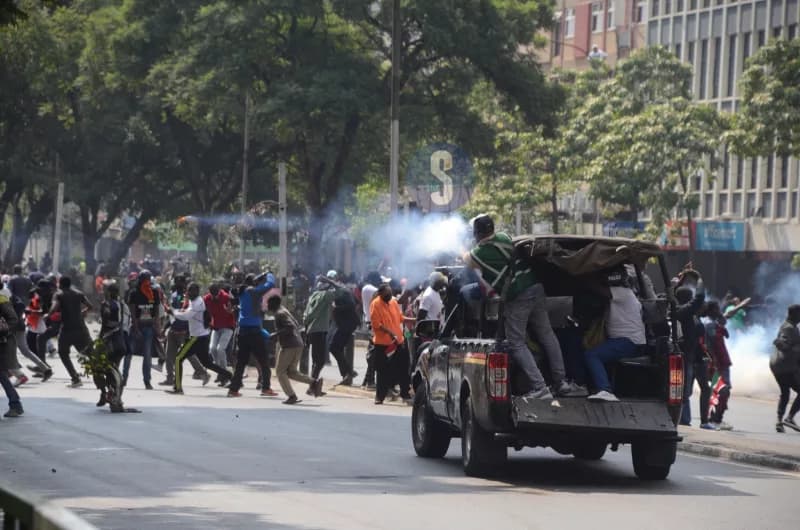
Anti-riot police engage protesters on the streets of Nairobi during June 25 commemorative demonstrations. /DOUGLAS OKIDDY

Police officers and the National Police Service can be held constitutionally accountable for unlawful shootings even when victims cannot identify the individual officers who fired the bullets, the High Court has ruled.
Justice Joe Omido said victims caught up in chaotic police operations cannot reasonably be expected to identify individual officers before seeking redress for injuries inflicted during such encounters.
The judge held that requiring victims to name or identify the officers responsible could effectively shield the police from accountability, particularly where officers conceal their identities during operations.
"An officer cannot, by concealing his or her identity in the course of an operation, thereby insulate himself, herself or the National Police Service from accountability for unlawful conduct," Justice Omido ruled.
He added that where individual identification is difficult or impossible, the responsibility to maintain proper command structures, operational records and undertake effective investigations becomes even more important.
The decision followed a constitutional petition by Lucas Otieno Okuta, who was shot in the pelvic region during post-election demonstrations in Kisumu on October 10, 2017.
Okuta sued the Inspector General of Police, the Cabinet Secretary for Interior and the Attorney General, accusing the State of violating his constitutional rights through the unlawful use of force and subsequent failure to investigate his complaint.
He told the Kisumu High Court that he was walking to work when he encountered running battles between police officers and demonstrators at Kondele roundabout.
After hearing gunshots, he ran into a nearby shop for safety but was struck by a bullet as he entered the premises.
He remained on the ground for several hours before being taken to Jaramogi Oginga Odinga Teaching and Referral Hospital, where surgeons extracted a bullet lodged in his pelvic region.
He was admitted for four days and subsequently experienced persistent pain and difficulty walking. He maintained that the injuries left him partially permanently disabled and unable to resume his work as a mechanic and welder.
Okuta produced in court medical records including a hospital discharge summary dated October 14, 2017, a police medical examination report issued on May 8, 2018, and a forensic medical report prepared by the Independent Medico-Legal Unit on November 9, 2017.
He also told the court that he reported the shooting at Kondele police station under OB No. 35/30/10/2017 but no meaningful investigation or action against the officers responsible followed.
The respondents opposed the petition, arguing that Okuta had failed to provide eyewitness evidence directly linking his injuries to any identifiable police officer.
They further maintained that the case was essentially a personal injury claim dressed up as a constitutional petition to circumvent statutory limitation periods.
The State argued that the petitioner should have instituted an ordinary civil suit or lodged a complaint with the Independent Policing Oversight Authority (Ipoa).
It also contended that the petition, filed in 2022, was time-barred, having been brought approximately five years after the October 2017 incident.
However, the respondents did not file replying affidavits to controvert the petitioner's account.
In rejecting their arguments, Justice Omido said the case raised constitutional questions extending beyond an ordinary claim for damages arising from assault or negligence.
Citing the Court of Appeal decision in Chief Land Registrar & 5 others v Koech & 3 others (2018), the judge observed that there is no statutory time limit for filing constitutional petitions seeking enforcement of fundamental rights, although delays must be assessed on their individual circumstances.
He also distinguished the decision in Kainga v Mukhone & 2 others (2024), which the respondents had relied on to argue that claims arising from unlawful shootings should be treated as ordinary tortious claims.
On exhaustion of alternative remedies, the judge held that Ipoa's investigative mandate could not replace the High Court's constitutional jurisdiction to declare rights violations and award compensation.
"The fact that Ipoa may investigate the conduct of a police officer does not mean that it can determine the constitutional consequences of that conduct or grant the full range of remedies available under Article 23(3)," he said.
Turning to the shooting itself, Justice Omido found that the petitioner's account was corroborated by his father, who found him bleeding and in severe pain at the hospital, as well as medical records documenting the gunshot injury.
Although Okuta could not identify the officer who fired the bullet, the judge said the surrounding circumstances, including the police operation and the absence of evidence suggesting another source of the bullet, established on a balance of probabilities that he had been shot by a police officer.
The court also found no evidence that Okuta was armed, participating in violence or posed an imminent threat that could justify the use of live ammunition.
Justice Omido reiterated that lethal force should only be used when strictly necessary to protect life or prevent serious injury from an imminent threat.
He consequently found violations of Okuta's rights to human dignity under Article 28 and freedom and security of the person under Article 29(c) of the Constitution.
However, he declined to make a separate finding of torture under Article 25(a), noting that unlawful shooting and injury do not automatically satisfy the legal threshold for torture.
In his judgment that could have significant implications for accountability over police brutality, the judge awarded Okuta Sh3.5 million in general damages against the national government, together with interest and costs.
He declined to award a further Sh15,669 in medical expenses because Okuta had produced an invoice but no receipt proving payment.
The judge also declined to compel the Inspector General to initiate investigations, noting that the court should not dictate how independent investigative agencies exercise their mandates.
Instead, he directed that a certified copy of the judgment delivered virtually on October 26, 2026, be served on Ipoa within seven days for consideration and any lawful action deemed appropriate.
The judge emphasised that the court had not determined the criminal or disciplinary culpability of any particular officer, which remains the responsibility of the relevant investigative and prosecutorial agencies.


Comments
No comments yet. Be the first to share your thoughts.