
Shakahola guards blocked escapees as fasting regime claimed 191 lives, court finds

The court found that Mackenzie prescribed the order in which followers were to die, beginning with children, followed by young people, women and men. He and his family were to fast last.
Guards at Shakahola Forest helped enforce a deadly fasting regime by preventing followers from escaping, assaulting those who resisted and obstructing rescue attempts, the High Court has found in the trial over the deaths of 191 people linked to preacher Paul Nthenge Mackenzie.
In its judgment delivered on October 19, 2026, the court found that the fasting regime operated through an organised structure in which leaders, village administrators, security personnel and other followers performed different but interconnected roles.
The security personnel helped maintain control over the settlement, guarded exit routes and apprehended followers who attempted to leave.
Evidence presented during the trial also linked members of the group to assaults on survivors, interference with rescue efforts, the transportation of bodies and the digging and concealment of graves.
The court heard that some people who tried to escape were caught and returned, while efforts to rescue those inside the settlement were obstructed. Motorcycles used by rescuers were also burned, according to the evidence before the court.
These activities formed part of a wider system that the court found supported Mackenzie's instructions for followers to fast to death in the belief that they would meet Jesus.
Latest Stories
- Second shipment of heavy machinery arrives in Lamu for Sh2.2 trillion Dangote refinery
- Oil prices hold above Sh14,161 as fresh Russia-Ukraine attacks deepen supply fears
- World Bank warns of jobs crisis as 1.2 billion young people enter working age
- Watch: Mashujaa Day celebrations at Kipchoge Keino Stadium in Eldoret
The court found that Mackenzie prescribed the order in which followers were to die, beginning with children, followed by young people, women and men. He and his family were to fast last.
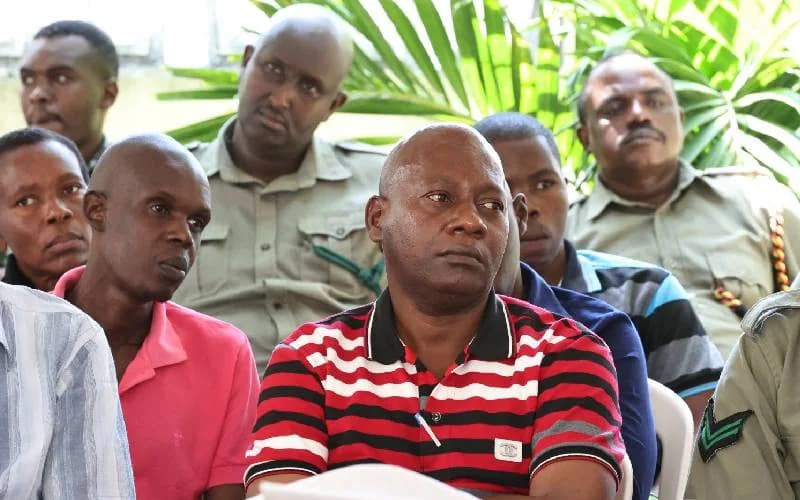
Shakahola massacre suspects, among them cult leader Paul Mackenzie, appear before the Mombasa High Court on October 19, 2026. (Photo: Courtesy)Those who resisted the instructions were to be forced to comply through “kwa mangumi na mateke”, meaning kicks and blows.
Evidence from child survivors showed that children who tried to eat, drink or escape were beaten, tied up or confined. They also described siblings dying one after another while food and water were withheld despite supplies being available.
The court found that the system depended on different people carrying out specific functions, including leadership, village administration, security, enforcement of fasting, provision of food, digging graves, transporting bodies and concealing deaths.
The settlement occupied approximately 4,860 acres within Chakama Ranch in Kilifi County and was divided into villages bearing biblical names, including Galilaya, Judea, Bethlehem, Sidoni, Samaria and Sikari.
The court heard that followers had relocated there after being taught to reject formal education, medical treatment and government institutions and to separate themselves from the outside world.
The investigation began after a report was made at Lango Baya Police Station on March 17, 2023, concerning the starvation of two children. A multi-agency operation followed, and 429 bodies were recovered during four phases of exhumation between April and July 2023.
Of those recovered, 191 deaths formed the subject of the murder charges, involving 190 children and one adult.
Post-mortem evidence established starvation as the cause of death in 72 cases. Other deaths were attributed to asphyxia, manual neck compression and traumatic head injury. In 110 cases, severe decomposition prevented the pathologist from determining the cause of death.
The court nevertheless found that the fasting regime, eyewitness testimony, the circumstances surrounding the deaths and the condition of the graves supported the inference that the victims whose causes of death could not be medically established had also died from starvation.
 Search team members are pictured next to bodies found in the Shakahola Forest in Kilifi County on June 3, 2024. (Photo: Farhiya Hussein/EV)
It also found that children had not given free, informed and legally meaningful consent to the fatal fasting regime.
The court held that parents had a legal duty to protect their children's lives, health and welfare and could not rely on religious beliefs to justify subjecting them to death.
The court convicted 29 accused persons of all 191 murder counts. One of them had pleaded guilty to all the counts and was convicted on his own plea.
Proceedings against two other accused persons were terminated following their deaths.
The court emphasised that the existence of an organised system did not automatically establish the guilt of every person associated with it.
Criminal responsibility had to be proved individually through evidence linking each accused to the common purpose and the deaths.
Director of Public Prosecutions Renson Ingonga has welcomed the conviction of preacher Paul Nthenge Mackenzie and 28 co-accused on 191 counts of murder involving 190 children and one other victim in the Shakahola massacre. Ingonga described the judgment delivered by Lady Justice Diana Kavedza at the Mombasa High Court as a significant step towards justice for victims and their families.
He commended the prosecution team, the Judiciary, DCI investigators, the media and members of the public for their roles in advancing accountability.
The DPP reaffirmed his office’s commitment to evidence-based prosecutions, professionalism and ensuring that those responsible for serious crimes are held accountable under the law.



Comments
No comments yet. Be the first to share your thoughts.