
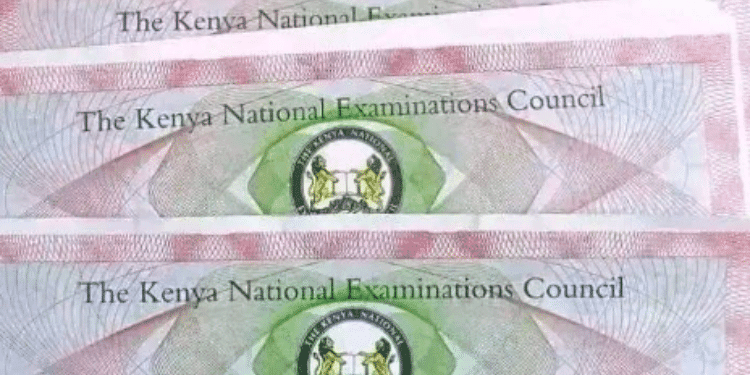
Candidates sitting for the 2026 Kenya Certificate of Secondary Education (KCSE) examinations may face penalties for examination malpractice.
The penalties may include cancellation of subject results and criminal prosecution, depending on the nature and severity of the offense, under guidelines issued by the Kenya National Examinations Council (KNEC) and Kenyan laws.
According to KNEC, examination irregularities under the law carry substantial fines, imprisonment, or both under the Kenya National Examinations Council Act, No. 29 of 2012.
Candidate Risks Losing an Entire Subject
KNEC lists cancellation of results for an entire subject following an examination irregularity as a penalty for candidates in 2026.
A candidate found to have cheated in one examination paper risks losing the results for the whole subject rather than only the paper in which the malpractice occurred.
The council states that such a candidate will not be entitled to a result for the affected subject and will be awarded an overall “Y” result.
Under Section 4.1.2 of the 2026 examination guidelines, the council may cancel results for an entire examination center if evidence shows widespread irregularities.
“Where the Council is satisfied that there has been an irregularity in the course of any examination,the Council shall suspend or nullify such examination or any part thereof,” the Act outlines.
In addition, Section 32 of the KNEC Act provides that candidates who copy from another candidate’s script, communicate to seek or provide unauthorized assistance, possess unauthorized textbooks or electronic devices in the examination room, or receive external assistance without lawful authority may be disqualified from the entire examination.
Any paper already taken may be canceled, and the candidate may be barred from taking another examination for up to three years.
KNEC ON KCSE Examination Paper Leakages
Beyond canceling results, the law imposes criminal penalties for specified examination-relatedoffensess.
Section 27 of the Kenya National Examinations Council Act addresses unauthorized possession of examination papers, materials or information.
Under the provision, a person who, before or during an examination, possesses or controls examination material or information purporting to relate to the contents of an examination without lawful excuse commits an offense.
Upon conviction, the offender is liable to imprisonment for a term not exceeding 10 years, a fine not exceeding Sh2 million, or both.
Individuals who negligently or wilfully assist candidates in obtaining unauthorized examination material may also attract a 10-year jail term and a fine of up to Sh2 million or both.
Section 28 of the Act further criminalizes examination malpractice, including unlawfully disclosing examination papers, altering candidates’ original answer scripts, fraudulently replacing scripts, changing candidates’ marks or results, and altering examination identification details.
A person convicted of an offense under section 28 faces imprisonment for up to five years, a fine of up to Sh1 million, or both.
Damaging Examination and Impersonation
The 2026 KCSE guidelines, Section 30 of the KNEC Act, further outline penalties for willfully and maliciously damaging examination materials.
A person found guilty of the offense faces imprisonment for up to five years, a fine of up to Sh5 million, or both.
On the other hand, under Section 31 of the KNEC Act, a person who is not registered to sit a particular examination but presents, or attempts to present, themselves as an enrolled candidate with the intention of impersonation commits an offense.
The Council notes that the offense carries imprisonment for a term not exceeding two years, a fine not exceeding Sh2 million, or both.
In addition, a person convicted of the offense is prohibited from taking any examination conducted by, or on behalf of, KNEC for three years.
The law also penalizes registered candidates who knowingly allow another person to sit an examination on their behalf.
KNEC states that such candidates could face imprisonment for up to two years, a fine not exceeding Sh2 million, or both, and may also be barred from taking examinations for up to three years.
Disturbances at Examination Centers
KNEC Act further addresses offenses involving disturbances at or near examination venues.
A person who possesses or uses an offensive weapon or other material, or acts disorderly to disrupt an examination, intimidate or harm candidates, or obstruct examination officials, commits an offense under Section 33 of the Act.
Upon conviction, the person faces imprisonment for up to three years, a fine of up to Sh500,000, or both.
If the offender is a candidate, KNEC must also cancel the candidate’s entire examination results and may prohibit the candidate from taking another examination for up to three years immediately after the offense.
Penalties for Forged Certificates
The consequences of examination-related malpractice may also extend beyond the KCSE examination room.
Under Section 34 of the KNEC Act, a person who presents a forged certificate, diploma, results slip or statement of results, or uses another person’s academic documents as their own to obtain employment or admission to an educational institution may face penalties.
According to KNEC, the person may face imprisonment for up to two years, a fine of up to Sh1 million, or both.
“A person who presents a forged certificate or diploma, result slips or statement of result to a prospective employer or to an institution of learning with intent to gain employment or admission is an offense and is liable, upon conviction, to imprisonment for a term not exceeding two years, or a fine not exceeding one million shillings, or to both,” KNEC directs.
A person who counterfeits a KNEC certificate or diploma for commercial purposes faces imprisonment for up to 10 years, a fine of up to Sh10 million, or both.
Follow our and X Account for real-time news updates.



Comments
No comments yet. Be the first to share your thoughts.