
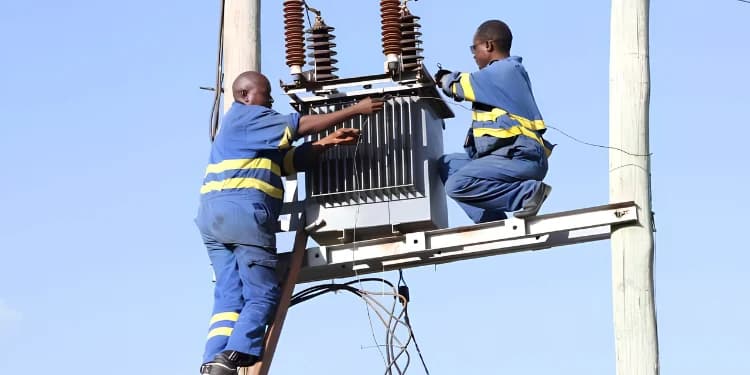
Kenya Power continues to lose more than one in every five units of electricity supplied to the national grid, highlighting the scale of inefficiencies and illegal connections even as the country’s appetite for power reaches record levels.
The latest Energy and Petroleum Statistics Report shows Kenya Power’s system losses stood at 21.38 percent, well above the Energy and Petroleum Regulatory Authority (EPRA) target of 16.5 percent.
The findings mean that a substantial portion of electricity generated and imported into the country never reaches paying consumers, raising concerns about revenue losses, network inefficiencies, and the cost burden ultimately borne by customers.
Peak electricity demand reached an all-time high of 2,514.28MW on June 29, 2026, up from the previous record of 2,316.22MW.
Electricity sales increased by 5.3 percent to 12,350.57GWh from 11,728.53GWh recorded in the previous year.
The number of electricity customers rose by 411,710 to reach 10,432,707 connections across the country.
Kenya Power Losses Persist as Demand Hits Record High
Total electricity generation increased by 8.44 percent to 15,692.81GWh from 14,472.00GWh recorded during the previous period.
The increase of 1,220.82GWh represented the highest annual growth in electricity generation recorded over the last five years.
Geothermal remained Kenya’s leading source of electricity generation after producing 6,420.51GWh.
The source accounted for 40.91 percent of total electricity supplied into the national grid.
Hydropower generated 3,554.31 GWh and contributed 22.65 percent of total supply.
Wind power accounted for 1,931.72 GWh, or 12.31 percent of electricity supplied.
Interconnected thermal plants generated 1,309.42 GWh and accounted for 8.34 percent of total supply.
Electricity imports increased by 25.9 percent to 1,913.66GWh from 1,533.85GWh recorded a year earlier.
Imported electricity accounted for 12.19 percent of energy supplied into the national grid.
Ethiopia remained Kenya’s biggest source of imported power, supplying 1,577.66GWh.
Uganda supplied 322.06 GWh, while Tanzania supplied 6.53 GWh.
Electricity from Ethiopia accounted for 82.45 percent of all imported electricity.
Industry, Homes Drive Consumption
Large commercial and industrial consumers remained the country’s biggest electricity users after consuming 5,920.06GWh.
The category accounted for 47.57 percent of all electricity sales during the period.
Domestic consumers used 4,327.07 GWh, representing 34.77 percent of electricity sold.
Small commercial consumers accounted for 2,012.17GWh.
Electric mobility consumption grew the fastest, increasing by 143.01 percent to 12.25GWh.
Nairobi remained the country’s largest electricity market after consuming 5,465.36GWh.
The capital accounted for 43.92 percent of all electricity consumed nationally.
The Coast region consumed 2,087.62GWh while North Eastern recorded consumption of 1,411.66GWh.
The report also shows that energy curtailment declined by 39.59 percent, from 668.70 GWh to 403.94 GWh, compared with the previous year.
Petroleum Demand Climbs as Fuel Imports Hit Record
Kenya’s domestic demand for petroleum products increased by 8.41 percent to 6,330,507.92 cubic meters during the year under review, according to the Energy & Petroleum Statistics Report 2026.
Petroleum imports increased by 11.52 percent to 10,880,926.86 cubic meters, the highest year-on-year growth recorded over the five years under review.
A total of 7,880,619.18 cubic meters was imported through the Government-to-Government importation framework, while 3,000,307.68 cubic meters was imported through Uganda’s importation framework.
Imports under the Government-to-Government framework accounted for 72.42 percent of total import volumes.
Of these, 5,546,379.78 cubic meters, representing 70.38 percent, was destined for the domestic market.
Petroleum imports from the Middle East accounted for 74.8 percent of supplies received through the Government-to-Government arrangement.
India supplied 14.43 percent while Europe accounted for 10.8 percent.
The report attributes the increase in domestic demand to growth in the transport and construction sectors.
Transportation and storage grew by about 5.4 percent while construction expanded by 5.7 percent.
Follow our WhatsApp Channel and X Account for real-time news updates.



Comments
No comments yet. Be the first to share your thoughts.