
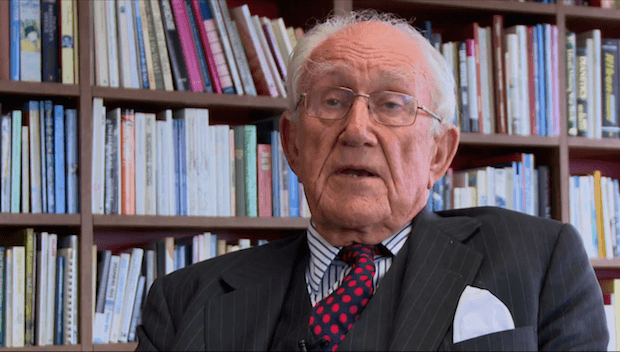
John Malcolm Fraser, known throughout his life as Malcolm Fraser, was an Australian politician and grazier who served as the 22nd Prime Minister of Australia from 11 November 1975 to 11 March 1983.
Born on 21 May 1930 in Toorak, Melbourne, Victoria, he was the younger of two children of John Neville Fraser, a pastoralist of Scottish descent who had trained as a lawyer, and Una Arnold Woolf, whose family background included Jewish ancestry.
Raised largely on family sheep stations, first at Balpool-Nyang in the Riverina district of New South Wales and later at Nareen near Hamilton in western Victoria, Fraser was educated at Tudor House in New South Wales and Melbourne Grammar School before studying philosophy, politics and economics at Magdalen College, Oxford.
He returned to Australia to work as a grazier and entered federal politics at a young age.
He died in Melbourne on 20 March 2015.
Table of Contents
ToggleSiblings
Malcolm had one sibling, an older sister named Lorraine, born in 1928.
The two children of Neville and Una Fraser grew up in a privileged pastoral environment shaped by their father’s properties and the family’s long-standing connections to Victorian public life through their paternal grandfather, Sir Simon Fraser, a colonial politician and Federation-era senator.
Details of Lorraine’s later life remain largely private, and she did not play a prominent public role alongside her brother’s political career.
Career
After completing his studies at Oxford and returning to the family property at Nareen, Fraser joined the Liberal Party and first contested the rural Victorian seat of Wannon unsuccessfully in 1954.
He won the seat at the 1955 election at the age of 25, becoming one of the youngest members of the federal parliament, and held it continuously until his retirement in 1983.
He spent a decade on the backbench before entering the ministry under Harold Holt as Minister for the Army in 1966, a period that coincided with Australia’s deepening involvement in the Vietnam War.
Subsequent portfolios included Education and Science and Defence under John Gorton and William McMahon.
After the Coalition’s defeat in 1972 he remained a senior figure in opposition and, in March 1975, replaced Billy Snedden as Liberal leader.
Later that year the Senate, controlled by the Coalition, blocked the Whitlam government’s supply bills.
On 11 November 1975 Governor-General Sir John Kerr dismissed Whitlam and commissioned Fraser as caretaker prime minister.
Fraser led the Coalition to a landslide victory in the subsequent election and won further elections in 1977 and 1980.
His governments pursued tighter economic management while expanding immigration from Asia, including the resettlement of large numbers of Vietnamese refugees, advancing multiculturalism, opposing apartheid in South Africa, and supporting environmental and human-rights initiatives.
The Coalition was defeated by Bob Hawke’s Labor Party in March 1983.
Fraser resigned the party leadership and left parliament shortly afterwards.
In later years he became an outspoken advocate on human rights, refugees and foreign policy, often critical of subsequent Liberal positions, and eventually resigned from the Liberal Party in 2009.
Accolades
Fraser was appointed a Privy Councillor in 1976 and a Companion of Honour (CH) in 1977. In 1988 he was made a Companion of the Order of Australia (AC).
He received the Australian Human Rights Medal in 2000 in recognition of his domestic and international work on human rights.
Additional honours included the B’nai B’rith International President’s Gold Medal for Humanitarian Services, the Grand Cordon of the Order of the Rising Sun from Japan, and the Grand Companion of the Order of Logohu from Papua New Guinea, among others.
He held senior roles with CARE Australia and CARE International, served on United Nations and Commonwealth bodies concerned with southern Africa, and received several honorary doctorates.

Comments
No comments yet. Be the first to share your thoughts.