
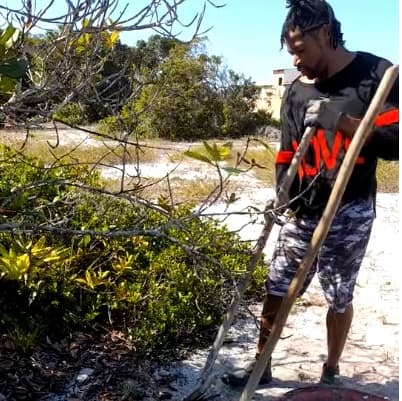
By Antynet Ford and MaryAnne Musilo
Globe-trotting couple, Kimroy and Shekira, are growing grape vines over bus shelters in coastal Brazil after turning sandy sidewalks in Prado Bahia state into vibrant fruit and vegetable gardens in a model they are now working to spread across Africa too.
The heart of their breakthrough lies in nursing scrubby patches of sandy land, owned and cared for by no-one, into new and public food engines.
When we arrived …it was sand everywhere,” said Kimroy Bailey, but the couple were determined to grow food.
They cleared patches and planted seeds, most of which failed in the scorching sand. “Those that germinated would die shortly after they germinated. Lettuces and cabbages germinated, but they died from the high heat from the sand,” said Kimroy.
Yet weeds were growing, and Sherika Trott Bailey was certain that if weeds could grow, farming had to be possible.
So they tried a new approach, working with the natural weeds on the sands, and slowly introducing ground cover plants like pumpkins, with leaves that protected the sand from the sunlight, as well as mulches.
The sum, said Sherika, writing to FarmBizAfrica from Brazil, was adaptation through low-cost testing of what was around them.
“We planted, failed, harvested, photographed, changed our assumptions, and kept separate what we observed ourselves from what local growers told us and what published research explains,” said Sherika Trott Bailey.
“We wanted to use how the other wild herbs were growing and use that to plant food,” said Kimroy.
In a one-year field record from two sand plots at the coast, they found a raft of seeds that never worked well, including strawberries, sweet peppers, chilli peppers and cucumber.
But “we learnt the lessons,” said Kimroy, and patiently grew pumpkin, which then spread, providing thicker ground cover.
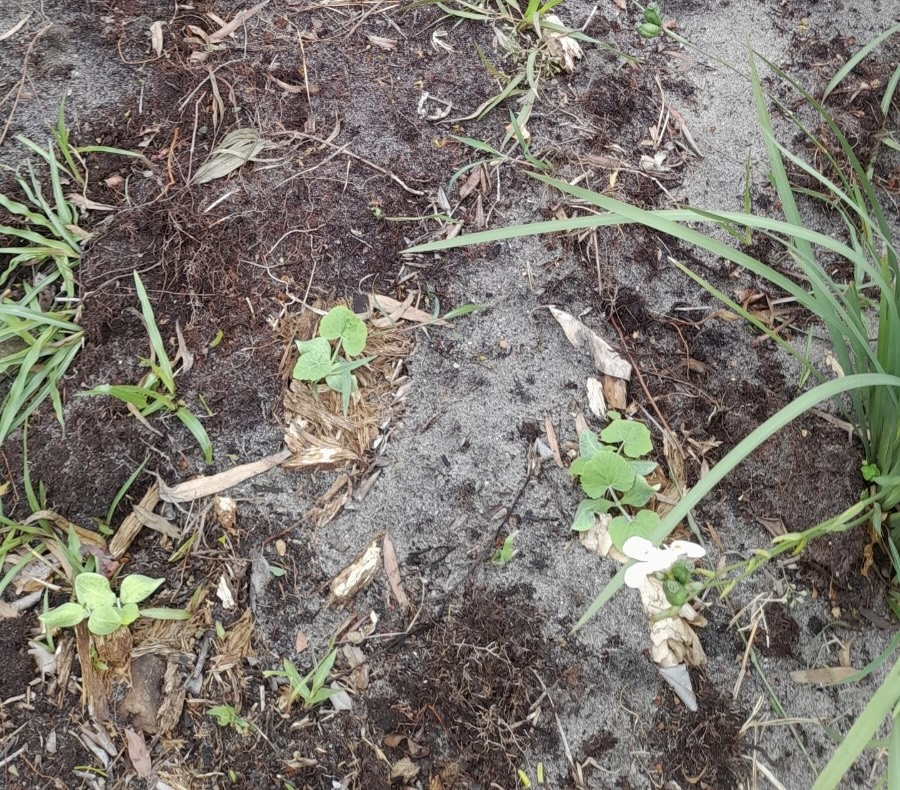
“All the crops that did well are pumpkins, squash, zucchini, papaya, coconut, which is native to the area, sugarcane, banana, where we have three types of banana known locally as banana Jiteha which is Plantain, banana husha and prata. Those did very well too. Those didn’t need seeds, but seedlings.”
“We went on experimenting with papaya, where we break branches of an existing papaya tree and stick it into the soil and shield it and it adapts exceptionally well.”
“So we do combination planting, where we use the pumpkin as the ground cover for the sand because it is really hot. We also use dry grass for mulching and banana roots too in covering the soil,” said Kimroy.
“We also have to plant trees that have beautiful flowers to attract pollinators like butterflies and birds plus bees. The diversity of the pollinators is very important and we have also learnt a lesson about resting the land which we learnt in Jamaica, where I am from originally,” he said.
“We started our world journey from Jamaica, after we left we went to America then Turkey, where we learnt a lot of farming as they do it a lot. and we moved to South Korea, before now moving to Brazil,” he said.
“In Turkey we understood that resting the land, which is our theory that we applied here, resting the land does not mean abandoning the land. The land is best rested when it has crops that come in different seasons and different varieties too, not just food alone. And that cycle, where we have organic compost biomass, is how the land rests.”
“What happens is that every crop comes with seasons and they are simultaneous in their coming in a three months or so season. So it is good to have mangoes that come in March and apples in August, so that when one is hibernating and has falling leaves, the other one is using the soil.”
To water the crops, they have a water irrigation system running irrigation pipes to the roots of the trees, which is the traditional method of irrigation.
“We found that the sand is so dry and to rehabilitate it with life, we use open streams. So we dug a well which is about nine metres deep. We then installed our water pump and then we use clay and wood to make a stream in the orchard. So we move the water out of the well into the orchard that way,” he said.
It’s an approach that has now turned scrubby sidewalks into food banks, and is also now adding shade and shelter in the heat.
“The project has changed how people see unusual road side walks and spaces, because we are also doing grape vines which are excellent for bus stops. Because a bus stops may have a lot of space that needs a shade and now some can stand in there and wait for a vehicle. So vines, passion fruits, watermelon and grapes are good for a bus stop,” he said.
To decorate and make a shade for the bus stop, Kimroy said they only needed four sticks to let the vines run up and gave it six months and it turned out to be very beautiful.
“These are things that we want governments to think of. This is something that we call double spending. You spend for a loan to renovate a bus stop or a side walk, the people are still repaying that loan and then they have again to do normal-day life, like not being able to access food from that loan.”
“We think that if we are going to rehabilitate our road networks or make sidewalks, plant some food and let the government use the money available to (instead) manage schools, hospitals and parks.”
They have left the new food walks unfenced too.
“We realize that even animals are participating in the project because when we transplant large papaya plants, a horse did come and it ate like four leaves of the papaya and it left the rest. It did not eat the budding leaves. It just ate the older ones that were dying away and this was, literally, pruning. A local said, you see, I told you it was going to eat it, and I told him no, a horse is a one-and -a-half tonne animal. I don’t think four papaya leaves can fill its belly. If it wanted to kill the whole plant, it could have eaten all the plant.”
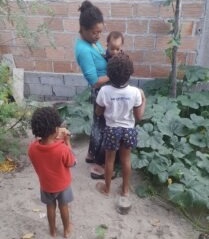
They are also now getting interest from Nigeria and Côte d’Ivoire in applying the same model.
“It’s already so fulfilling as we are sharing it with other states in Brazil, who are adopting it, and other countries across Africa as well, Nigeria and Cote d’Ivoire, who want to apply it and see how farming can be free and sustainable to the locals, if they can do it and sell the fruits and vegetables and make a living out of it,” he said.
“For anyone who thinks the land they are in cannot produce anything, I will tell them never to underestimate the seedlings or any type of soil as these are God made resources and he doesn’t make mistakes. Use the resources you have to make it work. Start a little and watch it. Don’t do it with your expertise, but be humble and patient and be willing to learn. You’ll be surprised how the land will reward you,” said Kimroy.


Comments
No comments yet. Be the first to share your thoughts.