
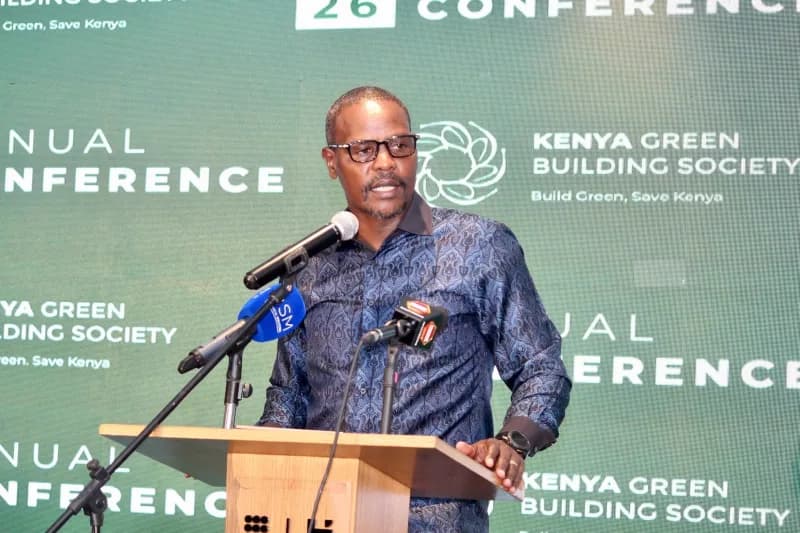
Principal Secretary for Environment and Climate Change Dr Festus K. Ng’eno/HANDOUT

Environment and Climate Change Principal Secretary for Dr Festus K. Ng’eno has been recognised for his efforts in restoring Mau Forest.
Ng’eno achieved the fete through the Mau Forest Complex Integrated Conservation and Livelihoods Improvement Programme (MFC-ICLIP).
The PS, who serves as patron of the programme, was commended for championing a community-centred conservation model that combines ecological restoration with economic empowerment while mobilising funding from partners rather than relying on public resources.
The initiative seeks to address forest degradation, loss of tree cover and encroachment in the Mau Forest Complex, a critical water catchment supporting 12 major rivers, including the Mara, Sondu, Njoro, Ewaso Ng’iro South and Nyando.
The programme’s first edition recorded the restoration of 2,500 hectares of degraded forest through the growing of 2.5 million tree seedlings, contributing to the government’s presidential directive to grow 15 billion trees.
It also reached more than 10,000 local farmers and their families through community livelihood improvement interventions designed to ensure that conservation efforts translate into economic benefits for households living around the forest.
In addition, more than 400 schools participated in environmental education and stewardship activities, helping to establish a network of more than 360,000 student and educator ambassadors.
“Environmental conservation and community prosperity are inextricably linked, and sustainable forest restoration can only succeed when communities are actively involved in protecting natural resources while benefiting from the opportunities they create,” the programme’s commendation noted.
The initiative has integrated local communities into conservation governance and decision-making, with the aim of strengthening ownership and ensuring that forest protection efforts are sustained beyond conventional enforcement measures.
Ng’eno has also been recognised for mobilising support from private sector organisations, development institutions and civil society partners to finance large-scale ecological rehabilitation.
The approach is intended to reduce pressure on public resources while expanding investment in forest restoration and community development.
The Mau Forest Complex is a major ecological asset whose protection is critical to water security, biodiversity conservation and the livelihoods of communities that depend on its resources.
Through forest rehabilitation, the programme also contributes to expanding carbon sinks, protecting wildlife habitats and safeguarding water catchments against environmental degradation.
The achievements under the first edition of MFC-ICLIP provide a model for linking environmental protection with rural development, with the programme seeking to demonstrate that conservation can deliver measurable ecological and socioeconomic benefits.


Comments
No comments yet. Be the first to share your thoughts.