
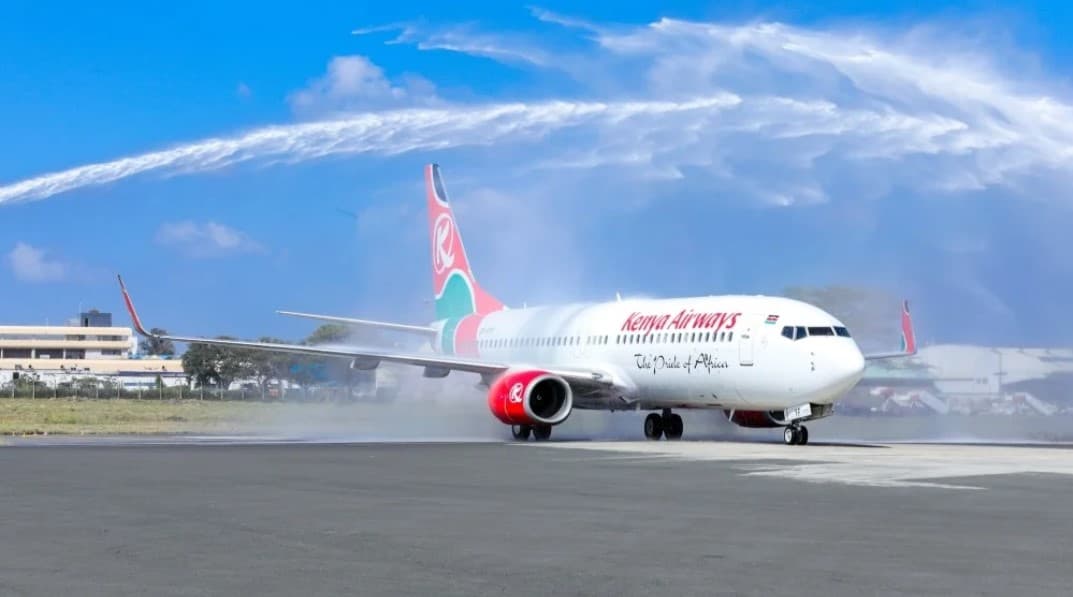
Recently, Kenya Airways, our national carrier and perennial punching bag, was hauled before the Senate for the ritual public flogging. What followed was a masterclass in confident conjecture delivered by honourable members who were, to put it charitably, factually unencumbered. It was long on theatre, short on turbulence charts and entirely innocent of how aviation actually works.
Since the complexities of a global airline cannot be absorbed in one theatrical afternoon of playing to the gallery, allow me to offer ten inconvenient truths for future reference.
1. Skills in any aspect of aviation are not inherited like eye colour or family farm
They are forged through years of punishingly rigorous training, endless examinations and humbling practical experience in which the sky grades you without favour. They are not, as one distinguished Senator seemed to suggest with a straight face, transmissible by bloodline or absorbed through osmosis at the family dinner table. The fact that one’s brother has endured 29 years in the cockpit does not, by some miraculous process of fraternal contagion, confer aeronautical expertise upon the entire lineage.
2. Kenya Airways is not the Illuminati with wings
Contrary to popular parliamentary fantasy, KQ is not a secret society. It is a public limited company. Its books are audited annually by eminently reputable firms whose professional existence depends on not inventing numbers to please Senators.
The contracts it signs do not vanish into a vault. They are disclosed in its annual accounts, having been arrived at through that quaint, old-fashioned ritual known as sound corporate governance. There are no shadowy politically incorrect bogeymen lurking in its shareholder register. And every finance and operating lease that keeps its aircraft in the sky, not by levitation but by contract, is available for scrutiny to anyone curious enough to actually ask.
Khafafa: Think Kenya Airways is expensive? Consider these 10 factors on air tickets
3. Kenya Airways does not source its Jet Fuel from a chap with a jerry can in a back alley
Contrary to the thrilling conspiracy floated in the chamber, the airline procures its standard, fossil-based Jet A-1 through perfectly ordinary commercial agreements with major, legitimate petroleum distributors; at JKIA and at every other respectable airport where it lands. It pays the prevailing market price, like everyone else who wished to remain airborne. There is no secret discount, no black-market premium.
And no, it is not currently engaging in fuel hedging. Not because it has forgotten how derivatives work, but because trying to predict fuel prices while the Middle East is on fire is akin to trying to do precision astrology during an earthquake. In such an exquisitely fluid global situation, getting one’s hedging instruments right would require, not financial acumen, but prophecy.
4. Jambojet is a wholly owned subsidiary of Kenya Airways
It is not, despite what feverish parliamentary imagination might conjure, owned by a labyrinth of shell companies registered on a sunny beach in the Caymans. It is a fully private entity, run by its own independent Board and its own Chief executive; a structure that actually exists outside the Senate. That board happens to include two members from KQ, because even in aviation, the parent is generally permitted to know what the child is doing.
A word to the wise; because KQ is a public limited company cross-listed in the exchanges of both Uganda and Tanzania, any changes to the registration of its subsidiaries including Jambojet or any sale or spinoff, would have to be publicly made known across all three countries. Listed companies don’t lend themselves to shadowy deals.
And for those concerned about transparency, Jambojet’s performance and financial figures are not hidden in a treasure chest. They are incorporated, line by line, in the Group reports.
5. Prepare to be astonished: Jambojet actually makes money
We know it ruins a perfectly good narrative, but facts can be so inconsiderate. The airline turned a profit from 2025 and remained stubbornly in the black, defying predictions of imminent demise, right up until Covid-19 politely grounded the entire planet.
Between 2020 and 2023, owing to the minor inconvenience of almost no one flying anywhere, it did slip into a brief period of losses, as did virtually every airline that wasn’t in the business of transporting unicorns. It then dared to recover. It returned to profitability in 2024 and has remained steadily profitable ever since, no Senate intervention required.
6. Kenya Airways and its subsidiary Jambojet are not locked in some Shakespearean rivalry to the death
Kenya Airways is a full-service carrier. It flies medium to long-haul, serves you a meal, offers you a drink and generally behaves like a national carrier that remembers its manners. Jambojet is a low-cost carrier. No frills, no free meals, no complimentary champagne. It is a stripped-down, honest model designed for the budget-conscious traveller, the weary bus passenger seeking salvation and the wide-eyed first-time flyer.
Operationally, KQ runs the hub-and-spoke model; it gathers you from the world and brings you home. Jambojet runs point-to-point; it gets you here to there without ceremony. The two carriers complement each other. One feeds the other international traffic; the other provides the last-mile connection to the corners of the country. It is called synergy. It is taught on day two of business school.
7. Kenya Airways has had some grounded aircraft
Not because its engineers have taken up gardening but because of global supply chain constraints. Spare parts are scarce. The return to service of aircraft undergoing perfectly scheduled maintenance is delayed by months. This is a rather irritating reality that sits beyond the airline’s control and which, inconveniently for local conspiracy theorists, has affected every airline on the planet, manifesting itself in the universal symphony of delays and cancellations.
Airline margins in Africa are, as ever, famously generous: less than one percent this year, according to projections. One dreams of such largesse. Consequently, one cancelled Dreamliner flight; a mere 234 passengers who must suddenly be rescheduled, rerouted or accommodated; is enough to see that already gossamer-thin margin vaporise, quite literally, into thin air.
8. High prices are a global reality
They are not a particularly vivid hallucination suffered by Kenya Airways. Since the beginning of this year, the war in the Middle East has driven jet fuel prices up by more than twofold. In KQ’s case, fuel costs have surged by 70 percent, a detail that tends to put a slight damper on profitability.
It is not alone in this predicament. Three large Chinese carriers have just reported net losses for the first half of the year, presumably also part of the same conspiracy. Globally, the industry’s net profit margin has halved; from 4.2 per cent to 2.0 per cent.
The full, glorious extent of the carnage across the entire sector will only become evident when full-year results are announced. Until then, we may continue to pretend that fuel is cheap and airlines are just being dramatic.
9. The sale of Kenya Airways’ slot at Heathrow was not an act of national treason
It was actually a practical necessity. That particular slot was, in fact, a spectacular inconvenience: it permitted a KQ aircraft to arrive in London in the morning and then sit, idle and ornamental, on the tarmac for twelve hours before it was graciously allowed to depart in the evening. To ground an aircraft for twelve hours, when your network is fully optimised, is not a strategy. It is simply bleeding revenue in a very expensive parking lot.
The sale therefore killed two birds with one very sensible stone: it ensured that none of KQ’s aircraft would suffer costly ground time at Heathrow and it added a tidy sum to KQ’s coffers at precisely the moment it desperately needed financial restructuring. Moral of the story: sometimes selling the family silver is wiser than paying to polish it all day.
10. Utterances in the August House should, ideally, bear some passing acquaintance with facts
We understand it thrills the citizenry when audacious, chest-thumping claims against the national carrier are launched from the floor of the House. It makes for excellent theatre. Such claims, comfortably protected by parliamentary privilege, tend to wither rather quickly once exposed to the harsh sunlight outside the House, where privilege does not pay the bill.
In the meantime, they do risk jeopardising the very real relationships the airline has painstakingly cultivated with manufacturers, financiers, lessors, suppliers and other stakeholders; people who, unlike the House, deal in contracts, not applause lines.
Is it too much to ask that our legislators trouble themselves to verify an allegation before repeating it with such vigour on the floor of the House? Apparently, it is!


Comments
No comments yet. Be the first to share your thoughts.