
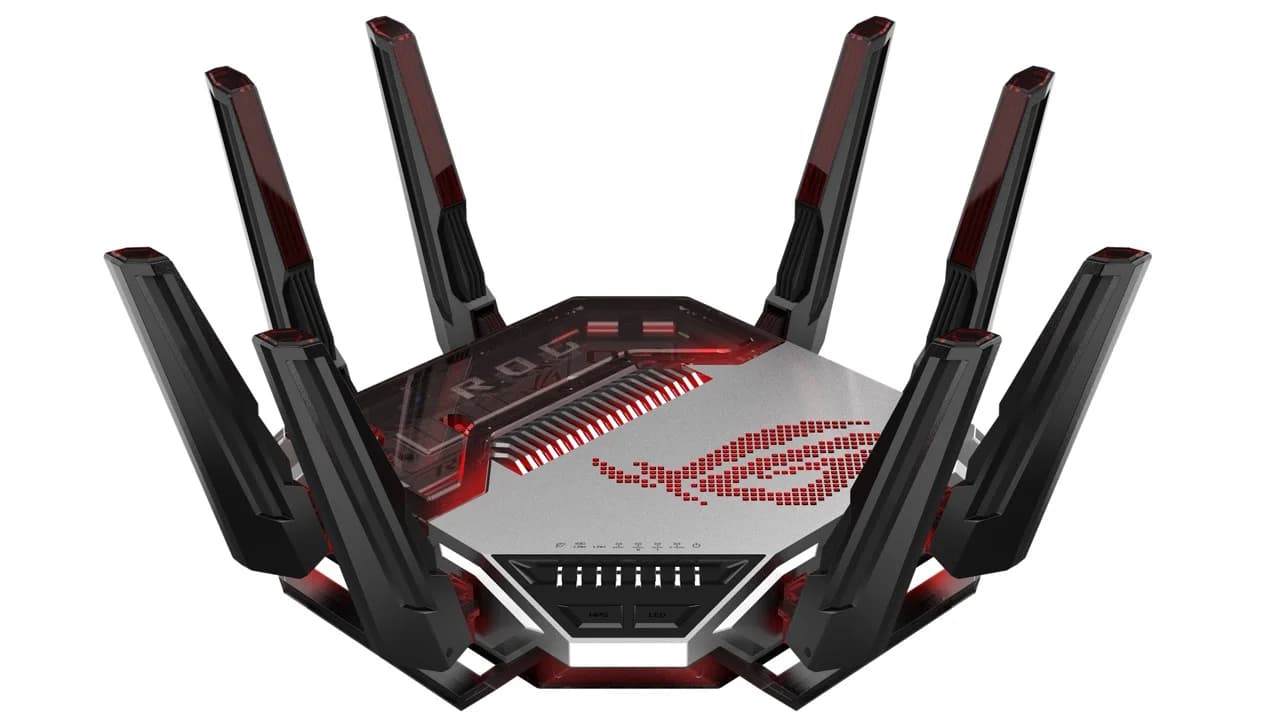
The first Wi-Fi 8 routers have gone on sale. ASUS started shipping the ROG Rapture GT-BN98, a gaming router, on 6th October 2026. It had already been on sale in Canadian shops since early September. TP-Link opened pre-orders for its Archer 8 Ultra in Germany on 30th September and in Australia on 1st October.
They aren’t cheap. The Archer 8 Ultra lists at EUR 799.90, or about KES 117,000, in Germany. In Australia it’s AUD 1,499, or about KES 136,000. ASUS didn’t give a price when it announced the Canadian sale or the shipping date.
So if you bought one tomorrow, what would get better in your home? Not the top speed. On paper, Wi-Fi 8 is no faster than Wi-Fi 7, the version in today’s best routers. ASUS says so itself: “theoretical data speeds remain unchanged”. What changes is how steady your connection stays when things in the house get in the way.
Think about where your Wi-Fi is bad. It’s fast next to the router and slow in the bedroom. A video call freezes for a second, then carries on. If you have more than one router or a mesh system, your phone sometimes hangs on to the weak one in the sitting room when you’ve walked into the kitchen.
All of it comes from Wi-Fi being radio. Walls weaken the signal and other networks talk over it. Your router and phone pick from a fixed ladder of data rates, so as the signal weakens they step down the ladder, and each step is a drop you can feel. And when a neighbour’s network is using the same channel, your router waits its turn, which is the lag spike you feel in a game or call.
Wi-Fi 8 goes after those moments. Its formal name is IEEE 802.11bn, and the group writing it calls it “Ultra High Reliability”. The targets it set itself, all measured against Wi-Fi 7, are 25% more throughput, the speed you get in practice, at some signal levels; 25% lower latency, the delay before data arrives; and 25% fewer lost data packets, especially when a device moves from one access point to another. The latency target is measured on the slowest 5% of moments, the spikes you notice.
New MCS rates, one of the names you’ll see printed on the boxes, add in-between rungs to that ladder of data rates. So when you walk away from the router, your phone steps down in smaller jumps. UEQM, short for unequal modulation, helps in the same way. Router and phone talk over several streams at once, and each stream can now run at its own rate, so one weak stream doesn’t drag the others down with it.
NPCA, non-primary channel access, deals with the neighbours. When another network is busy on the main part of a wide channel, the router can send on the free part instead of waiting. Coordination features let two or more access points in one house take turns and aim their signals, so mesh units stop talking over each other. And a new roaming feature is meant to hand your phone from one unit to the next without a drop, which is the fix for the phone that clings to the sitting room.
So if your router sits at one end of the house and you use the other end, Wi-Fi 8 is designed for you. The router vendors put numbers on it. TP-Link says the Archer 8 Ultra gets up to 33% more consistent throughput than Wi-Fi 7 at mid-to-long range. In its own tests for CES in January, ASUS measured up to twice the mid-range throughput and up to six times lower latency in the worst 1% of moments. Both are the companies’ own numbers.
Most of these features need a Wi-Fi 8 device on the other side of the conversation. Your laptop or phone has to understand the new rate steps, and coordination needs at least two Wi-Fi 8 access points.
Phones with Wi-Fi 8 are only just arriving. Last month we explained that Qualcomm’s Snapdragon 8 Elite Gen 6 chips support it, but a chip that supports Wi-Fi 8 doesn’t mean the phone has it switched on. Honor’s Magic 9 Pro Max lists Wi-Fi 8, but a note on Honor’s own spec page says Wi-Fi 8 needs a software update first, and the same page lists Wi-Fi on 2.4GHz and 5GHz only. Your older phones, laptops and TVs will connect to a Wi-Fi 8 router as they do today, because the standard is backwards compatible.
ASUS says its engineers measured gains with today’s Wi-Fi 7 phones and laptops, and that UEQM and NPCA will help “as compatible client devices arrive”. So a Wi-Fi 8 router bought now may help your current devices a little, and the bigger changes wait for new ones.
Then there’s the router itself. TP-Link’s Australian release lists what works on day one: the new rate steps, UEQM, better error correction and NPCA. The range features and the coordination between access points come later “via OTA (Over-the-Air) updates”, once “the standard matures”. That’s because the standard isn’t finished. ASUS lists its router as “IEEE 802.11bn (Draft)”. The IEEE’s own schedule has final approval in May 2028.
The widest Wi-Fi channels, 320MHz wide, carry the most data at once, like a road with more lanes. They only exist in the 6GHz band. Kenya opened the lower part of that band, 5925 to 6425MHz, for indoor Wi-Fi without a licence in the Communications Authority’s 2022 short range device guidelines. So a Wi-Fi 8 router can use 6GHz here, as long as it’s indoors and at low power.
Wi-Fi 8 also only covers the hop between your router and your devices, so it does nothing to the line coming into the house. Safaricom’s home fibre packages run from 40Mbps for KES 2,999 a month up to 1,000Mbps for KES 20,000, so on the 40Mbps package no router can pull more than 40Mbps from the internet.
For most homes, no, not yet. You’d pay about KES 117,000 for a router whose biggest features need phones you probably don’t own, on a standard that won’t be final until 2028. If your problem is a dead bedroom, a second access point or a mesh system costs a fraction of that today. Safaricom itself has a Wi-Fi extender add-on for homes where the signal has to pass through more than two walls.
Wi-Fi 8 starts to make sense when phones with it switched on become ordinary. Qualcomm, whose chips are in many Android flagships, expects the first products with its Wi-Fi 8 chips in late 2026. Once your own phone and laptop have it, and the standard is final, the steadier bedroom signal and the video call that stops freezing are what you’d be paying for.

Comments
No comments yet. Be the first to share your thoughts.