
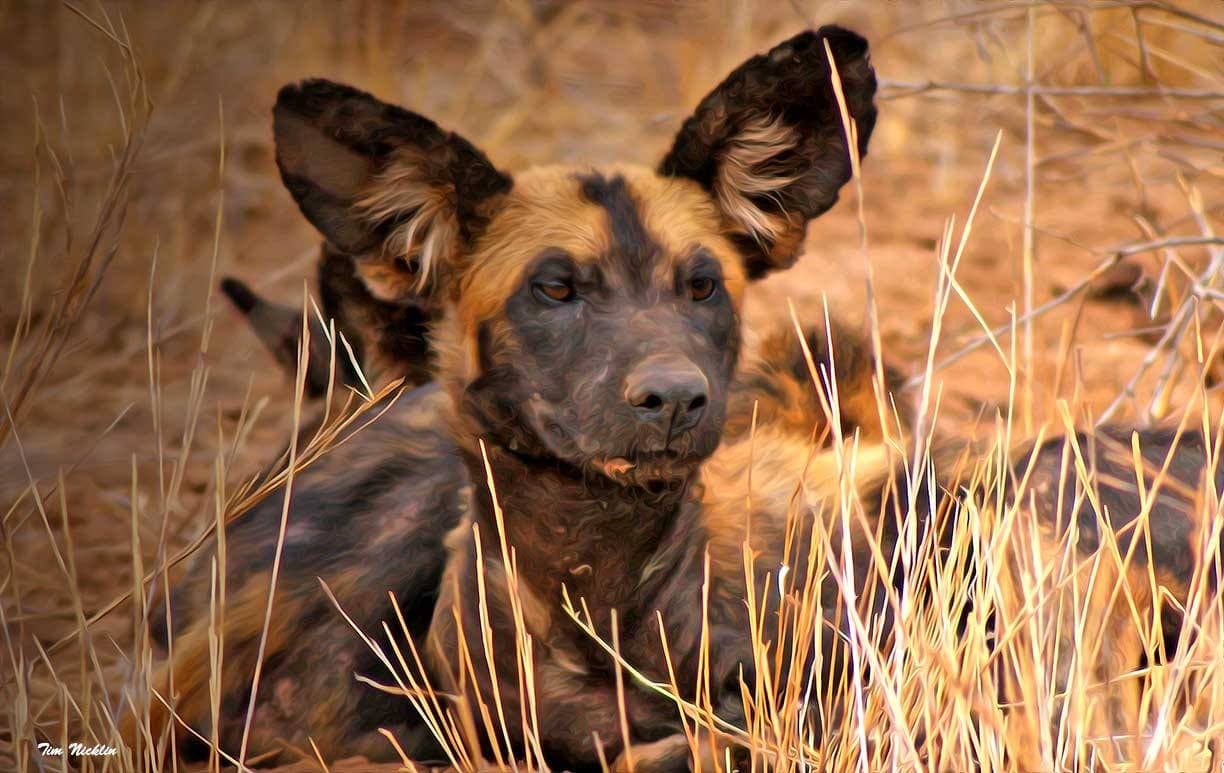
Across Eastern and Southern Africa, endangered wild dogs are still capable of making long journeys between distant ecosystems, according to research published by Ecology journal in mid-September.
The study expressly provides new evidence that wildlife corridors still connect protected areas even with expanding human activity.
It documented 19 groups of wild dogs dispersing across thousands of kilometres of human-dominated landscapes in Zambia and into, or close to, five neighbouring countries.
Among them were three that travelled 4,126 kilometres over eight months: the longest recorded dispersal for any African mammal. Dispersals are one-way, one-off movements by young dogs seeking mates or new territory, distinct from migrations where animals cycle seasonally across landscapes.
Kenya Wildlife Service says African wild dogs (also known as Lycaon pictus), listed as Endangered on the IUCN Red List of Threatened Species, are popular for their extraordinary teamwork, strong family bonds and incredible endurance, reminding us that survival in the wild is often a team effort.
Despite their resilience, they face numerous threats, including habitat loss, disease, and threats from predators such as lions and hyenas.
As farms, roads, and towns fragment wildlife habitat, the connections that sustain species are increasingly fragile and dangerous. That means many dispersing wild dogs fail to reach new habitat or find mates, including dogs in the study groups that travelled some of the furthest distances who died in wire snares set for bushmeat, sometimes after they had moved 2,000km or more.
The findings raise questions about whether wild dogs must today make such long journeys because suitable prey and habitat are much harder to find.
Professor Scott Creel of Montana State University, the paper’s lead author, have studied wild dogs since 1991 and would not have imagined that in 2026, dogs can successfully navigate long journeys.
“Despite their invariably small population sizes and the high risk of mortality in humandominated landscapes, wild dogs’ enduring capacity to move long distances through unfavourable landscapes provides an extraordinary opportunity to conserve a functional meta-population of an endangered large carnivore at the continental scale,” Creel says.
The four groups of 14 dogs that travelled the furthest covered almost 10,000 km – more than crossing the entire United States on I-90 from Seattle to Boston and back again.
They dispersed as far or further in one journey than animals circling back and forth on Africa’s famed mammal migrations, including wildebeest and zebra of the Serengeti, and whitetailed kob and tiang in South Sudan and Ethiopia.
“These extraordinary journeys show that natural connections between Africa’s wildlife strongholds still exist and that maintaining continent-wide connectivity for endangered African wild dogs remains a realistic conservation goal,” said Dr Matt Becker, CEO of Zambian Carnivore Programme (ZCP).
In Zambia, resident wild dog populations, often move into Mozambique and Malawi, and close to Zimbabwe, Angola, and the Democratic Republic of the Congo.
Many times one group of dogs from Zambia’s South Luangwa National Park was seen in neighbouring Malawi for the first time in July.
The study’s findings, experts add, will reinforce conservation approaches that focus on conserving the community lands surrounding national parks and the wildlife corridors between them, rather than protecting national parks alone as isolated islands.
“Creating these safe spaces on the peripheries of national parks and in the buffer zones between them creates the stepping stones for these extraordinary movements,” said Bruce Ellender, one of the paper’s co-authors and conservationist says.
Meanwhile, wild dogs naturally leave their birth packs between two and three years of age to find unrelated mates and establish new packs.
These dispersal journeys are essential for
maintaining healthy populations and genetic diversity, but they are also among the most dangerous periods in a wild dog’s life.


Comments
No comments yet. Be the first to share your thoughts.