
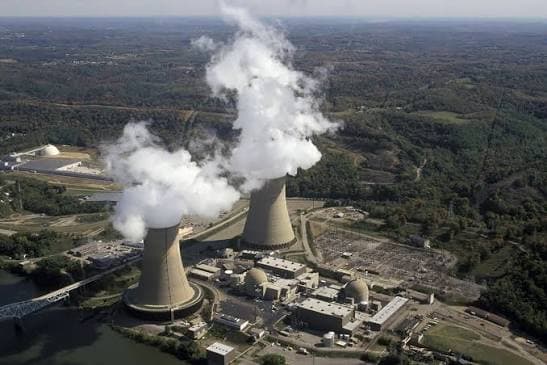
The U.S. government is expected to provide about $4.2 billion in federal financing to Vistra Corp. to increase nuclear power output at plants serving the PJM grid, as rising data center demand puts pressure on regional electricity supplies.
Energy Secretary Chris Wright is expected to announce the financing Monday, October 5, during a visit to Vistra’s Perry Nuclear Power Plant in Lake County, Ohio.
Reuters reported Saturday, citing a person familiar with the matter, that the U.S. plans to lend Vistra about $4.2 billion. The Department of Energy and Vistra had not confirmed the amount at the time of the report.
The expected financing would support power uprates at Perry and Davis-Besse in Ohio and Beaver Valley in Pennsylvania, allowing Vistra to increase output from existing nuclear facilities rather than build new reactors.
Perry uprate construction is moving forward
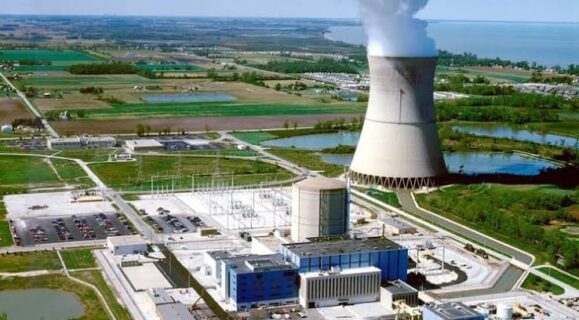
At Perry, the project is already progressing toward construction.
A September 15 Department of Energy filing says construction on the Perry Nuclear Power Plant Power Uprate Project is expected to begin in October 2026. DOE is evaluating a federal loan guarantee for the project through its Office of Energy Dominance Financing.
The planned work would upgrade the plant’s existing reactor and turbine systems.
The scope calls for a new main turbine and generator rotor, new moisture separator-reheaters, and an upgraded turbine control system. Contractors would also replace or modify pumps and valves.
Vistra also plans to install an in-vessel steam dryer and a new auxiliary mechanical-draft cooling tower. The project includes two support buildings within areas of the site that developers previously disturbed.
According to DOE’s environmental review, the work would remain within the plant’s existing footprint. The project would not require new access roads or tree clearing.
Perry has a single boiling-water reactor with roughly 1.25 GW of generating capacity. The planned uprate is expected to add about 200 MW, bringing the unit toward approximately 1.5 GW.
The plant previously completed a power uprate in 2000.
The current schedule centers on refueling outages planned for 2027, 2029 and 2031. The largest phase is expected during the 2031 outage, which is planned to last about 80 days. That work could bring roughly 1,000 additional workers to the site.
Federal financing comes ahead of the full NRC uprate review
The timing of the federal financing is notable because the physical work and regulatory process will progress on different tracks.
DOE’s September filing covers the federal financing and environmental review. The Nuclear Regulatory Commission separately handles the nuclear safety review required before Perry can operate at its higher authorized power level.
The NRC’s published schedule lists Vistra’s expected application for an extended power uprate at Perry 1 in the third quarter of 2029.
That means Vistra can proceed with qualifying engineering, procurement and plant modifications while the formal regulatory process continues. The reactor cannot operate at its higher output until the NRC approves the uprate.
The NRC has approved more than 170 nuclear power uprates since the 1970s. Uprates can involve additional fuel utilization or major equipment modifications, including turbine replacements.
For Vistra, the approach allows major components of the expansion to move ahead at existing nuclear sites rather than waiting for a new reactor project to reach construction.
Three Vistra nuclear plants could add capacity to PJM
The expected financing extends beyond Perry.
The program is expected to support uprates at Perry, Davis-Besse and Beaver Valley, three of Vistra’s four nuclear stations in the PJM market. Vistra operates six nuclear reactors across four plants, with more than 6.5 GW of combined generating capacity.
The company acquired the Ohio and Pennsylvania nuclear assets from Energy Harbor in 2024.
The additional capacity is particularly valuable to PJM because the grid operator is facing a widening gap between electricity demand and available generation.
PJM serves about 67 million people across 13 states and Washington, D.C. The grid operator has identified a 6,831-MW capacity shortfall for the 2028/2029 delivery year and has proposed a backstop procurement process to secure additional resources.
PJM also expects large-load growth of as much as 70 GW by 2038, with data centers representing a major source of new demand.
Data centers are changing the power market
The Vistra financing comes as utilities and grid operators race to keep pace with the electricity requirements of artificial intelligence and other large-scale computing facilities.
Data centers require large amounts of electricity around the clock. That has increased the value of existing nuclear plants because they can provide firm generation without relying on weather conditions.
Nuclear uprates can also add capacity faster than new reactor construction because the projects use existing sites, transmission connections and operating infrastructure.
That combination has made existing nuclear plants an increasingly important part of the U.S. response to rising electricity demand.
Meta has already contracted for the additional nuclear power
Vistra’s expansion also has a major corporate customer behind it.
In January 2026, Vistra and Meta announced long-term power purchase agreements covering about 2,609 MW across Perry, Davis-Besse and Beaver Valley.
The agreements include about 2,176 MW of existing nuclear generation and another 433 MW of capacity associated with the planned uprates.
Perry’s additional capacity is expected to come online in 2031, while the broader uprate program across the three plants is expected to be completed by 2034.
Vistra expects the uprate investments to meet or exceed its mid-teens levered return target.
The company has separately signed a 20-year agreement with Amazon covering 1,200 MW from its Comanche Peak nuclear plant in Texas, showing how large technology companies are increasingly securing long-term nuclear generation to support growing electricity demand.
Federal financing targets existing nuclear capacity
The Vistra project reflects a broader federal push to increase U.S. nuclear generation by extending the life and output of existing reactors.
Rather than waiting for new nuclear units that can require years of development and construction, the strategy focuses on equipment upgrades, additional fuel utilization and other modifications that can increase output from operating plants.
Vistra’s Perry project fits that model.
The plant occupies an approximately 1,100-acre site in North Perry, Ohio, along Lake Erie. It employs about 600 full-time workers and more than 200 permanent contractors.
The planned uprate would increase the plant’s output by roughly 200 MW without adding a new reactor.
If the broader Vistra program proceeds as expected, the company will add capacity at three existing nuclear stations serving one of the country’s largest electricity markets.
For PJM, the additional generation comes as data center development and other large loads accelerate.
For Vistra, the financing would reduce the capital burden of expanding its existing nuclear fleet.
And for the federal government, the project offers a way to increase nuclear generation without waiting for a new reactor to be built.
Part of a broader push to expand U.S. nuclear generation
The Vistra uprate program is part of a broader push to expand U.S. nuclear generation as electricity demand rises. South Korea is pursuing an even larger expansion through plans for eight new U.S. nuclear reactors with up to 10.2 GW of combined capacity, adding another major pipeline of nuclear construction projects across the country.
Also, as utilities work to add nuclear capacity, data center developers are also looking for power sources that can be deployed on shorter timelines. Wärtsilä is supplying 282 MW of onsite generation for a U.S. data center, using 15 gas engines to provide dedicated power as grid constraints slow the expansion of large computing projects.
Factsheet: Vistra Nuclear Uprate Program
- Federal financing: About $4.2 billion
- Primary project: Perry Nuclear Power Plant Uprate
- Location: North Perry, Lake County, Ohio
- Additional plants: Davis-Besse, Ohio; Beaver Valley, Pennsylvania
- Owner/operator: Vistra Corp.
- Perry reactor: Single-unit boiling-water reactor
- Current Perry capacity: About 1.25 GW
- Expected Perry capacity addition: About 200 MW
- Expected Perry output: About 1.5 GW
- Perry site: About 1,100 acres
- Perry construction: Anticipated October 2026
- Major work phases: 2027, 2029 and 2031 refueling outages
- Largest Perry work phase: 2031
- Expected Perry uprate: 2031
- Broader uprate program: Expected completion by 2034
- Corporate power customer: Meta
- Meta agreements: About 2,609 MW
- Uprate capacity under Meta agreements: About 433 MW
- PJM service area: About 67 million people
- PJM identified capacity shortfall: 6,831 MW
- PJM projected large-load growth: Up to 70 GW by 2038
- Vistra nuclear fleet: Six reactors at four plants
- Vistra nuclear capacity: More than 6.5 GW


Comments
No comments yet. Be the first to share your thoughts.