
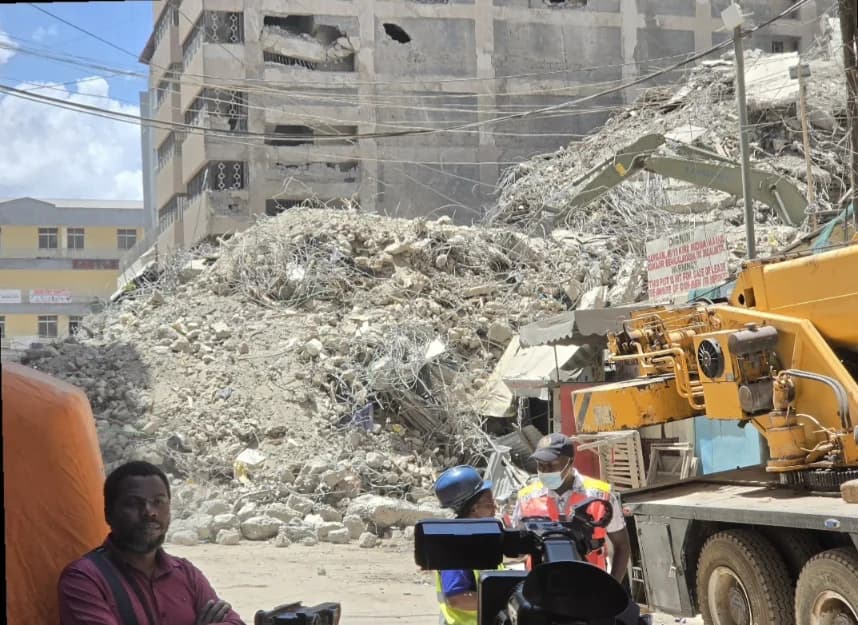
Basement supermarket could be sustaining survivors in Eastleigh rubble - rescue team

According to Zhang Yuran, most of the people believed to be trapped are thought to be in the building’s basement, where a supermarket may be providing access to food and water while they await rescue.
The rescue mission at the collapsed building in Eastleigh, Nairobi, has entered its seventh day, with Chinese experts saying they have detected two possible signs of life beneath the rubble and that people trapped in the basement may have access to food and water from a supermarket located there.
In a video posted on the Chinese Embassy in Kenya’s X account, Zhang Yuran, a member of the Chinese rescue team, said experts had detected two possible signs of life and were working to create access for rescuers to reach the locations where the signals were detected.
The team, part of the Blue Sky rescue team, arrived at the scene on Monday night with specialised equipment to help locate people who may still be trapped beneath the collapsed building.
Zhang said the team had brought three types of life-detection equipment to support the ongoing search and rescue operation, which has faced challenges due to the condition of the site and limited access to areas where people are believed to be trapped.
"So far we have detected two potential signs of life beneath the collapsed building," he said.
He said the team was working with other rescuers to create a path to the locations where signs of life had been detected, enabling them to reach those who may be trapped beneath the debris.
Latest Stories
- High Court declares Ruto’s 20 per cent housing allocation directive for teachers, police officers unlawful
- KNCHR raises alarm over targeting of persons seeking sanctuary in Kenya
- DRC medics celebrate as final Ebola patient leaves Mongbwalu treatment centre
- Russia, African Union sign new cooperation framework at Moscow summit
According to Zhang, most of the people believed to be trapped are thought to be in the building’s basement, where a supermarket may be providing access to food and water while they await rescue.
"I heard there is a supermarket in the basement, so they may have some food and water," he said.
Zhang explained that the team had brought three types of equipment, each designed to detect possible signs of life using different methods.
The first is a radar life detector, which helps rescuers identify possible human presence beneath the rubble, while the second detects sound waves and vibrations that could indicate movement from people trapped inside the building.
The third piece of equipment is a thermal imaging snake-eye probe fitted with a camera, allowing rescuers to examine spaces beneath the debris and search for signs of life.
The equipment is expected to help the team identify the locations of people who may still be alive and guide rescuers as they work to reach them.
Meanwhile, National Disaster Management Unit Director Duncan Ochieng said on Thursday that search and rescue operations remained challenging because of the confined spaces and limited access within the collapsed multi-storey building.
Ochieng said the chances of survival depended on several factors, including whether those trapped had sustained injuries and the conditions in which they remained beneath the rubble.
"From a professional point of view, we know that life can be sustained within the first 72 hours. If somebody is not injured in any way, they can remain alive for up to two weeks," he said.
His remarks came as rescuers continued searching the site a week after the building collapsed, with teams working to access areas where people are believed to remain trapped.
Rescuers continue efforts to create access to the identified locations as the operation enters its seventh day.



Comments
No comments yet. Be the first to share your thoughts.