
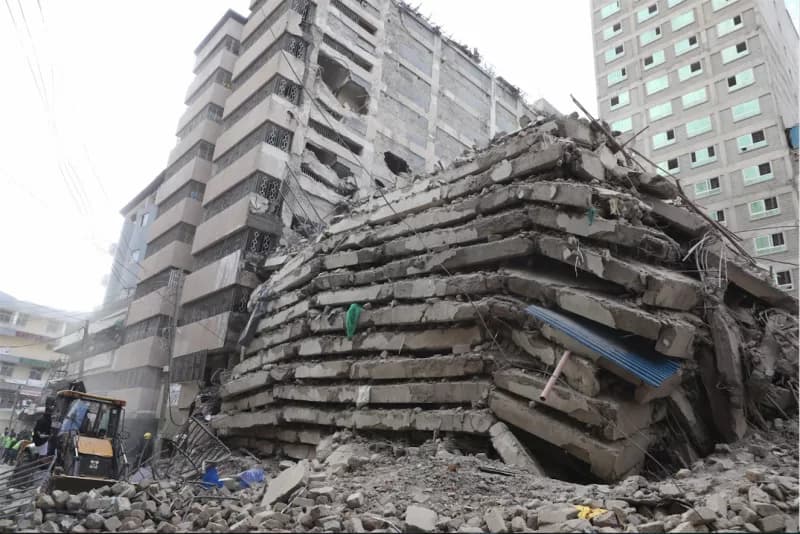
The collapsed 18-storey building along 9th Street in Eastleigh, Nairobi, on October 23, 2026 /EZEKIEL AMING'A

On Friday, October 23, an 18-storey building under construction collapsed in Nairobi’s Eastleigh neighbourhood. Several people were injured, and seven were reported missing and feared trapped beneath the rubble. It was not the first such incident in Nairobi.
In January, a multi-storey building under construction collapsed in South C, killing two people. In February, six workers were trapped when another building under construction collapsed near OTC, along Kirinyaga Road in Nairobi’s Central Business District. All six were rescued.
Repeated building collapses raise an uncomfortable question: how many more lives must be put at risk before those responsible for enforcing construction standards are held accountable? These tragedies expose serious weaknesses in the regulation of Kenya’s rapidly expanding urban centres.
They also point to a troubling culture of impunity, weak enforcement and the apparent prioritisation of profit over human life. Authorities must do more than issue statements and promise investigations.
The Eastleigh collapse, like those before it, is a warning about unchecked urban development, regulatory failures and possible official negligence. Unless incidents are investigated transparently and those found responsible are held accountable, ordinary Kenyans will continue to pay the price for failures that put public safety at risk.
Nairobi has experienced rapid, often poorly planned development over the past decade. High-rise buildings are transforming neighbourhoods such as Kileleshwa and Kilimani, where lower-rise housing and more open spaces once offered residents a different quality of life.
Some towers are rising along narrow roads and in areas whose infrastructure cannot adequately support growing populations and commercial activity. Development is proceeding without sufficient attention to roads, water, transport and public spaces.
The January 2026 collapse in South C illustrates wider concerns about construction safety and regulatory oversight in Nairobi. The building was reportedly approved for 12 storeys but had four additional floors when it collapsed.
This raises a fundamental question: how was construction allowed to extend four floors beyond the approved design? The incident underscores the need for effective monitoring and enforcement to ensure that developers adhere to approved building plans and that breaches are identified and addressed before they put lives at risk.
Preventing such breaches requires effective oversight throughout the construction process, not simply the approval of building plans. Authorities must conduct regular inspections to ensure that approved designs and safety standards are followed.
This includes checking materials and structural work and ensuring that qualified professionals supervise construction as required. The temptation to cut costs by using substandard concrete, steel or other materials makes consistent oversight essential.
Eastleigh illustrates the wider consequences of unchecked development. Once a well-organised residential neighbourhood in the 1970s and 1980s, it has become a congested commercial place, with little corresponding investment in infrastructure. Its narrow roads struggle to accommodate today’s volume of traffic and commercial activity.
Gridlock has encouraged greater reliance on boda bodas, adding to congestion and safety risks, while hawkers occupy roads and pedestrian walkways, leaving limited space for people to move safely. The neighbourhood’s transformation has come at a significant cost to residents’ quality of life.
The problem extends beyond Eastleigh. Nairobi needs more green spaces, parks and children’s play areas, not simply more concrete towers. Neighbourhoods such as South C, Kilimani and Kileleshwa are also experiencing changes that raise questions about sustainable development and the public interest. The city needs reliable public transport, adequate roads and sustainable water infrastructure. Heavy reliance on boreholes also raises concerns about pressure on groundwater resources.
Kenyans must demand justice for the victims of the Eastleigh collapse and accountability for previous incidents. Authorities must publish investigation findings and take appropriate action against developers, approving authorities and officials where negligence or other wrongdoing is established.
Too often, investigations are promised after disasters, but the public is left without clear answers about their outcomes. As an Eastleigh resident, I am deeply concerned that the latest collapse could follow the same path.
Nairobi does not need development at any cost. It needs responsible construction, effective regulation and investment in infrastructure and public spaces. Development must serve the public good, not private interests at the expense of safety, dignity and human life.
The writer is a governance expert, public-interest commentator and a research fellow at the HORN International Institute for Strategic Studies. [email protected]


Comments
No comments yet. Be the first to share your thoughts.