
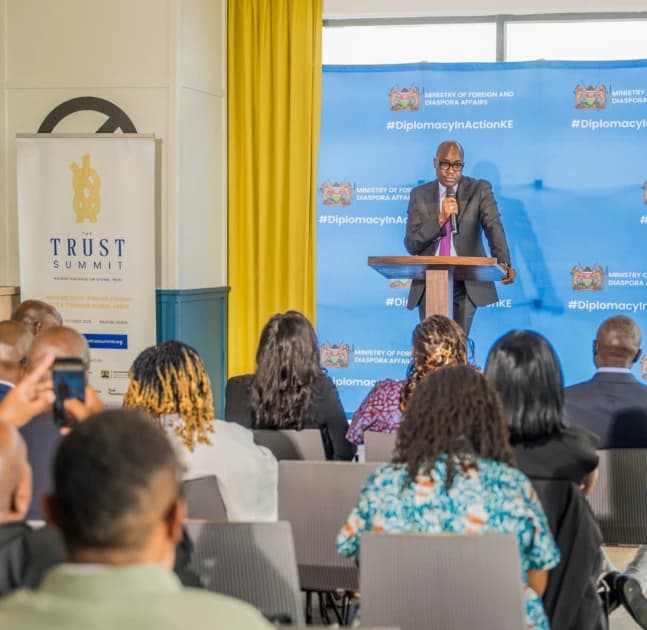
The call was made during a pre-summit roundtable held at KOFISI Square in Nairobi, where participants examined the barriers preventing creative talent from translating into sustainable livelihoods and competitive businesses.
The Creative and Cultural Industries Pre-Trust Summit Roundtable brought together stakeholders from music, film, fashion, broadcasting, performing arts and digital content to discuss how trust, stronger institutional frameworks and investment could help Kenyan creative enterprises expand into regional and international markets. The meeting was held ahead of the Trust Summit: Nairobi Dialogues on Global Trust, scheduled for October 21–23, 2026.
Principal Secretary for Foreign Affairs Dr Korir Sing’Oei, who presided over the meeting, said the creative economy was an important pillar of Kenya’s economic diplomacy, national identity and international standing.
“We want to explore how we can use our missions across 70 geographies as billboards to tell your story and amplify what you have worked hard to achieve and produce," Sing'oei said.
Discussions focused on establishing systems that protect creators, attract investment and connect Kenyan creative businesses to wider markets.
Participants identified transparent royalty payment systems, fair contracts, stronger intellectual property protection and financing models tailored to creative enterprises as key priorities for the sector.
They also called for greater transparency from digital platforms, improved access to audience data and safeguards against the unauthorised commercial use of creative work, particularly as artificial intelligence continues to reshape the industry.
The discussions covered five thematic areas: market access and national values; digital platforms, artificial intelligence and data; regulation and accountability; finance and enterprise; and rights, intellectual property and fair work.
Under market access, participants explored how Kenya could expand opportunities for its creative products locally and internationally while protecting its cultural heritage, national identity and values.
Representatives from the Ministry of Culture, the State Department for Youth and Creative Economy, regulatory agencies, financial institutions and private-sector organisations also participated in the roundtable.
Recommendations from the meeting are expected to inform a proposed Creative Economy Trust Compact, a framework for institutional commitments and a pipeline of initiatives seeking investment and partnerships.
The outcomes will also feed into the Trust Summit: Nairobi Dialogues on Global Trust, scheduled for October 21–23, which is expected to bring together policy leaders, ministers from across Africa, academics, media representatives, think tanks and young people.
The roundtable highlighted the need for stronger collaboration between government, creators, investors and technology companies to address structural barriers and ensure Kenya’s creative talent translates into sustainable incomes, viable enterprises and greater access to global markets.

Comments
No comments yet. Be the first to share your thoughts.