
Eastleigh building: Search for missing people enters day two

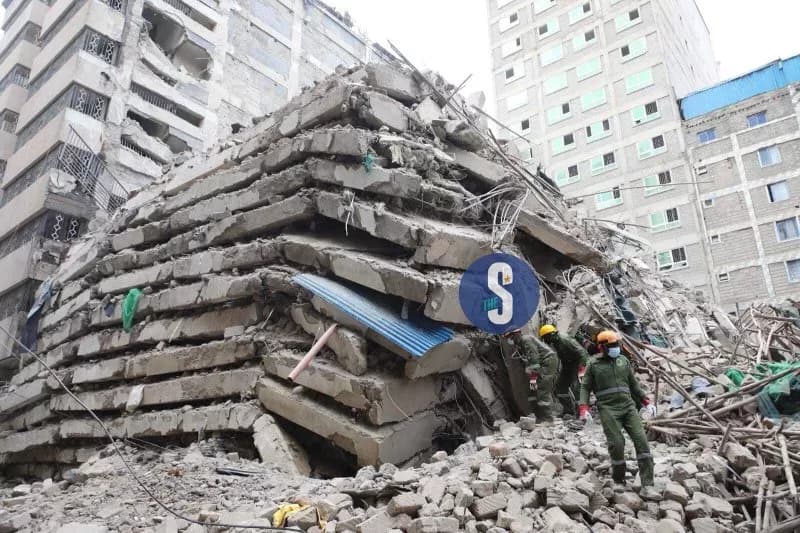
The “pancake collapse” identified by engineers at the Eastleigh building disaster has left rescuers facing the challenge of reaching people trapped beneath stacked concrete slabs without destabilising the wreckage.
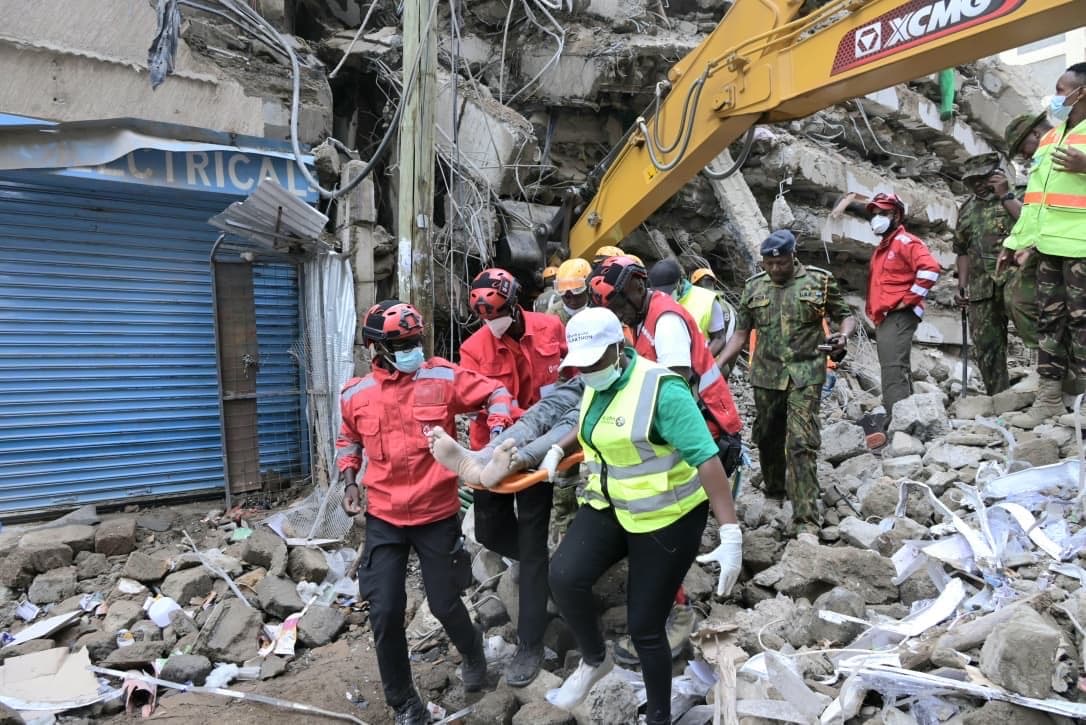
The search and rescue operation continued on Saturday, with no one retrieved from beneath the rubble for several hours as teams worked through the debris amid fears that shifting slabs could endanger those still trapped.
Institution of Engineers of Kenya Vice-President Robert Otieno Ogallo, who was at the scene, said a visual assessment indicated that the building had suffered a pancake collapse, a structural failure in which floors fall vertically onto the levels below.
“I have been able to determine visually that this is a pancake collapse,” Ogallo told reporters as rescue teams searched for people feared trapped beneath the rubble.
The term describes a collapse in which floors stack on top of one another, resembling a pile of pancakes. It can occur when supporting structural elements fail, causing one floor to fall onto the level beneath it.
The impact can place additional force on the lower floors, potentially triggering a chain reaction in which several levels collapse in quick succession, leaving a compressed mass of concrete, steel and other building materials.
For people inside, the consequences can be devastating. Falling slabs can crush spaces where occupants were working or moving, leaving little room to escape.
Unlike collapse patterns in which sections of a building lean against one another and create larger pockets of space, a pancake collapse can leave narrow gaps between slabs. These conditions can make it difficult for rescuers to locate and reach survivors, although survivable spaces may still form.
Rescue teams must therefore remove debris cautiously, balancing the urgency of reaching trapped people against the risk of destabilising the remaining structure.
Warning signs before disaster
Ogallo said there were reports that the building may have shown signs of distress before it collapsed, although the circumstances had yet to be established.
“People here are saying distresses were observed, like cracks,” he said.
Cracks can sometimes indicate structural movement or distress, but their significance depends on their location, pattern, width and the circumstances in which they developed. Their presence alone does not establish the cause of a collapse.
Ogallo also warned against using substandard construction materials.
“If you build with the wrong materials, it becomes a time bomb,” he said.
His remarks have raised questions about construction quality, supervision and enforcement of building regulations in Nairobi, where high-rise developments have transformed neighbourhoods such as Eastleigh.
However, the precise cause of the collapse has not been established. Investigators will need to examine the building's design, construction materials, structural elements and compliance with approved plans before drawing conclusions.
The reported cracks also raise questions about whether warning signs were identified before the collapse and, if so, what action was taken.
Structural distress can manifest through cracking, unusual movement, deformation or other changes. While some cracks may be superficial, others can indicate more serious problems. Any suspected structural danger requires assessment by qualified professionals.
A thorough investigation would need to establish whether the building was constructed according to approved designs, whether the materials met the required standards and whether structural components were adequately designed and executed.
It would also need to examine workmanship, construction supervision and the roles of relevant professionals and regulators.
The National Construction Authority said the project was registered on July 30, 2025, as a proposed development on 9th Street, Eastleigh. Its records listed 9th Street Plaza Limited as the developer.
Registration alone does not establish whether the building complied with all construction requirements or whether any party was responsible for the collapse. Those questions remain subject to investigation.
A race against time
As the search and rescue operation continued, the pancake-collapse pattern presented responders with the challenge of locating people beneath heavy slabs while ensuring that debris could be removed safely.
Heavy machinery can help clear large quantities of rubble, but its use must be carefully coordinated because moving one section can affect the stability of another.
The Kenya Red Cross said two injured people had been taken to Kenyatta National Hospital, while 26 people who had earlier been reported missing had been traced and accounted for.
As of Saturday afternoon, 31 missing-person cases were reported to the Kenya Red Cross.
Its teams remained at the scene alongside multi-agency responders, with a tracing desk helping families search for their loved ones.
The agency urged relatives seeking information to call its toll-free number, 1199.
Beyond the immediate rescue operation, the collapse has renewed calls for accountability and stronger enforcement of construction standards.
Nairobi Police Commander Issa Mohamud said those found culpable would face the law after thorough investigations.
“Whoever is the owner, whoever authorised the building, all of them will be charged properly. But that will come after thorough investigation is done,” he said.
As investigators work to establish what caused the structure to fail, rescue teams continue searching for those who may remain trapped beneath the rubble, while families await news of their loved ones.


Comments
No comments yet. Be the first to share your thoughts.