
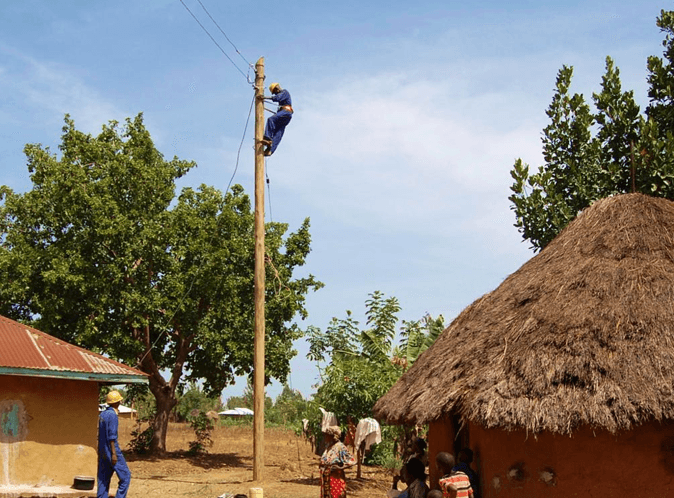
The arrival of electricity is changing daily life in rural communities across Kenya, bringing light to homes that for years relied on kerosene lamps, candles and other costly sources of energy.
For families gaining access to the national grid, electricity means more than simply lighting their homes. It is extending the hours available for children to study, enabling small businesses to operate for longer and improving access to essential services in areas that have traditionally lagged behind urban centres.
Across Kericho, Nandi, Busia and Kwale, rural electrification projects are extending power lines into villages and connecting households, schools, health facilities and markets.
The expansion is being driven through grid extensions, installation of transformers and connections to public facilities, alongside renewable-energy and mini-grid projects for communities where extending the national grid remains difficult.
The Rural Electrification and Renewable Energy Corporation (REREC) and Kenya Power are among the key agencies implementing the government’s rural electrification programmes, including the Last Mile Connectivity Project.
Kericho pushes to connect more households
In Kericho, the push to bring electricity to more homes has gained momentum through several projects.
A countywide rural electrification project worth Ksh329.25 million was announced in March 2025, targeting 3,055 homes across the county’s six constituencies.
The investment was part of efforts to extend electricity to underserved communities and support economic activity in the tea-growing county.
In July 2025, the Ministry of Energy announced another Ksh1.4 billion rural electrification project in Kericho, targeting more than 14,000 households under the Government’s Rapid Results Initiative.
The project was announced during the launch of the Kericho County Electricity Master Plan, which seeks to guide investment in the county’s power infrastructure.
For rural households, the arrival of electricity can change how homes are used after sunset, while shops, salons, eateries, workshops and other small enterprises can operate for longer hours.
Nandi takes power closer to rural communities
In Nandi, the electrification drive forms part of REREC’s wider regional programme.
The corporation’s Uasin Gishu Energy Centre serves Nandi alongside Uasin Gishu, Trans Nzoia, Baringo and Elgeyo Marakwet counties.
The centres provide communities with information and technical support on renewable-energy technologies, complementing the expansion of electricity infrastructure.
The growing availability of electricity in rural areas is also creating opportunities for the adoption of appliances and technologies that can improve household productivity and support small enterprises.
For schools and health facilities, reliable electricity is particularly important, providing power for lighting, equipment and other essential services.
Busia villages join the electrification drive
In Busia, REREC reported the commissioning of electrification projects as part of a wider national rollout that also covered Kericho, Kakamega, Uasin Gishu, Kitui, Kisii, Nyandarua and Embu.
The projects are intended to extend electricity beyond major urban centres and bring power closer to rural households and public institutions.
The Busia Energy Centre, which also serves neighbouring Siaya, provides technical outreach on renewable-energy technologies.
REREC’s network of energy centres promotes technologies including solar power, biogas and improved cooking solutions, helping communities explore alternatives where conventional grid electricity is unavailable or insufficient.
Kwale combines grid expansion with renewable energy
Along Kenya’s coast, electricity is reaching communities through both grid expansion and off-grid solutions.
In Kwale, two rural electrification projects commissioned in August 2025 targeted 366 households in Matuga and Msambweni constituencies.
The projects were expected to connect 202 households in Fuzo-Mkokoni and another 164 in Madongoni-Majikuko.
For communities in remote coastal areas and islands, however, extending conventional power infrastructure can be challenging.
REREC’s Kenya Electricity Modernisation Project includes a hybrid renewable-energy mini-grid for Wasini and Mkwiro in Kwale.
The project is designed to provide electricity to communities where connection to the national grid is not considered viable in the medium term.
The Wasini-Mkwiro project is part of a wider programme covering eight sites, including islands and remote markets in Siaya, Homa Bay, Turkana and Marsabit counties.
A wider rural transformation
REREC’s published project portfolio shows the scale of the Government’s investment in rural electrification.
The corporation lists 4,006 government-funded grid electrification projects across the country, targeting 324,387 customers. The projects have a combined investment value of Ksh35.61 billion.
The figures cover completed and ongoing projects and therefore should not be interpreted as the number of connections made in 2026.
REREC says its electrification projects are intended to support education, healthcare, entrepreneurship, employment, communication, housing and agricultural development.
Its public-facility electrification programme also targets schools, health centres and markets, with households located near the facilities potentially benefiting from the extension of power infrastructure.
The Ministry of Energy has previously reported that the Last Mile Connectivity Project had connected 1,039,143 customers to electricity by October 31, 2022.
That figure provides a historical measure of the programme’s reach and is not a current national connection figure.
Beyond lighting homes
For rural communities, electricity is increasingly being viewed not simply as a source of lighting but as infrastructure for economic development.
Once a village is connected, households can use electrical appliances, businesses can extend their operating hours and public institutions can provide services under better conditions.
But connection to the grid does not automatically guarantee the full benefits of electrification. Households still need to afford connection charges, electricity consumption and appliances, while businesses require reliable power to make productive use of the service.
This is why the expansion of the grid is being accompanied by renewable-energy programmes and technical support through REREC’s energy centres.
From the tea-growing highlands of Kericho and Nandi to the villages of Busia and the coastal communities of Kwale, the spread of electricity is gradually changing what rural communities can do after sunset.
For families that once depended on kerosene lamps and candles, a connection to the grid marks the beginning of a broader transformation — one in which electricity can support education, enterprise, healthcare and the growth of local economies.
>>> Kenya Power to Set Up Two Substations in Kwale and Kilifi Counties Costing KSh765Million



Comments
No comments yet. Be the first to share your thoughts.