
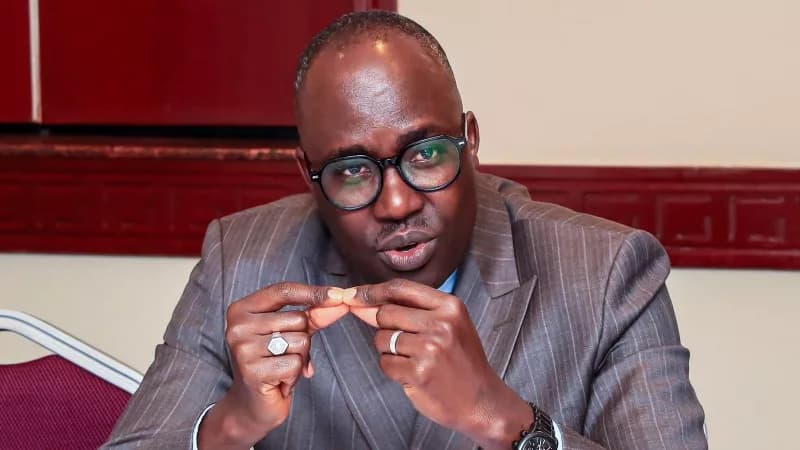
Foreign Affairs Principal Secretary Korir Sing’Oei said the country hasnot declared support for any contender for the position
Foreign Affairs PS Sing'Oei Korir. PHOTO/ X.

Kenya has denied endorsing any candidate for the position of United Nations Secretary-General, dismissing claims that it had thrown its weight behind the United Arab Emirates candidate.
“Quite to the contrary, Kenya has not expressed support for any candidate at this point,” Sing’Oei said in a response to a claim posted on X.
He said Kenya was following the campaigns, including expressions of interest from new candidates, and was confident that a suitable candidate would emerge to lead the global organisation.
“We are following keenly the ongoing campaigns for UNSG, including the expression of interest by new candidates and are confident that a candidate with the capacity to lead the UN at this critical juncture will not only receive our support but that of the majority of Members of the UN,” he said.
Sing’Oei’s clarification followed a post on X claiming that Kenya had backed the UAE candidate days after President William Ruto met with Abu Dhabi’s top diplomat in Nairobi.
The claim linked the reported endorsement to the diplomatic meeting, prompting the clarification from the Foreign Affairs PS.
Kenya’s position, as outlined by Sing’Oei, is that it has yet to commit to any candidate and will assess the contenders as the campaigns progress.
The race to succeed António Guterres as the next leader of the United Nations is taking shape, with a streamlined field of candidates and a more transparent selection process.
With Guterres’ second term set to end on December 31, the UN is now deep into the process of identifying its next secretary-general, who will assume office on January 1 next year.
While the procedure is rooted in longstanding provisions of the UN Charter, recent reforms have significantly opened up what was once a largely opaque process.
At the heart of the selection is Article 97 of the UN Charter, which states that the Secretary-General is appointed by the General Assembly upon the recommendation of the Security Council.
However, how that recommendation is reached has evolved, particularly since reforms introduced over the past decade aimed at improving transparency and inclusivity.
“The process of appointing and selecting the next Secretary-General is based on General Assembly resolutions and guided by principles of transparency and inclusivity,” the UN emphasised in outlining the current framework.
The latest phase of the process was formally triggered on November 25 last year when the president of the General Assembly and the president of the Security Council issued a joint letter to all member states.
The communication invited nominations and laid out the roadmap for the selection process, including key milestones and expectations for candidates.
Under the established guidelines, candidates must be nominated by at least one UN member state, though not necessarily their country of origin.
Each nominee is required to submit a comprehensive package that includes a vision statement, curriculum vitae and disclosures related to campaign financing.
“The joint letter… invites nominations from member states and outlines the principles of the selection process and notional events,” the UN said.
As nominations are received, the presidents of the General Assembly and Security Council jointly notify member states and maintain a publicly accessible list of candidates.
This list includes detailed profiles, allowing governments and the public alike to scrutinise those vying for the world’s top diplomatic post.
A key innovation in the modern selection process is the use of public “interactive dialogues,” where candidates present their vision and answer questions from member states.


Comments
No comments yet. Be the first to share your thoughts.