
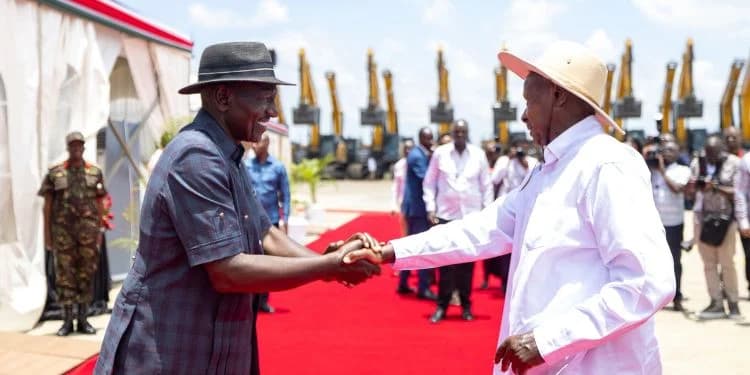
President William Ruto has dismissed claims of a disagreement with Ugandan President Yoweri Museveni over competing refinery projects in East Africa, saying Kenya has no problem with Uganda pursuing its own facility alongside the KSh2.2 trillion Dangote refinery being constructed in Lamu.
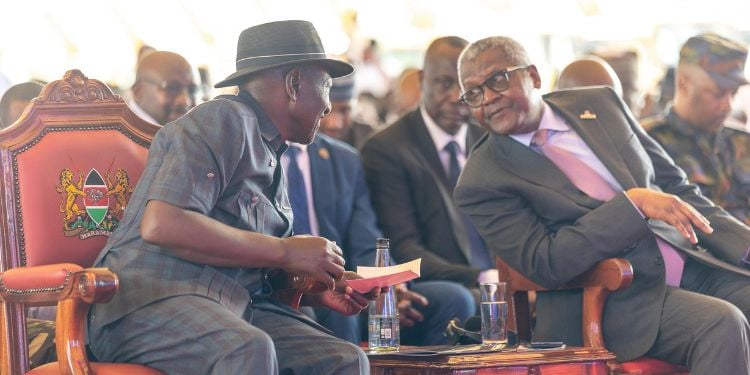
Ruto addressed the issue during a media engagement at State House, Mombasa, on Thursday, October 1, a day after he and Museveni attended the groundbreaking ceremony for the Dangote East Africa Petroleum Refinery in Lamu on September 30.
His clarification on the Lamu refinery comes after Museveni declared at the groundbreaking that Uganda would continue with plans for its own refinery.
The President affirmed he had discussed the matter with Museveni and maintained that Uganda could proceed with its planned refinery without affecting Kenya’s project.
Following Museveni’s intention to build a refinery in Uganda, Ruto added that Kenya would be prepared to purchase petroleum products from Uganda if they were competitively priced and could reach the Kenyan market economically.
“There is no bad blood at all. There is no problem. We have agreed with President Museveni that the small refinery will be built in Uganda. If the refinery is near Busia and can supply to Kenya economically, we will buy from Uganda,” Ruto said when asked about the apparent differences between Kenya and Uganda over refinery investments.
Museveni Confirms Uganda Will Build Its Own Refinery
During the September 30 groundbreaking ceremony in Lamu, Museveni gave his stance on the Dangote refinery.
The Ugandan President said Kampala had discussed building a refinery with Ruto, Dangote, and Tanzanian President Samia Suluhu Hassan, and that Uganda would proceed with a smaller facility.
“In Uganda, we have got some petroleum. I discussed with Mr Dangote, President Ruto, and Samia that we are going to build a small refinery in Uganda. We had planned this long ago. We can’t change that,” Museveni said during the ceremony.
Uganda has been developing plans for a refinery in Hoima, close to the country’s oil-producing region.
According to Museveni, the proposed facility, with a capacity of between 60,000 and 120,000 barrels per day, would serve Uganda and markets in the African interior.
Museveni also raised the question of an earlier refinery proposal involving Tanzania’s Tanga port, citing that before committing financially to the Lamu project, the country wanted to know what happened.
Ruto on East Africa Proposed Refineries
Addressing the speculated rivalry in the East Africa over investments, Ruto argued that the size of the regional petroleum market means that Kenya, Uganda and Tanzania can develop separate refining facilities without necessarily undermining one another.
According to Ruto, the Lamu refinery alone would not be enough to meet the petroleum needs of the entire East African region, citing that Kenya would be open to participating in Tanzania’s proposed Tanga refinery if the project proceeds.
Ruto explained that the Dangote refinery would strengthen East Africa’s control over its petroleum supply by reducing reliance on refined fuel imported from outside East Africa.
Additionally, the Lamu facility will help provide more stable access to petroleum products while lowering some costs associated with transporting and insuring imported fuel.
Ruto also emphasized that the project will set aside about 5,000 acres for industries that will utilize refinery by-products, creating a wider industrial zone around the facility and allowing the region to benefit from products generated during the refining process.
The Dangote Refinery
The Dangote East Africa Petroleum Refinery is planned as a KSh2.2 trillion ($16 billion) project with a designed processing capacity of 700,000 barrels of crude oil per day.
The facility is being developed in Lamu as part of a wider petroleum refinery and petrochemicals special economic zone. Construction is expected to take about 40 months to serve Kenya, Uganda, Tanzania, Rwanda, Burundi, South Sudan, Ethiopia and the Democratic Republic of Congo.
Uganda is also an oil-producing country, with petroleum development centered around the Albertine Graben.
The country has sought to establish domestic refining capacity rather than exporting crude oil without processing it.
Dangote Group Chairman Aliko Dangote said during the groundbreaking that the project was intended to support Africa’s shift from exporting raw materials to processing them locally.
The project also links to the broader LAPSSET corridor, which was designed to connect Kenya’s northern coast with markets and transport routes extending towards Ethiopia and South Sudan.
Ethiopian Prime Minister Abiy Ahmed, who attended the groundbreaking, described the project as one capable of expanding industrial capacity and supporting additional investments in sectors such as fertilizer and cement.
Follow our WhatsApp Channel and X Account for real-time news updates.

Comments
No comments yet. Be the first to share your thoughts.