
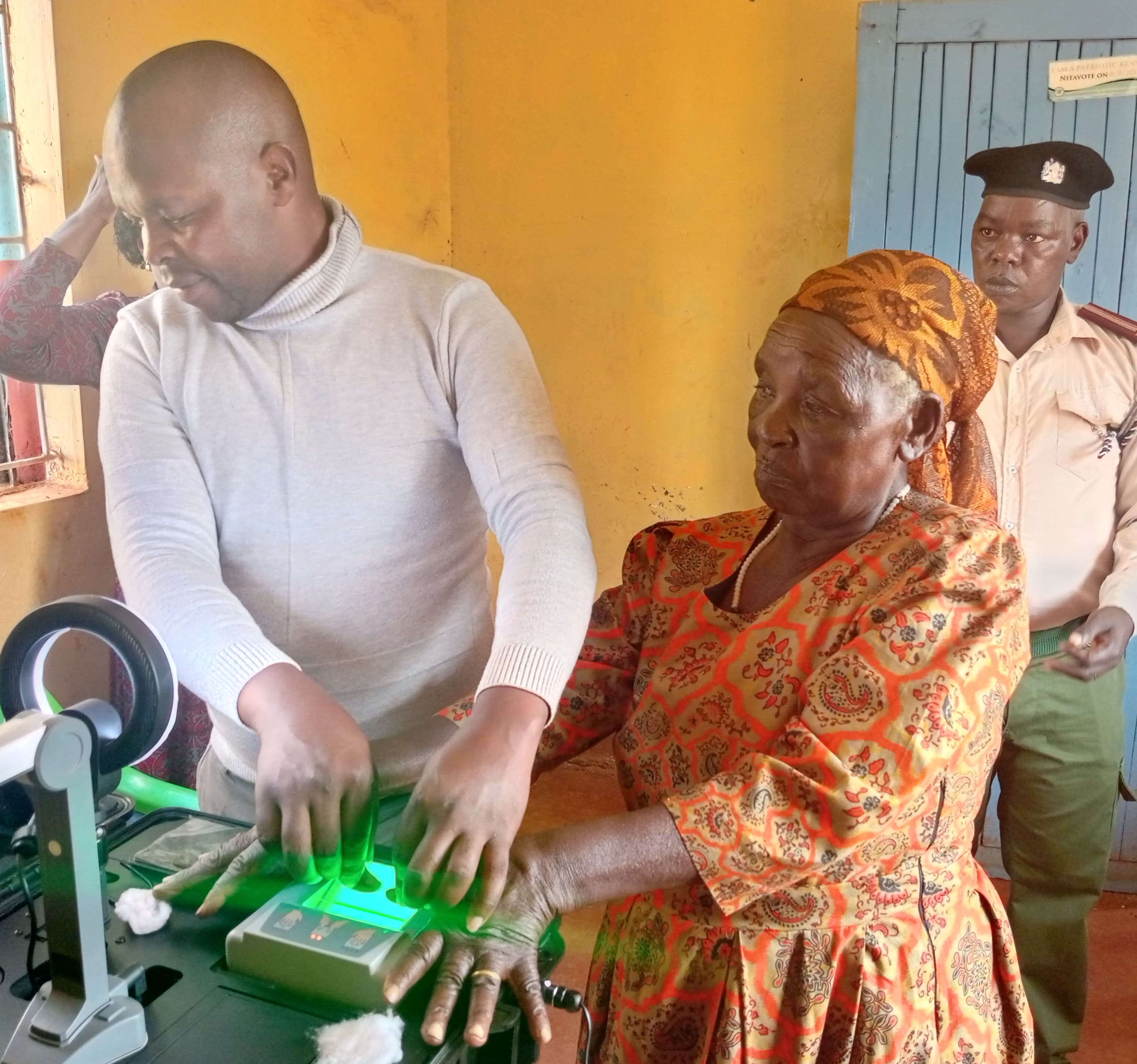
The government is conducting a proof-of-life exercise for Inua Jamii beneficiaries to verify their status, clean up the programme’s payroll and facilitate the removal of deceased beneficiaries from the register.
Ruth Gichuki, Social Services Officer in Maragua Constituency, said beneficiaries were required to present themselves physically at designated Chiefs’ Offices, according to a scheduled programme.
“As programmed, we continue to carry out the verification exercise, and each beneficiary must present themselves in person (physically), carry their original National Identity Card and be ready to undergo facial and biometric verification as part of the exercise,” said Gichuki.

She noted that the verification would help establish the status of existing beneficiaries, adding that a new targeting exercise would be conducted later.
Maragua Constituency has 10,883 older persons registered under the Older Persons Cash Transfer (OPCT) programme, while 252 persons with severe disabilities benefit from the Persons with Severe Disabilities Cash Transfer (PWSD-CT) programme.
In Murang’a County, the programme covers slightly over 68,000 beneficiaries (older persons and persons living with severe disability).
The verification exercise comes as beneficiaries continue to rely on the monthly Sh2,000 stipend to meet basic needs, including food, healthcare and other household expenses, amid limited income sources in old age.
In Mathioya Constituency, 72-year-old Jeffrey Kuria and his wife, Mary Muthoni, noted that the stipend had become an important source of income for them, even as they depend on their two-acre farm, because they can no longer actively work on the farm to sustain themselves.
“When we receive the Sh2,000 each, we immediately buy food and other essential items that we require to take us throughout the month,” Kuria said.
“This support has helped us survive in old age after years of working to provide for their family,” he added.
However, delays in disbursement sometimes forced them to borrow money to meet their daily needs, with much of the stipend going towards repaying debts once it is disbursed.
“Like now, we last received the stipend for August. I appeal to the government to ensure the funds are disbursed consistently every month to enable us to plan our monthly expenditure,” he said.
Kuria observed that many elderly people could not depend on their children for financial support because younger households were also struggling with economic pressures.
“When a child visits you, you can tell whether they are doing well, and, as much as you are struggling, you cannot ask too much of them, especially when they have children to support,” he said.
Kuria, a small-scale farmer, said he had worked hard to educate his children up to tertiary level but had little energy left to sustain himself and his wife in old age.
For 75-year-old Agnes Wanjiru from Maragua Constituency, the stipend helps her manage arthritis, a condition that has affected her fingers and made farming increasingly difficult.
She said the pain becomes severe during cold weather, leaving her dependent on medication and limiting her ability to carry out routine activities.
“When this money comes in, my priority is the arthritis drugs, and whatever remains goes towards food,” she said.
Her two children work in Nairobi’s informal sector and struggle to meet their own financial obligations, limiting the assistance they can offer her.
Wanjiru said her children sometimes ask her to send them farm produce to help reduce their household expenses, highlighting the financial strain facing both elderly parents and their adult children.
She, however, asked the government to consider increasing the monthly stipend from Sh2,000 to at least Sh5,000, noting that the current amount was inadequate given the cost of basic commodities.
“But we are very grateful for this programme. Without it, some of us would have died a long time ago,” she said.
The stipend also supports some elderly people who have taken on the responsibility of raising grandchildren, whose parents have moved to urban centres in search of employment.
Anastacia Muceru, 76, of Kambirwa in Kiharu Constituency, said the money helped her meet basic school requirements for her grandson, whom her daughter had left in her care five years ago.
She said her daughter had occasionally sent financial assistance, but that she had not heard from her since the previous year.
“She brought me her son five years ago and has been sending me a little support, but since last year, I have not heard from her,” Muceru said.
Wanjiru urged the government to improve economic conditions and create more employment opportunities for young people, saying stable jobs would enable parents to support their children and reduce the burden on elderly relatives.
“If my daughter had a stable job, she would be able to provide for her child, and I would only have myself to worry about, because even so, this amount is too little to cover my grandson’s education needs, while also meeting our household needs,” she added.
By Florence Kinyua


Comments
No comments yet. Be the first to share your thoughts.