
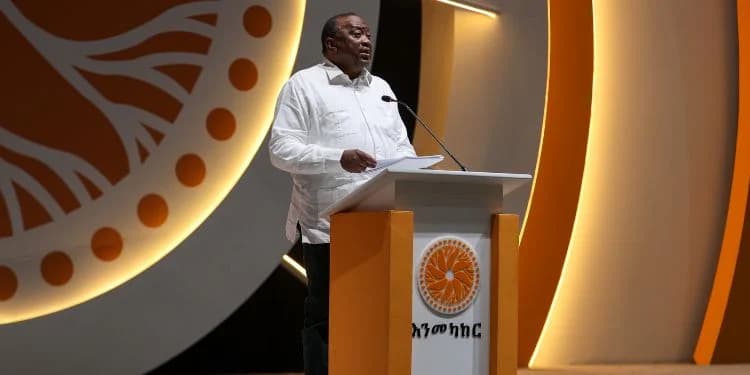
Kenya’s Former President Uhuru Kenyatta has revealed a little-known story about his father, Kenya’s founding President Jomo Kenyatta, and Ethiopia, recalling how the country’s flag became a symbol of African freedom for the young nationalist.
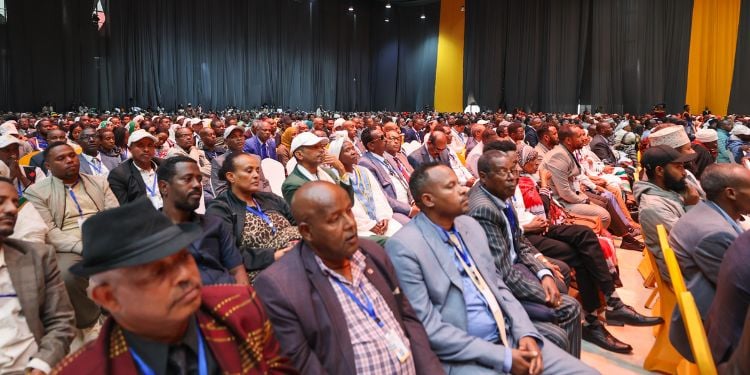
Uhuru made the revelation while speaking at the closing ceremony of Ethiopia’s National Dialogue Conference in Addis Ababa on Saturday, August 22, 2026.
According to Uhuru, in 1931, while Jomo Kenyatta was a young man living in London, he displayed the green, gold, and red Ethiopian flag in his rented room.
Uhuru further explained that Kenya did not t exist as an independent nation when his father chose to display Ethiopia’s flag.
According to the former President, the Ethiopian colors represented freedom and demonstrated to colonized Africans that African nations could stand independently.
“Today is a special day for me because it was Ethiopia that inspired the forefathers of this continent, including my own father, who in 1931, in a rented room in London, as a young man, pinned up a flag in his room, and it was not the flag of Kenya because Kenya did not exist,” the former president explained.
Ethiopia’s example inspired Jomo Kenyatta’s father and many other Africans living under colonial rule.
Uhuru further described the Ethiopian flag as proof that African nations could stand free, linking its symbolism to the broader struggle for African dignity and self-determination.
Ethiopia’s Influence on Africa’s Freedom Struggle
In his speech, he reflected on Ethiopia’s wider historical significance to Africa.
He cited the 1896 Battle of Adwa, when Ethiopian forces defeated an invading Italian army, describing the victory as an event whose significance extended beyond Ethiopia.
Adwa showed that European colonial power could be challenged and gave colonized Africans a powerful symbol of resistance and dignity, as the former president said, inspiring Africans even in the Diaspora.
Additionally, he added Ethiopia’s role in the formation of African unity, noting that Addis Ababa became the birthplace of the Organization of African Unity in 1963, the predecessor to the African Union.
Jomo Kenyatta’s Longstanding Ties With Ethiopia
Uhuru said his father’s connection with Ethiopia did not end with the symbolism of the Ethiopian flag.
He explained that after Kenya gained independence, Jomo Kenyatta set protocol aside and arranged for Ethiopia’s leader to be his first visitor.
Further, he also highlighted the peaceful relationship between Kenya and Ethiopia, recalling that the two countries settled their common boundary in 1970.
During his speech in Ethiopia, the former president noted that the day marked exactly 40 years since the death of his father, Jomo Kenyatta.
He clarified that the occasion was particularly significant to him as he stood in Ethiopia, a country he described as having influenced his father’s thinking and that of many African nationalists.
Call for Ethiopian Unity
Beyond his personal recollections, Uhuru used the address to encourage Ethiopians to embrace the country’s diversity.
He argued that Ethiopia’s many communities, cultures, languages, and religious traditions should not be treated simply as political divisions.
Instead, he described the country’s diversity as a national resource and stressed that many different communities had built Ethiopia’s history.
“When Ethiopia chooses peace, trade routes open, the economy is steady, and our shared borders grow more secure. When Ethiopia embraces dialogue, the whole continent gains confidence,” said Kenyatta.
Uhuru emphasized that no single community represented the entirety of Ethiopia, arguing that the country’s identity had been shaped by the contributions of different peoples across its regions.
However, he acknowledged the cost of past conflict in Ethiopia, referring to the loss of thousands of lives and disrupted families and communities affected by violence, calling upon Ethiopians to pursue peaceful reconciliation.
Follow our and X Account for real-time news updates.



Comments
No comments yet. Be the first to share your thoughts.