
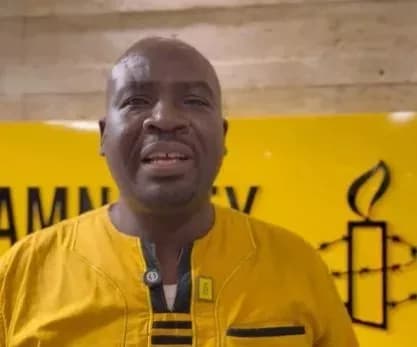
George Morara, Executive Director of Amnesty International Kenya/AMNESTY INTERNATIONAL

Amnesty International has accused President William Ruto’s administration of undermining independent oversight institutions and showing hostility towards the Judiciary.
In a report released on October 19, the human rights organisation warned that pressure on constitutional watchdogs is weakening accountability in Kenya.
The report said the Executive had increasingly challenged institutions responsible for checking government power, citing criticism of court decisions by senior officials, a stated refusal to comply with a court order and alleged intimidation of the Auditor-General and Controller of Budget.
“Other oversight institutions, such as the Auditor General and the Controller of Budget, continue to face intimidation from the executive,” Amnesty said in its report, Human Rights Under Siege: Authoritarian Practices and Economic Pressure Amid Youth-Led Protests in Kenya.
The report argues that the erosion of institutional oversight has coincided with the government’s response to youth-led protests between 2023 and 2025, during which demonstrators demanded accountability, economic justice and greater public participation in fiscal decisions.
The global right agency said President William Ruto and other senior government officials had repeatedly criticised the Judiciary for issuing orders that nullified government actions, policies, programmes or appointments.
“The Executive’s hostility towards the Judiciary has been particularly manifested in its disregard for protest-related court orders,” the report states.
The organisation cited remarks made by Interior CS Kipchumba Murkomen in Parliament on August 13, 2025. The CS reportedly said the government would not comply with a court order barring police officers from concealing their faces and using unmarked vehicles during protests.
The report also cited the High Court case of Law Society of Kenya v Kithinji, in which the court found the deployment of police officers with concealed faces and service numbers, alongside unmarked vehicles, unconstitutional.
Amnesty said Murkomen dismissed the judgment, referring to it as one of the decisions “made by judges in the comfort of their offices in Milimani with air conditioning”.
Seven people interviewed by Amnesty said they had been arrested by police officers wearing balaclavas, while three said they had been placed in unmarked vehicles.
The report further cited the case of Kanchory v Inspector General of the National Police Service, in which the High Court barred police from using water cannons, tear gas, live ammunition and rubber bullets, as well as brute force or other violence against people exercising their constitutional right to protest.
“Despite this order, protesters interviewed for this research said that police continued to use excessive force against protesters, resulting in injuries,” Amnesty said.
The organisation said the weakening of Parliament’s oversight capacity was another concern, particularly in the management of public finances.
It argued that formal parliamentary processes for scrutinising budgets and other fiscal decisions had largely been monopolised by the government through the co-option of lawmakers, influence-peddling and the creation of an environment of fear.
The report linked these concerns to public discontent over taxation, rising living costs, public debt and corruption, arguing that inadequate public participation in fiscal policy had contributed to the protests.
Amnesty said its findings were based on interviews with 102 people conducted between April and July 2026 in Kajiado, Kiambu, Kisumu, Machakos and Nairobi counties. Those interviewed included protesters, lawyers, journalists, government officials, social media influencers and civil society organisations.
Researchers also reviewed national and county budgets, government debt and tax policies, as well as reports from state institutions and parliamentary Hansard records.
In September 2026, Amnesty said it wrote to relevant government bodies, including the Presidency, the Inspector-General of Police and the Interior Ministry, outlining preliminary findings and requesting responses.
However, the organisation said it had received no responses by the time the report was published.
The findings place renewed focus on the constitutional role of Parliament, the Judiciary and independent oversight offices in holding the Executive accountable.
The Auditor-General audits public expenditure, while the Controller of Budget monitors budget implementation. Parliament is constitutionally mandated to scrutinise government spending and hold the Executive to account.
Amnesty urged the government to comply with court orders issued in relation to the use of force against protesters between 2023 and 2025. It also called on lawmakers to strengthen oversight of public debt, corruption findings and economic policy decisions.
The organisation wants Parliament to ensure that corruption findings by its Public Accounts Committee, the Controller of Budget and the Auditor-General are investigated and prosecuted, with cases concluded within specified timelines.
It also called for greater transparency in economic decision-making and human rights impact assessments before major policy decisions are implemented.
Amnesty argues that disregard for court orders and pressure on oversight institutions risk weakening the safeguards intended to protect constitutional governance.
The organisation urged the government to address the economic grievances behind the protests, strengthen accountability and ensure that public institutions can carry out their mandates without intimidation.


Comments
No comments yet. Be the first to share your thoughts.