
Kenya’s more than 60 years of independence have been marked by triumphs, resilience, betrayal and hope. The dream of a prosperous republic, however, has remained a constant aspiration under every government.
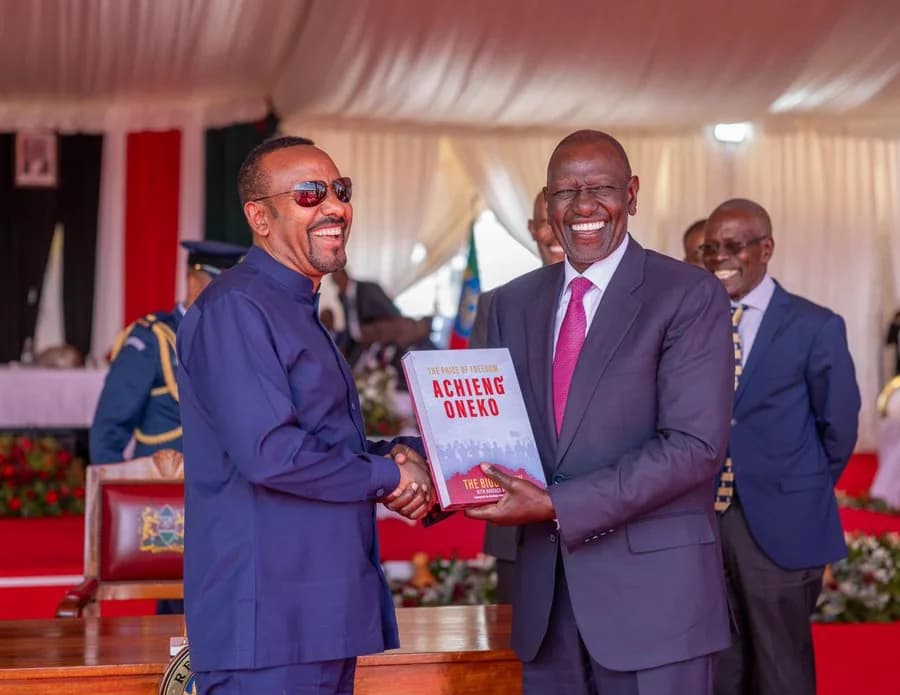
This is why President William Ruto’s launch of the biography of the late independence freedom fighter Ramogi Achieng’ Oneko, The Price of Freedom, during the Mashujaa Day luncheon at State Lodge in Eldoret, presented a paradoxical moment. The book captures both the broken promises and the enduring hope that have shaped the country.
Oneko’s public life is a story of resilience, courage, sacrifice and betrayal in the pursuit of the state Kenyans have long yearned for. He was among the most consequential figures in Kenya’s struggle for independence in the 1950s and early 1960s. He was one of the Kapenguria Six, named after the sham trial they endured in Kapenguria, following their arrest on October 20, 1952.
The other five were Jomo Kenyatta, Paul Ngei, Bildad Kaggia, Kung’u Karumba and Fred Kubai, who were also arrested by the British colonial authorities in Kenya.
The book recounts Oneko’s remarkable life and times, drawing largely on his own account and notes he left behind before he died in 2007. It also draws on other historical sources, including eyewitness accounts, to offer a revealing account of the elusive quest to build a Kenyan nation.
In the book’s foreword, the late former Prime Minister Raila Odinga describes it as a story about Kenya’s unfinished journey, as much as it is about the country’s struggle for independence from colonial rule.
“It is about the story of resilience, bravery and solidarity, running side by side with treachery, betrayal and missed opportunities; ignored or misunderstood signals during the struggle for independence and after, and how these continue to shape the trajectory of the nation,” Raila wrote.
The narrative explores key debates surrounding land, nationalism, governance and the formation of the post-independence state. Through Oneko’s reflections, readers gain insight into the aspirations and tensions that accompanied the transition from colonial rule to self-government.
As a member of the Kapenguria Six, Oneko stood at the centre of Kenya’s independence struggle, enduring a trial in Kapenguria that history has since exposed as a colonial sham.
“I have often been confronted in public with ambiguous questions as to how I was involved in violent activities during Kenya’s struggle for independence. My reasoning is that such a double-meaning question presupposes that I am a violent person. This question can only be adequately addressed by examining my background…” an excerpt from Oneko’s personal notebook, reproduced in the book, reveals.
Oneko recounts how Nairobi was a growing municipality in the 1940s and a hub of political and journalistic activism. He moved to the capital to contribute more effectively to the liberation struggle.
In 1947, he co-founded Ramogi Press, a printing shop intended to give Kenyans the means to write, produce and distribute their own news.
Another objective was to present a range of voices from different ethnic communities across the country. Ramogi Press achieved this by printing newspapers in various Kenyan languages. One of its publications was Ramogi, founded and edited by Oneko to serve as a mouthpiece for the Luo community.
The publication was widely used by the Kenya African Union (KAU), the political party campaigning for independence, to mobilise support in Nyanza. Oneko was entrusted with the task of building regional support for KAU.
In 1949, Ramogi Press relocated to Kisumu to be closer to its primary target audience, the Luo community. Three years later, Oneko had established himself as a political organiser and was appointed KAU secretary-general.
His new leadership role saw him selected as part of a delegation sent to London in 1951. During the trip, he presented a paper to the League of Nations, now the United Nations, calling for the return of ancestral lands that had been taken from Kenyans.
Upon his return, he became more deeply involved in KAU activities, attending meetings and rallies to champion the liberation cause. As political tensions escalated, Mau Mau attacks increased, and a state of emergency was declared in Kenya in 1952.
Dr Barrack Muluka, a seasoned publishing editor and strategic and political communications consultant who edited the book, describes Oneko as a quintessentially stubborn Kenyan nationalist, an Afro-optimist and a political romantic idealist.
The book is a historical account told through the eyes of someone who witnessed the events firsthand. Oneko confronts difficult questions of land injustice and political assassinations, including the killing of fellow independence hero Tom Mboya.
For post-independence Kenya, some of the most valuable lessons emerge from the chapters examining the origins of tribal politics and the hostilities that followed independence. Through Oneko’s reflections, readers gain insight into the challenges of managing diversity, achieving justice and equity in the sharing of the national cake, and ensuring economic mobility for all citizens.
Comments
No comments yet. Be the first to share your thoughts.